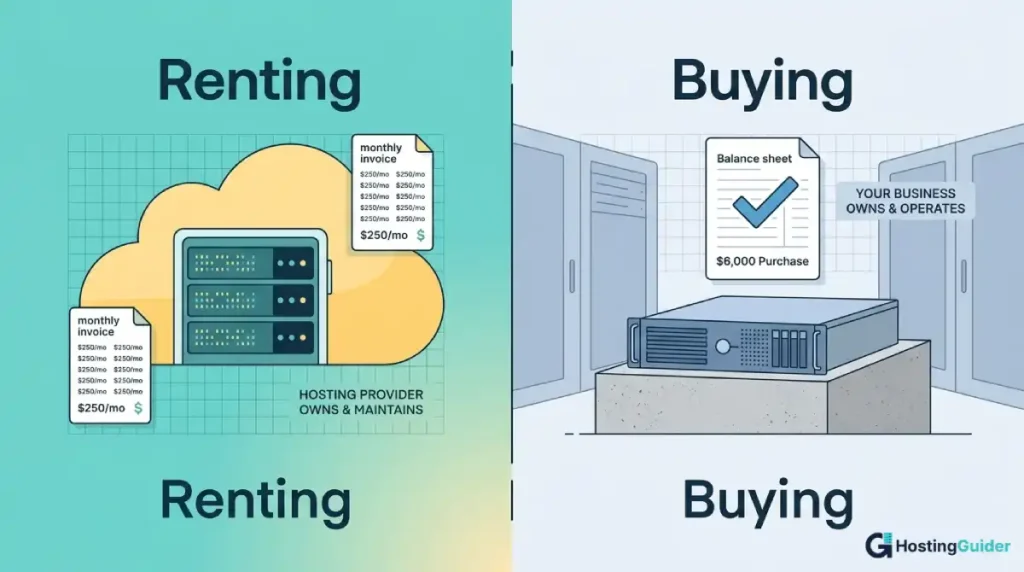
Quick answer: Renting a dedicated server means paying a monthly fee to a hosting provider who owns and maintains the hardware. Buying means purchasing the server outright and either running it on-premises or placing it in a colocation facility. Renting is cheaper in the short term and operationally simpler. Buying is cheaper over five to seven years for stable workloads at scale.
It is the middle of budgeting season and a familiar argument is happening in conference rooms across the world. The CFO wants to know why hosting is a recurring line item instead of a one-time hardware purchase that would sit on the balance sheet as an asset. The CTO is patiently explaining that the recurring cost includes things the spreadsheet does not show, including replacement parts, data center space, network transit, and the engineering hours nobody wants to put on a slide. Both people are right and both people are missing pieces of the picture.
Renting versus buying a dedicated server is not a question with one correct answer. It is a question with a correct answer for your specific business, your specific cash position, your specific compliance situation, and your specific tolerance for operational risk. This guide walks through the decision the way an experienced infrastructure team actually thinks about it, with real numbers, real failure modes, and real scenarios drawn from how companies handle the choice in 2026.
Table of Contents
The Question Most Buyers Are Actually Asking
The surface question sounds simple. Should I rent a dedicated server from a hosting provider, or should I buy the hardware outright and either keep it on-premises or place it in a colocation facility? The honest deeper question is different and rarely stated out loud.
It is closer to this: how much of the operational risk and capital expense do I want to keep, and how much do I want to push onto someone else for a monthly fee?
Renting and buying sit on opposite ends of that risk-and-cost spectrum. Renting trades long-term ownership for predictable monthly costs and zero hardware responsibility. Buying trades higher upfront capital and operational complexity for full ownership of an asset that will keep working long after the payment is amortized. Most teams who get this decision wrong made it by comparing the wrong numbers. They compared the rental price to the purchase price and ignored the four or five categories of cost that make the real difference.
Before going any further, it helps to define both options clearly because the marketing language around them is genuinely confusing.
What Renting a Dedicated Server Actually Looks Like
Renting a dedicated server means paying a hosting provider a monthly fee for exclusive use of a physical machine that the provider owns, houses, powers, cools, connects, and maintains. You get root access, a chosen operating system, the resources of the entire box, and a service level agreement. What you do not get is the hardware itself. If you stop paying, the server goes back into the provider’s pool and a different customer eventually uses the same metal.
The day-to-day experience as a renter is closer to using cloud infrastructure than people expect. You log in over SSH or a remote console, install your stack, and run your workload. When a hard drive fails, you open a ticket and someone in a data center somewhere swaps it. When a power supply dies, the same thing happens. When the hardware reaches end of life, the provider migrates you to a newer machine, often at the same price, and the upgrade feels like a planned maintenance window rather than a budgeting event.
The financial profile of renting is what makes it attractive to most growing companies:
- Predictable recurring costs with no large capital outlay
- No depreciation schedule or warranty paperwork to manage
- Zero hardware responsibility during failures
- Operating expense treatment for tax purposes, fully deductible in the year incurred
- Free cash flow for the parts of the business that grow revenue
What Buying a Dedicated Server Actually Looks Like
Buying a dedicated server means purchasing the physical hardware outright and taking responsibility for everything that comes with owning it. You choose the chassis, the CPU, the RAM, the drives, and the network cards. You either run the server in your own facility or you place it in a colocation data center that rents you rack space, power, cooling, and network connectivity. The hardware appears on your balance sheet as a depreciable asset and stays there until it is sold, scrapped, or written off.
The day-to-day experience as an owner is fundamentally different from renting. You are the person responsible when a drive fails. You either fix it yourself, pay a remote-hands service to fix it, or accept the downtime until you can drive to the facility. You order spare parts in advance because waiting for a vendor during an outage is a bad strategy. You schedule firmware updates, BIOS patches, and hardware refresh cycles. You also keep the savings, because once the purchase is amortized the ongoing cost drops substantially compared to renting equivalent capacity.
Buying makes the most sense for organizations that already have data center experience, an existing colocation contract, or a workload large enough that the math clearly favors ownership. It makes the least sense for early-stage companies who are paying capital for hardware they could rent for less than the cost of the engineering hours required to manage it.
The Financial Picture: CapEx, OpEx, and the Real Cost Curve
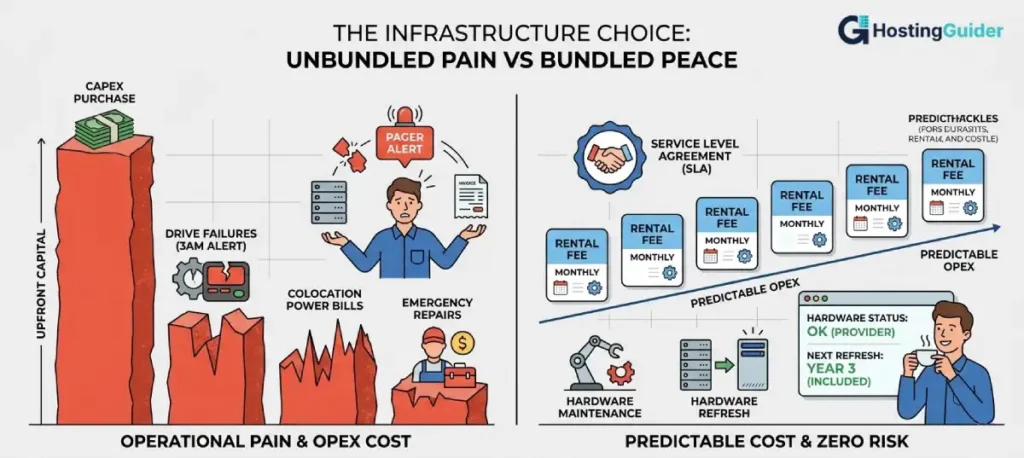
The financial argument is where most renting-versus-buying conversations get derailed. People compare the sticker price of a server (let us say 6,000 USD for a current generation machine) to the monthly rental cost (let us say 250 USD) and conclude that buying pays for itself in two years. That math is not wrong, but it is incomplete in ways that change the answer significantly.
A purchased server is not a one-time cost. The hardware is the smallest line item in a multi-year ownership scenario, and the items that surround it usually add up to more than the server itself. Renting bundles all of these costs into a single monthly fee, which is part of why the rental sticker looks expensive in isolation but reasonable in context.
The full cost of ownership over five years includes:
- Hardware purchase including any redundant components ordered as spares
- Colocation fees of 100 to 400 USD per month per server depending on power draw and region
- Bandwidth and transit of 50 to 500 USD per month for a single server depending on traffic
- Spare parts inventory including drives, RAM, and power supplies kept on hand
- Remote hands time billed by the hour when data center staff physically work on your server
- Warranty and support contracts that become essential after the first year
- Insurance and asset tracking often overlooked until the accountant asks
- Disposal and refresh costs when the server reaches end of life
Renting collapses all of those line items into one number that the provider can predict because they amortize the costs across thousands of customers. Whether that number is cheaper or more expensive than ownership depends on the specifics, but the comparison is no longer 6,000 USD versus 3,000 USD per year. It is the full ownership stack versus the rental fee.
There is also a tax angle that matters more than most technical buyers realize. Rental costs are operating expenses, fully deductible in the year they are incurred. Purchased hardware is a capital expense, depreciated over several years according to local tax rules. For some companies the depreciation schedule is favorable. For others, especially early-stage businesses with limited taxable income, the full deduction of operating expenses is more useful. The right answer depends on the tax position, not on the hardware itself.
The Operational Picture: Who Carries the Pager?
The financial picture matters, but the operational picture is what actually decides this question for most teams. The single biggest practical difference between renting and buying is who gets the alert when a drive fails at 3 a.m. on a holiday weekend.
When you rent, the answer is the provider. Their on-call engineers and data center staff handle the physical response. You may still need to handle the application-level recovery, the data restore, or the failover, but the hardware response is somebody else’s problem. The service level agreement defines how fast they respond and what happens if they miss the target.
When you buy, the answer is your team. If the server is on-premises, somebody on your staff drives in. If the server is in colocation, you either dispatch a remote-hands ticket and pay by the hour, or you send an engineer to the facility. Companies that own dedicated hardware without a real operational plan around it usually find this out during their first serious failure, and the lesson is expensive.
The operational gap is most painful in three specific situations:
- Drive failures are common, predictable, and almost always fixable quickly if you have spares on hand
- Power supply failures are less common but devastating without redundant supplies and on-site replacements
- Motherboard or CPU failures are rare but catastrophic, often requiring hours of work and sometimes a full server replacement
A rental provider absorbs all of this with their existing staff and inventory. An owner has to build the same response capability or accept longer outages. Neither answer is wrong, but the choice has to be made consciously rather than discovered during the first incident.
Hardware Lifecycle and the Refresh Problem
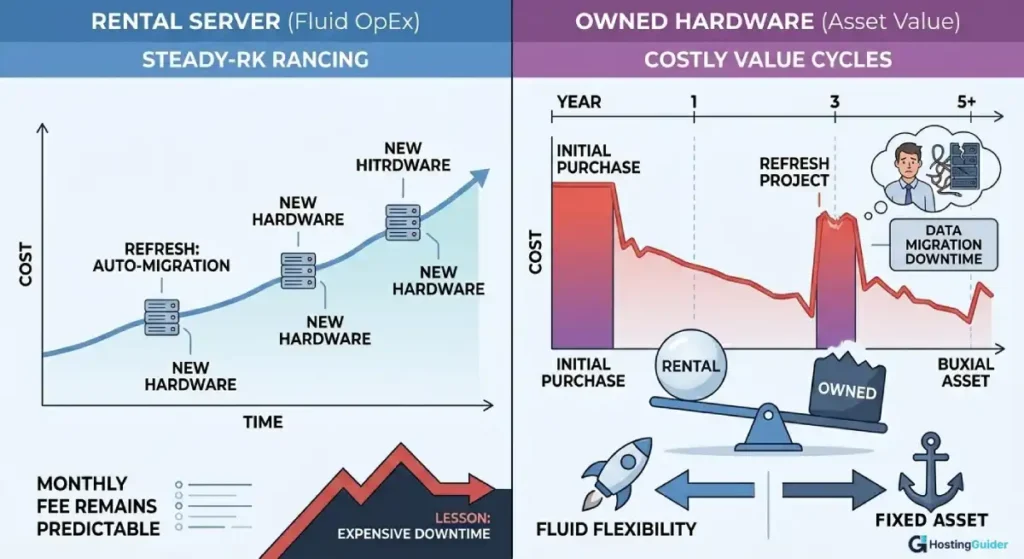
Hardware does not last forever, and the rate at which it goes from impressive to embarrassing is faster than most buyers expect. A server purchased in 2022 was a strong machine. The same machine in 2026 is competent for most workloads but clearly behind the current generation in performance per watt, in storage speed, and in network capabilities. By 2028 it will feel slow, and by 2030 it will be a liability.
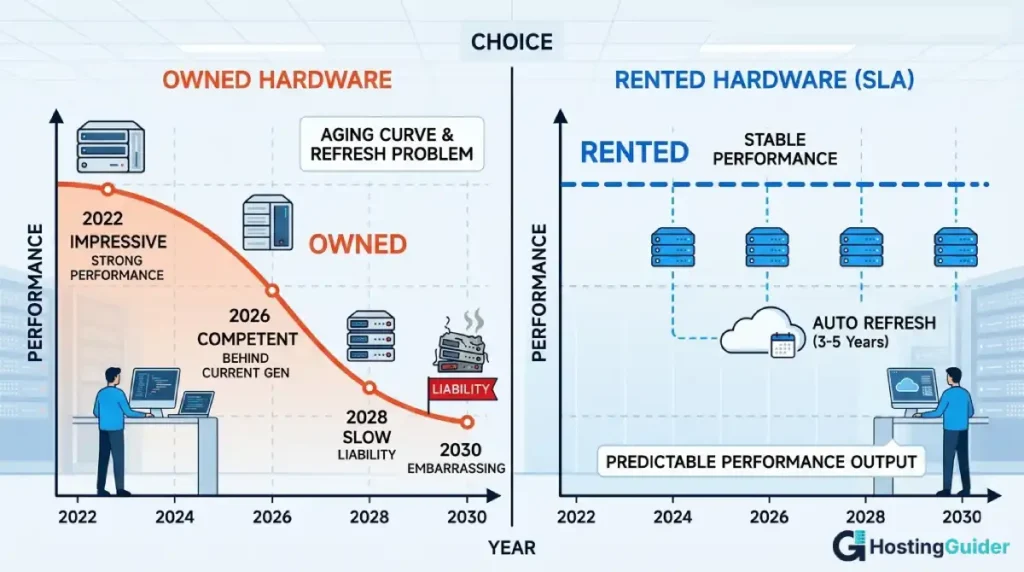
Renting handles this problem invisibly. Most providers refresh their fleets every three to five years and migrate customers to newer hardware as part of normal operations. The customer pays roughly the same monthly fee and benefits from each generation of improvements without writing a new check. The upgrade feels like a non-event because, from the customer’s perspective, it is one.
Buying turns the same problem into a recurring capital event. Every three to five years you face the question of whether to keep running aging hardware (risking reliability and falling behind on performance) or to replace it (writing another large check and going through another deployment cycle). The replacement is rarely a clean swap. It involves data migration, service cutover, and the disposal of the old hardware, all of which cost time and money on top of the new purchase price.
Some buyers handle this well by treating server purchases as planned five-year investments and budgeting for the refresh from the beginning. Others discover the problem on year four when the warranty expires, the failure rate climbs, and the replacement cost arrives unplanned. The discipline required to handle hardware refresh well is part of the real cost of ownership.
Deployment Speed and Geographic Reach
Renting wins on speed and geography by a wide margin. A rental provider can deliver a configured server in a chosen region within hours or sometimes minutes. The same provider can offer servers in twenty or thirty locations across multiple continents, allowing you to put workloads close to the users they serve without negotiating new contracts in each country.
Buying is dramatically slower. Procuring hardware takes weeks for in-stock configurations and months for custom builds. Shipping the server to a colocation facility adds days. Configuring power, network connections, and physical access takes another week in most facilities. Spinning up a dedicated server in a new country is a project that requires legal review, vendor selection, import logistics, and on-site coordination, all of which can stretch into months.
The deployment speed gap shows up most painfully during three kinds of business events:
- Sudden traffic growth from a successful campaign or a viral moment requires capacity now, not next month
- Geographic expansion into a new market with strict data residency rules forces local infrastructure on a tight schedule
- Disaster recovery is significantly easier when the provider already has capacity in another region
For companies whose growth is predictable and whose geographic footprint is stable, the deployment speed advantage of renting is less compelling. For companies who are growing fast, expanding internationally, or building disaster recovery into their architecture, renting often wins purely on the speed dimension regardless of cost.
Customization and Hardware Control
Buying gives you complete control over the hardware specification. You choose the exact CPU model, the exact RAM speed, the exact drive configuration, the exact network cards, and any specialized hardware your application requires. You can install GPUs, FPGAs, hardware security modules, custom storage controllers, and anything else your workload needs. The server is yours, and what you put inside it is your decision.
Renting offers narrower customization, but the gap is smaller than it used to be. Most providers now offer dozens of configurations, including current generation CPUs, large memory options, NVMe storage arrays, GPU servers, and high-bandwidth network connections. For the majority of workloads, the available rental configurations cover what the customer would have specified for a purchase anyway. The remaining cases where customization matters tend to fall into a few specific patterns:
- Specialized accelerators such as FPGAs, ASICs, or custom processing cards that providers rarely stock
- Unusual storage configurations including specific RAID controllers or extreme drive counts
- Dedicated hardware security modules required by some compliance frameworks and not always available in rental form
- Niche network hardware such as SmartNICs, custom DPUs, or specific switch integrations
If your workload genuinely needs one of those, buying is often the only realistic answer. If your workload is a website, a SaaS application, a database, or a typical enterprise system, the available rental configurations almost always cover what you need without requiring you to take on hardware ownership.
Hidden Costs That Make Buying More Expensive Than It Looks
Buying looks cheaper on a spreadsheet that only counts the hardware. The reality is messier, and several costs hide in places non-technical buyers rarely check until they appear on the third or fourth invoice.
The first hidden cost is colocation power billing, which is rarely a flat fee. Most facilities charge for power based on either committed amperage or actual usage, and a server pulling 400 watts at full load can easily double the colocation invoice compared to an idle baseline. Companies that buy servers without modeling power costs accurately end up paying more than they expected for the same workload.
The second hidden cost is bandwidth and transit. Colocation facilities sell network capacity separately from rack space, and the pricing varies dramatically between providers and regions. A single dedicated server with heavy outbound traffic can rack up bandwidth bills that exceed the rack rental, and the bills are usually metered, which makes budgeting harder.
The third hidden cost is operational overhead in the form of engineering hours. Every hour an engineer spends managing physical hardware is an hour they did not spend on the product. For small teams this trade-off is genuinely expensive, because the engineering hour is often more valuable than the rental savings would be.
The fourth hidden cost is the long tail of small expenses that surround any owned asset:
- KVM-over-IP appliances or out-of-band management gear
- Backup hardware and offsite storage contracts
- Network gear such as switches, firewalls, and load balancers
- Cabling and consumables that wear out and need replacing
- Licensing for management tools, monitoring agents, and operating systems
- Insurance riders covering hardware in colocation facilities
None of these line items is huge on its own. Together they often add another twenty to forty percent on top of the obvious budget, and they are the reason ownership math frequently disappoints buyers who only counted the server itself.
Hidden Costs That Make Renting More Expensive Than It Looks
Renting has its own set of hidden costs, and being honest about them is the only way to make a fair comparison. The biggest one is the long-term total. Over a five to seven year horizon, renting almost always costs more in absolute dollars than buying equivalent hardware, and the gap widens the longer you keep paying.
The second hidden cost of renting is bandwidth overage. Most rental plans include a bandwidth allowance, and traffic above the allowance is billed at rates that can be surprisingly steep. A viral moment, a new product launch, or a misconfigured backup job can produce a bill several times the normal monthly fee. Buying with a flat-rate or burstable colocation contract often handles the same traffic without the same shock.
The third hidden cost is feature lock-in, which sneaks up on customers who use provider-specific tools. Custom control panels, proprietary backup services, integrated monitoring, and managed firewalls are convenient, but they create migration friction. Moving from one rental provider to another can be straightforward if you stayed close to the standard, and genuinely difficult if you built around provider-specific features that have no direct equivalent elsewhere.
The fourth hidden cost is price drift over years. Rental prices for the same configuration tend to fall slowly as hardware improves, but customers on older contracts often keep paying their original rate even as the provider offers newer customers better deals. Reviewing your rental contracts every twelve months and renegotiating when the market has moved is part of cost control that buyers do not have to think about.
Risk Profile: What Happens When Things Go Wrong
The risk profile of each option is different in ways that matter for business continuity, and the differences become visible only when something actually breaks.
When you rent and the hardware fails, the provider replaces it. The service level agreement defines how fast they respond and what they owe you if they miss the target. Your data is your responsibility (backups always are), but the physical recovery is handled. The downside is that you are bound by the provider’s response speed, the provider’s spare parts, and the provider’s priorities, which may not match yours during a major incident affecting many customers at once.
When you buy and the hardware fails, you control the response, but you also own the consequences. If your team is well prepared with spare parts, documented procedures, and trained staff, recovery can be faster than what most rental providers offer. If your team is not prepared, recovery can be much slower than what a rental provider would deliver, and the difference shows up as extended downtime that costs the business real money.
There is also a risk dimension that rarely appears in renting-versus-buying discussions but matters for some companies. Owned hardware can be moved between providers and locations without permission. Rental hardware cannot. If your relationship with a hosting provider deteriorates, if their pricing changes unfavorably, or if their company is acquired by someone you do not want to work with, owned hardware gives you options that rental does not. For most companies this risk is theoretical. For some, especially those operating in politically sensitive regions or industries, it is real and worth pricing in.
Three Scenarios Where Buying Wins Clearly
The case for buying is strongest in specific situations where the assumptions that make renting attractive break down. The three scenarios below cover most of the real-world cases where ownership produces a clearly better outcome.
The first is the stable, long-term, high-volume workload. A company running a large database, a busy ecommerce platform, or a high-traffic SaaS product with predictable growth and steady requirements often saves significant money by buying. The math works because the hardware is fully utilized, the workload does not need frequent reconfiguration, and the multi-year total cost favors ownership once you have the operational capability to handle it.
The second is the regulated environment with strict isolation, sovereignty, or chain-of-custody requirements. Some regulations require not only single-tenant hardware but also physical control over the asset, including the ability to inspect it, move it, or destroy it under specific conditions. Rental rarely satisfies these rules cleanly, and ownership is often the only path that survives the audit.
The third is the existing data center investment. Companies that already operate data centers or have established colocation contracts have already paid the operational fixed costs that make ownership expensive for newcomers. Adding more servers to an existing facility is significantly cheaper than adding the first server, because the staff, the spare parts inventory, the monitoring tooling, and the operational procedures already exist. For these companies, buying additional capacity is often the obvious choice.
Three Scenarios Where Renting Wins Clearly
The case for renting is strongest where flexibility, speed, and operational simplicity matter more than long-term cost optimization. The three scenarios below cover most of the cases where rental produces a clearly better outcome.
The first is the early-stage company with uncertain growth. A startup whose traffic could double next month or could disappear in a quarter has no business buying hardware. The capital is better spent on the product, and the flexibility of rental matches the uncertainty of the business. Many companies that bought servers too early ended up either paying for capacity they did not use or selling the hardware at a loss when the business pivoted.
The second is the geographically distributed business. A company serving users in multiple countries needs servers in multiple countries, and standing up owned infrastructure in each region is a project measured in months and millions. Rental providers already operate in the regions you need, and the cost of geographic expansion drops to whatever the rental price happens to be in each location.
The third is the small or medium team without dedicated infrastructure staff. Running owned hardware well requires people who know how to run owned hardware well. If your team consists of application developers, product managers, and a handful of generalists, buying servers turns a fraction of that team into part-time hardware operators, and the productivity loss usually exceeds the rental savings. Renting lets the team stay focused on the product.
A Hybrid Strategy That Often Works Best
Many mature companies end up with a hybrid setup that combines the strengths of both options. The pattern is sensible enough to be worth understanding even if you are not yet ready to implement it.
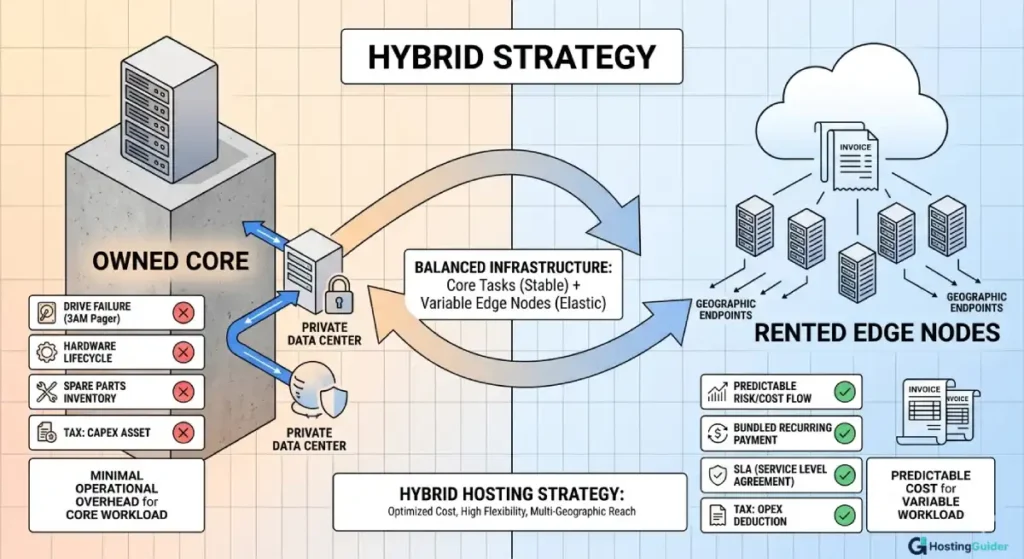
The hybrid approach typically uses owned hardware for the steady-state core of the workload, where the math favors ownership, and rented hardware for the variable edges where flexibility matters more than long-term cost. The core might be the primary database, the main application servers, and the long-running batch processing systems. The edges might be the development and staging environments, the geographically distributed edge nodes, the disaster recovery site, and any temporary capacity needed for marketing campaigns or seasonal peaks.
The hybrid approach also adapts well to changing business conditions. A company in rapid growth phase tilts heavily toward rental because flexibility matters more than savings. As growth stabilizes, the company gradually moves the predictable core onto owned hardware, keeping rental for the parts of the workload that still benefit from elasticity. The transition happens over years rather than in a single migration, which spreads the operational learning curve across enough time that the team can absorb it without disruption.
Companies that try to go all-in on either pure ownership or pure rental often discover the limits of their chosen approach after a couple of years. The hybrid pattern lets you keep the best of both, at the cost of slightly more complexity in vendor management and budgeting.
A Simple Cost Model With Real Numbers
A worked example helps make the abstract comparison concrete. The numbers below are realistic for 2026 for a single mid-tier dedicated server with current generation hardware, suitable for a typical business application.
Five-year cost comparison for a single mid-tier server
| Cost Component | Renting | Buying |
|---|---|---|
| Hardware purchase | 0 USD | 6,000 USD |
| Monthly recurring | 250 USD | 350 USD (colocation, bandwidth, ops) |
| 60-month total | 15,000 USD | 27,000 USD |
| Refresh at year 5 | Included | Additional 6,000 USD |
| Hardware ownership | No | Yes |
In this scenario, renting is significantly cheaper over five years. The buying scenario only beats renting if the hardware is paid in cash without financing, the operational overhead is genuinely lower than the estimate, the colocation contract is unusually favorable, or the workload runs much longer than five years without a hardware refresh.
Five-year cost comparison for ten servers in one rack
Now consider a different scenario. A company runs ten identical servers in a single colocation rack:
- Hardware: 60,000 USD upfront
- Colocation: 1,500 USD per month for the full rack, or 150 USD per server
- Bandwidth: 60 USD per server (bulk-discounted)
- Operational overhead: 20 USD per server because the team is already managing the rack
- Five-year total: 60,000 plus 60 months of 230 USD per server, totaling 198,000 USD across ten servers
Renting the equivalent ten servers at 250 USD each is 30,000 USD per year, or 150,000 USD over five years. In this scenario, renting still looks cheaper, but the gap has narrowed significantly, and a slightly different set of assumptions (longer hardware life, lower operational overhead, better colocation pricing) flips the answer in favor of buying.
The point of the worked example is not that renting always wins or that buying always wins. The point is that the answer depends on scale, on operational maturity, and on assumptions that have to be modeled honestly. A spreadsheet with realistic numbers always beats a gut feeling, and the comparison is rarely as one-sided as the marketing on either side suggests.
Questions to Ask Before You Decide
Before signing either a rental contract or a purchase order, walk through the questions below honestly. Each one points at a specific cost or risk that the marketing material is unlikely to address, and the answers tend to make the right decision obvious.
- How long do you realistically expect this workload to run unchanged?
- Do you have engineering staff who already manage physical hardware, or would buying create a new responsibility for them?
- Is your traffic predictable enough to plan capacity twelve to thirty-six months out?
- Do compliance rules require physical control of the hardware, or only logical isolation?
- How quickly do you need to deploy capacity in new regions?
- What is your tolerance for downtime during hardware failures, and who would respond to them?
- How sensitive is your budget to large one-time capital outlays versus steady operating expenses?
- What is the tax position of your company, and which expense type is more useful?
- How likely is your business to pivot, contract, or change shape in the next three years?
- What is the cost of an engineering hour spent managing servers instead of building the product?
If most of the answers point toward stability, scale, predictability, and existing operational maturity, buying is usually the right call. If most of the answers point toward growth, uncertainty, geographic spread, or limited operational capacity, renting is usually the right call. The cases where the answers genuinely split are the cases where a hybrid approach often makes the most sense.
Frequently Asked Questions
Is it cheaper to rent or buy a dedicated server?
Renting a dedicated server is cheaper in the short and medium term, typically saving 30 to 50 percent over the first three years once colocation, bandwidth, and operational costs are included. Buying a dedicated server becomes cheaper after roughly five to seven years for stable workloads at scale, particularly when the buyer already operates a data center or has an existing colocation contract.
How long does a dedicated server last before it needs replacing?
A dedicated server typically lasts three to five years before it needs replacing to stay competitive on performance and energy efficiency. Many servers keep running reliably for seven to ten years with proper maintenance, but each year they fall further behind current generation hardware. Most owners plan a full hardware refresh every four to five years.
What are the main downsides of buying a dedicated server?
The main downsides of buying a dedicated server are the upfront capital cost, the operational responsibility for hardware failures, slow deployment speed, difficulty of geographic expansion, and the recurring refresh cycle every three to five years. Ownership only makes economic sense if the buyer has the engineering capacity and data center experience to handle the responsibilities that come with it.
What are the main downsides of renting a dedicated server?
The main downsides of renting a dedicated server are the higher long-term total cost, dependency on the provider’s pricing and policies, bandwidth overage exposure, limits on hardware customization, and feature lock-in from provider-specific tools. Renting is rarely the cheapest option over a decade for stable workloads that could otherwise run on owned hardware.
Can I move from a rented server to a bought server later?
Yes, you can move from a rented server to a bought server at any time, and many companies do exactly that as they grow. The migration involves provisioning the new hardware, replicating data, cutting over traffic during a planned window with low DNS TTL, and decommissioning the rental after a one to two week rollback period.
Is colocation the same as buying a dedicated server?
Colocation is not the same as buying a dedicated server. Colocation is the housing arrangement for hardware you already own. Buying refers to the financial decision of purchasing the hardware. Colocation refers to the physical decision of where to place it. Most companies that buy dedicated servers also use colocation, but the two terms describe different parts of the same setup.
Do I need data center experience to buy a dedicated server?
Yes, you need either data center experience on your team or a colocation provider that offers full remote-hands services to buy a dedicated server safely. Without one of those, ownership creates an operational responsibility that becomes painful during the first hardware failure outside business hours. Most small teams without infrastructure staff are better served by renting.
What happens to my data if my hosting provider goes out of business?
If your hosting provider goes out of business, your data remains your responsibility, which is why offsite backups are essential. Reputable providers usually give customers thirty to ninety days to migrate during a wind-down. Keep current backups in a separate provider or cloud storage service so that a provider failure becomes a migration problem rather than a data loss event.
How do I decide between buying and renting a dedicated server?
Decide between buying and renting a dedicated server by building a five-year cost model that includes hardware, colocation, bandwidth, operational overhead, refresh cycles, and the value of engineering hours spent on infrastructure. Compare the realistic ownership total to the rental total, then weigh operational risk, deployment speed, and flexibility differences. The decision usually becomes clear once the numbers are honest and complete.
Can I run my own hosting business by buying servers and renting them out?
Yes, you can run a hosting business by buying servers and renting them out, and this is the basic model of every small hosting provider. However, running a hosting business profitably requires data center expertise, network engineering, twenty-four-hour staffing, billing systems, customer support, and a marketing budget large enough to acquire customers in a crowded market.
Closing Thoughts
The honest answer to renting versus buying a dedicated server is that the right choice depends on the shape of your business, the maturity of your operations, and the time horizon over which you plan to run the workload. There is no universal winner, and anyone who claims one option is always better is selling something rather than analyzing the question.
For most growing companies in 2026, renting is the better default because it matches the rhythm of how modern businesses actually grow. Capital stays free for the product. Hardware failures are someone else’s problem. Geographic expansion is a billing decision rather than a logistics project. The workload can scale up, scale down, or move sideways without writing new checks for hardware that may not be needed in two years.
For mature companies running stable workloads at significant scale, with operational maturity already in place, buying is often the better long-term answer. The total cost over five to seven years drops meaningfully, the company keeps assets that have real residual value, and the predictability of the workload matches the predictability of owned infrastructure.
The hybrid approach, where the steady-state core sits on owned hardware and the variable edges run on rented capacity, is where many companies land after enough years of running both. It is harder to manage than either pure option, but it captures most of the savings of ownership while keeping most of the flexibility of rental. Whatever path you choose, model the numbers honestly, count the operational hours, and revisit the decision every couple of years as the business changes. The cost of revisiting the choice is always smaller than the cost of sticking with the wrong one for too long.