Imagine two shops on the same street. One has been open for 10 years. Everyone in town knows it. Other shops recommend it. Customers trust it. The other shop opened last week. No one knows it yet.
If both shops put an ad in the newspaper on the same day, which one do you think more people will trust and visit?
The older, well-known shop. Every time.
Your website works the same way.
Domain Authority is the score that tells the internet how trustworthy and well-known your website is. A higher score means more people find you on Google. A lower score means you are still building your reputation.
This guide explains what Domain Authority is, why it matters, and exactly what to do to improve yours starting today.
Here is what you will learn:
- What Domain Authority means in simple words
- How the score works and what counts as good
- Why it matters for your business and website
- What things make your score go up or down
- How to check your score right now with free tools
- A step by step hands-on plan to improve it
Table of Contents
Key Takeaways
- Domain Authority (DA) is a score from 1 to 100 that predicts how well your website can rank on Google.
- It was created by a company called Moz. Google did not make it and does not use it directly.
- A higher DA means more trust, more traffic, and better rankings over time.
- The biggest thing that moves your score is backlinks, which are other websites linking to yours.
- DA is not something you fix in a week. It grows slowly over months with consistent work.
- New websites always start with a DA of 1. That is completely normal.
Quick Answer
Domain Authority is a score from 1 to 100 created by Moz that predicts how likely your website is to rank in search results. It is based mainly on how many quality websites link to you. Google does not use this score directly, but the things that raise your DA, like good backlinks and strong content, are the same things that help you rank higher on Google.
What Is Domain Authority in Simple Words
Think of Domain Authority like a school report card for your website.
A student who studies hard, turns in good work, and gets recommended by teachers will get high grades. A student who just started school this week has no grades yet.
Your website is the student. Google and other search engines are the teachers. And Domain Authority is the grade that shows how well your website is doing overall.
Domain Authority is a metric created by Moz, a well known SEO software company. It scores websites on a scale from 1 to 100. Higher scores mean stronger ranking potential. MonsterInsights
The key word is potential. DA does not guarantee you will rank number one. It tells you how strong your website looks compared to other websites trying to rank for the same things.
Simple example:
You run a small bakery website. Your DA is 18. A big food magazine website has a DA of 72. If you both write an article about chocolate cake recipes, the magazine is more likely to show up on the first page of Google. Not because their article is better. But because their website is more trusted in Google’s eyes.
That is Domain Authority in action.
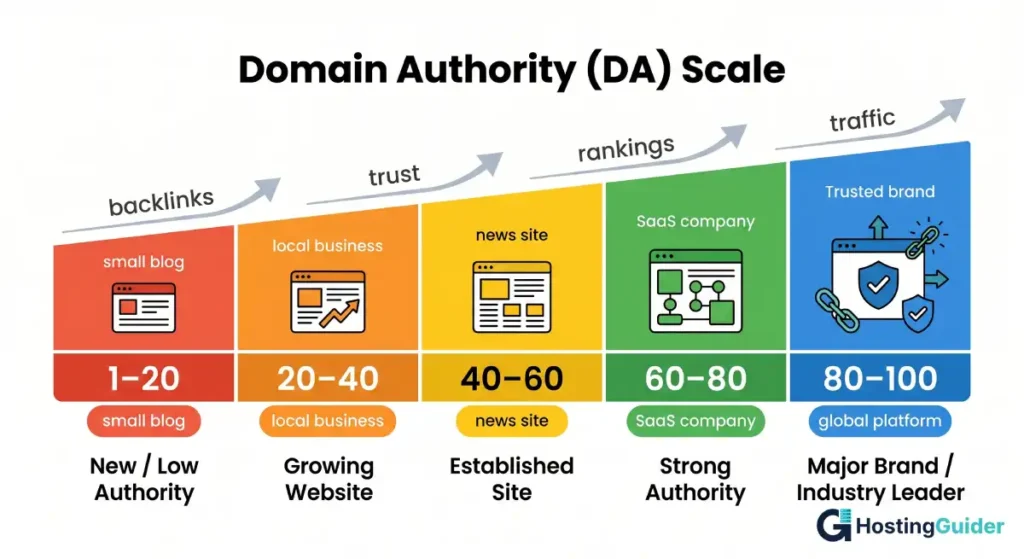
How Is DA Scored: The 1 to 100 Scale
The DA score runs on a logarithmic scale from 1 to 100. That means going from DA 20 to DA 30 is much easier than going from DA 70 to DA 80.
Think of it like climbing stairs. The first 30 steps are normal height. After that, each step gets taller and taller. Getting from 70 to 80 takes far more work than getting from 10 to 20.
Here is what each range generally means:
| DA Score | What It Means | Example Type of Site |
|---|---|---|
| 1 to 20 | New or very small website | Brand new blog, small local business |
| 21 to 40 | Growing website with some authority | Active small business site, niche blog |
| 41 to 60 | Established website with solid authority | Regional news site, popular niche site |
| 61 to 80 | Strong website, well known in its space | Industry publications, major brands |
| 81 to 100 | Extremely powerful website | Wikipedia, Google, BBC, Amazon |
Important: A good score is not the same for everyone. If all the websites competing with you have a DA around 25, then a DA of 30 is excellent for you. You do not need a DA of 80 to win.
A good Domain Authority score is one that is competitive in your specific search landscape, not one that matches the biggest sites on the internet. MonsterInsights
Why Domain Authority Matters for Your Business
Here is the honest answer. DA matters because the things that raise your DA score are the same things that help you rank higher on Google and get more visitors to your website.
Think of it this way. You cannot directly improve your Google ranking. Google does not tell you exactly how its system works. But you can track your DA score and use it to measure whether your SEO efforts are moving in the right direction.
Reason 1: It shows you how strong your website is
Before you try to rank for a search term, check the DA of the websites already on page one. If they all have a DA of 60 and yours is 15, you know you have a lot of work to do before you can compete for that term. This saves you months of wasted effort.
Reason 2: It helps you find easier keywords to target
If you find a topic where the top results have a DA of 25 to 35, and your DA is 28, that is a realistic fight. You can write better content and have a real chance of ranking.
Reason 3: It shows whether your SEO work is paying off
If you have been writing content and building links for six months, your DA should be slowly going up. If it is not moving at all, something in your strategy needs fixing.
Reason 4: It helps partners and advertisers trust your site
When brands want to place an ad on your site or work with you on sponsored content, they often check your DA first. A DA of 40 will attract more paying partners than a DA of 8.
What Affects Your DA Score
Several things push your score up or down. Here are the main ones explained simply:
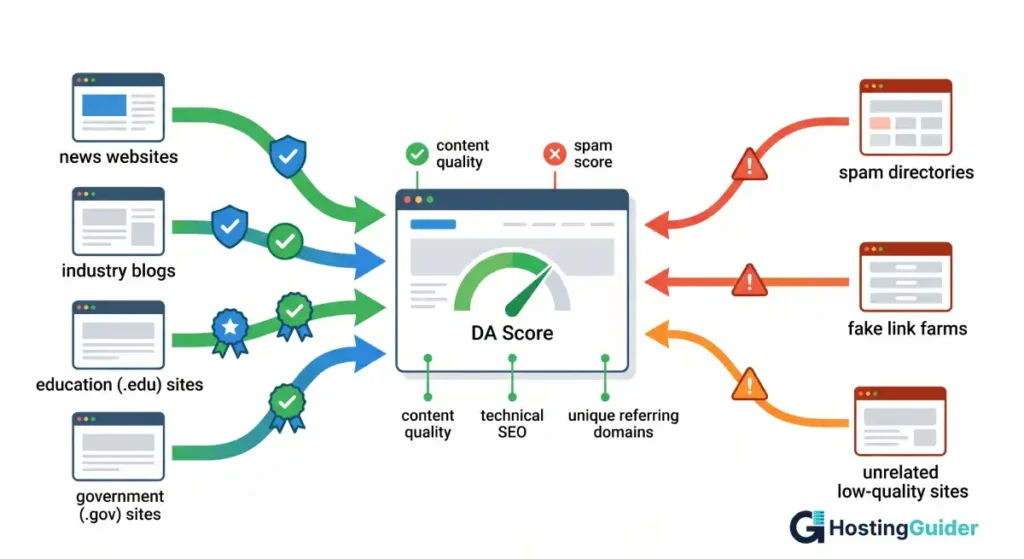
1. Backlinks (the biggest factor)
A backlink is when another website adds a link that goes to your site. Think of it like a vote. If a famous food blogger links to your bakery website, that is a powerful vote. If a random low quality site links to you, that vote counts for very little.
Quality matters far more than quantity. One high quality backlink from a trusted site can be more powerful than dozens of low quality ones. Wellows
Good backlinks come from:
- News websites and online magazines
- Industry blogs and publications
- Government or education websites (.gov and .edu)
- High DA websites that are relevant to your topic
Bad backlinks come from:
- Spammy directories
- Websites created just to sell links
- Sites with no real content or traffic
- Sites completely unrelated to your topic
2. How many different websites link to you
Getting 100 links from the same one website is not as good as getting one link each from 100 different websites. Moz looks at the number of unique root domains linking to you, not just the total number of links. Variety matters. ALM Corp
3. The quality of your content
Good content earns links naturally. When you write something truly helpful, people share it and link to it without you even asking. This is the cleanest way to build DA over time.
4. Your website’s technical health
A slow website, broken links, and pages that do not load properly all hurt your site’s credibility. Search engines trust websites that work well.
5. Spam score
If too many bad websites link to you, your spam score goes up and your DA can drop. You need to regularly check and remove bad links pointing to your site.
Hands-On Guide: How to Check Your Domain Authority Right Now
This takes less than 2 minutes. You do not need to create an account.
Tool 1: Moz Free Domain Analysis (The Original DA Tool)
Step 1: Open your browser and go to moz.com/domain-analysis
Step 2: Type your full website address into the search box. For example: yourbusiness.com
Step 3: Click Analyze Domain
Step 4: Read your results. You will see:
- Domain Authority: Your main score out of 100
- Linking Domains: How many unique websites link to you
- Inbound Links: Total number of links pointing to your site
- Ranking Keywords: How many keywords your site ranks for
Write these numbers down. This is your starting point. Check back every month to track your progress.
Tool 2: Ahrefs Free Website Authority Checker
Step 1: Go to ahrefs.com/website-authority-checker
Step 2: Type your website address and click Check Authority
Step 3: You will see your Domain Rating (DR). This is Ahrefs version of DA. It measures the same thing in a slightly different way.
Both DA and DR are useful. Check both and use them together for a clearer picture.
Tool 3: Check Your Competitors Too
This is where it gets useful. Do not just check your own score. Check the websites that appear on page one for your main keywords.
Step 1: Go to Google and search for your most important keyword. For example: best coffee shop in Manchester
Step 2: Open each result on page one in a new tab
Step 3: Go to moz.com/domain-analysis and check the DA of each competing website
Step 4: Compare their DA to yours
If their DA is 30 and yours is 25, that gap is closable with work over the next 6 to 12 months. If their DA is 75 and yours is 15, you need to either target less competitive keywords for now or invest heavily in building authority before going after that term.
Real example:
Sarah runs a dog grooming business in Bristol. She searches for best dog groomer Bristol and finds the top three results have DA scores of 22, 28, and 31. Her own website has a DA of 19. She knows the gap is small and that consistent work over the next few months can get her competing for that top spot. She focuses her energy there instead of trying to rank for best dog groomer in the UK where the top results have DA scores of 60 and above.
Hands-On Guide: How to Improve Your Domain Authority Step by Step
This is the practical part. Follow these steps in order. Do not skip ahead.
Step 1: Fix Your Website Technical Problems First
Before you try to get links, make sure your website is healthy. A broken website cannot hold authority even if you send good links to it.
Go to Google Search Console and connect your website. It is free.
Look for these problems and fix them:
- Broken links: Pages that return a 404 error. Find them and either fix or remove them.
- Slow loading speed: Go to Google PageSpeed Insights (pagespeed.web.dev), type your URL, and check your score. Aim for above 70 on mobile.
- Missing HTTPS: Your URL should start with https not http. If it starts with http, you need an SSL certificate. Most hosting providers offer this free.
- Mobile problems: More than half of all web traffic is on phones. Your site must work perfectly on small screens.
Why this matters: Technical health is the container for your link equity. A slow or broken site leaks authority even when good links point to it. Wellows
Step 2: Write Content That Is Worth Linking To
No one links to boring or average content. To earn backlinks naturally, you need content that gives people a reason to share it.
Types of content that earn links naturally:
- Original data or research: Run a survey in your industry and publish the results. Other writers will link to your data when they reference it.
- Complete guides: Write the most thorough guide on a topic in your niche. When people need to recommend a resource, they link to the best one.
- Free tools or calculators: A simple tool that solves a real problem earns links for years.
- Expert roundups: Ask 10 experts one question and publish their answers together. Most of them will share and link to it.
Real example:
A small accounting firm writes a complete guide to understanding tax returns for freelancers in plain English. Freelancer forums, blogs, and community sites start linking to it because it is genuinely the clearest explanation available. The firm earns 40 links from 28 different websites over the next year without any outreach. Their DA goes from 16 to 29.
Step 3: Get Listed in Relevant Directories and Publications
Start with easy, legitimate backlinks before doing heavy outreach.
Places to get listed:
- Google Business Profile: Free listing that gives your site a citation and improves local trust
- Industry directories: If you are a lawyer, get listed on legal directories. If you are a plumber, get listed on home services directories. Only choose well-known, reputable ones.
- Local business directories: Yelp, Trustpilot, and local chamber of commerce websites
- Niche publications: Many industry publications accept guest articles or company profiles that include a link back to your site
Each listing adds a legitimate link from a trusted source. Ten of these done properly move your DA more than 100 links from random low quality sites.
Step 4: Do Simple Outreach to Earn Backlinks
Outreach means contacting other website owners and asking them to link to your content. It sounds awkward but works well when done right.
The broken link method:
- Find a website in your industry that you respect
- Use a free tool like Ahrefs or Check My Links (Chrome extension) to find broken links on their site
- Email them politely to let them know about the broken link
- Suggest your relevant content as a replacement
Example email to send:
Hi [name],
I was reading your article on [topic] and noticed one of the links in the section about [specific part] is no longer working. The link goes to a page that returns a 404 error.
I have a similar article on this topic at [your URL] that might be a good replacement if you are looking to update it.
Either way, thought you would want to know about the broken link.
[Your name]
This works because you are helping them first. The ask is secondary and natural.
The guest post method:
Write a useful article for someone else’s website with a link back to your site in the author bio or naturally within the content. Pick websites that are relevant to your topic and have a higher DA than yours.
Step 5: Remove or Disavow Bad Links
Bad links pointing to your site hurt your DA. Check your backlink profile every few months and clean it up.
Step 1: Go to Moz or Ahrefs and look at your full backlink list
Step 2: Look for links coming from:
- Sites that sell links openly
- Sites with no real content (just pages full of links)
- Sites in completely unrelated industries
- Sites in other languages with no relevance to your audience
Step 3: Try to contact those sites and ask them to remove the link
Step 4: If they do not respond, use Google’s Disavow Tool inside Google Search Console to tell Google to ignore those links
This will not raise your DA overnight, but it stops bad links from dragging your score down.
Step 6: Build Internal Links Across Your Own Site
Internal links are links from one page of your website to another page on your same website. They are free, completely in your control, and most website owners underuse them.
When you publish a new article, go back to your older articles and add a link to the new one where it makes sense. This spreads authority across your whole site and helps search engines understand how your content connects.
Real example:
A website about gardening publishes 50 articles but none of them link to each other. Each article sits alone. A competing site publishes 30 articles but every article links to three or four related articles on the same site. The second site builds authority faster because search engines can follow the connections and see the site as a complete resource on the topic.
Step 7: Be Patient and Track Progress Monthly
DA does not move fast. A new site might take 6 to 12 months of consistent work before it sees meaningful movement. That is normal.
Check your DA score on the first day of every month. Track it in a simple spreadsheet:
| Month | DA Score | Linking Domains | Notes |
|---|---|---|---|
| Month 1 | 8 | 12 | Published 4 new articles |
| Month 2 | 9 | 18 | Got listed in 3 directories |
| Month 3 | 11 | 24 | First guest post published |
| Month 6 | 17 | 41 | Consistent growth |
Small increases month after month add up to big gains over a year.
DA vs DR vs Authority Score: What Is the Difference
You will hear three different terms depending on which tool you use. They all measure roughly the same thing in slightly different ways.
| Metric | Tool | What It Measures |
|---|---|---|
| Domain Authority (DA) | Moz | Backlink quality and linking root domains |
| Domain Rating (DR) | Ahrefs | Strength of backlink profile |
| Authority Score (AS) | Semrush | Backlinks, traffic, and spam signals |
None of these is the official Google score. Google does not publish its internal scoring system. But all three tools measure the same underlying signals that Google also cares about: good backlinks, trusted websites, and clean content.
Use whichever tool your team prefers. Just stay consistent and always compare your score within the same tool.
Common DA Mistakes to Avoid
Buying cheap links. Private Blog Networks and automated link packages can damage your site’s credibility. Google’s systems are now very good at identifying unnatural link patterns. A penalty from Google can drop your traffic overnight and takes months to recover from. Outreachfrog
Only caring about the number. DA is a tool, not a goal. The goal is more visitors, more customers, and more revenue. Use DA to guide your work, not as the final measure of success.
Expecting fast results. Many website owners try link building for four weeks, see no DA movement, and give up. DA moves slowly. Keep going.
Getting links from irrelevant sites. A link from a top cooking blog means nothing for a law firm website. Relevance is as important as authority. If a link does not make sense to a human reader, it likely will not provide much value to a search engine either. Outreachfrog
Ignoring on-page quality. Backlinks are powerful but they do not fix bad content. If people land on your site and leave immediately, that tells search engines your site is not useful. Great content keeps people on your pages longer and that matters too.
FAQ’s
What is Domain Authority?
Domain Authority is a score from 1 to 100 created by Moz that predicts how likely a website is to rank in search engine results. It is based mainly on the quality and number of websites that link to your site. A higher score means your website is seen as more trustworthy and has better ranking potential compared to sites with lower scores.
Is Domain Authority a Google ranking factor?
No. Google does not use Domain Authority as a ranking factor and did not create it. Moz created it as a tool to help website owners measure their SEO strength. However, the things that raise your DA score, like quality backlinks and strong content, are the same signals that Google uses to decide rankings. So improving your DA almost always improves your Google rankings too.
What is a good Domain Authority score?
A good Domain Authority score depends on who you are competing with. If the websites ranking on page one for your target keywords have a DA between 20 and 35, then a DA of 30 is strong for you. There is no single good number. The goal is to have a higher score than your direct competitors, not to match the biggest websites on the internet.
How long does it take to increase Domain Authority?
It typically takes 3 to 6 months of consistent work to see a meaningful increase in Domain Authority. Newer sites with very low scores can move faster in the early stages. Moving from a high DA like 60 to 70 can take years of sustained effort. The key is consistent monthly work on content and backlinks rather than short bursts of activity.
How do I check my Domain Authority for free?
You can check your Domain Authority for free by going to moz.com/domain-analysis, typing your website address, and clicking Analyze Domain. No account is required for a basic check. You can also use Ahrefs free Website Authority Checker at ahrefs.com/website-authority-checker to see your Domain Rating, which measures the same concept.
Why did my Domain Authority drop?
Your Domain Authority can drop for several reasons. Your competitors may have earned more links than you recently, raising the overall bar. Moz may have updated its algorithm. You may have lost some backlinks because the linking sites removed them or went offline. Or bad links may have been pointing to your site and you picked them up in a recent index update. Check your backlink profile and run a link audit to find the cause.
Does social media affect Domain Authority?
Social media does not directly affect Domain Authority. Links shared on social platforms are generally tagged as nofollow, which means they do not pass link equity in the traditional sense. However, social media helps indirectly. When your content gets shared widely, more people see it and some of them will link to it from their own websites. That earned link from a real website is what moves your DA.
Final Thoughts
Domain Authority is not a magic number and it is not the only thing that matters for SEO. But it is one of the clearest signals you have of whether your website is growing in the right direction.
Think of it as a health check. A doctor does not just look at one reading and declare you healthy or unhealthy. They look at several numbers over time to understand the trend. DA works the same way. One number in isolation tells you little. But watching it grow month after month tells you your site is getting stronger.
Start with the basics. Fix your technical issues. Write content people actually want to read and share. Get listed in real directories. Build one or two quality backlinks each month. Check your score on the first of every month and write it down.
Do that consistently for a year and your DA will grow. And as it grows, so will your traffic, your leads, and your business.