You build a business, grow your brand, and then one day you search for your own company name online and find someone else already owns your domain. Or worse, they are using it to sell counterfeit products, run a scam, or redirect traffic to a competitor.
This happens more than most business owners realize. More than 6,200 UDRP complaints were filed in 2025, the highest volume ever recorded. And that number only covers cases that went through formal dispute channels. Thousands more are resolved privately or never challenged at all. Dreyfus
The good news is that there is a clear, structured process to resolve domain name disputes. You do not always need to hire an expensive lawyer or fight a long court battle. Most disputes can be resolved in two to three months through an established international process.
This guide explains exactly what domain name disputes are, what types exist, and how to go through the resolution process step by step.
Here is what you will learn:
- The different types of domain name disputes with real examples
- What the UDRP is and how it works
- The three things you must prove to win your case
- A step by step walkthrough of filing a complaint
- When to use UDRP and when to go to court instead
- How to protect your domain before a dispute ever starts
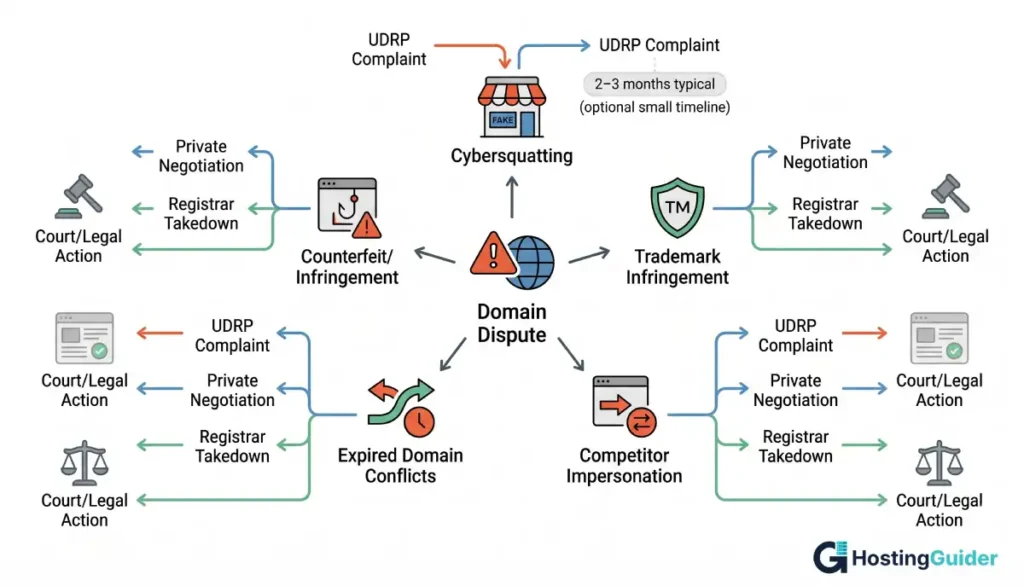
Table of Contents
Quick Answer
A domain name dispute is a conflict over who has the right to use a specific domain name. The most common resolution method is the UDRP, a process managed by accredited providers like WIPO. To win, you must prove that the domain is identical or confusingly similar to your trademark, that the registrant has no legitimate rights to it, and that it was registered and used in bad faith. Cases typically resolve within 2 to 3 months.
Key Takeaways
- A domain name dispute happens when two or more parties claim rights to the same or a similar domain name.
- Cybersquatting is the most common cause: someone registers your brand name as a domain in bad faith to sell it back or profit from your traffic.
- The UDRP (Uniform Domain Name Dispute Resolution Policy) is the main international process for resolving these disputes quickly and affordably.
- WIPO has administered over 51,000 UDRP cases covering more than 94,000 domain names and is the leading provider for domain dispute resolution. WIPO
- To win a UDRP case, you must prove three specific things. Missing even one of them will result in a loss.
- Prevention is far cheaper than resolution. Registering your brand domain early is the best protection.
What is a Domain Name Dispute
A domain name dispute happens when one party believes another party has registered or is using a domain name that infringes on their rights. Those rights usually involve a registered trademark, a business name, or a brand identity the complainant has built up over time.
The dispute does not have to involve identical names. A domain that is confusingly similar to your brand name can be enough to file a complaint. For example, if your brand is called BlueLeaf and someone registers blue-leaf.com or blueleafstore.com and uses it to sell competing products, that is a dispute.
Domain name disputes became a formal legal area after the internet expanded in the 1990s and people started registering famous brand names as domain names before the companies themselves could do it. ICANN created the UDRP in response to trademark-based domain name disputes, requiring all registrars to follow the policy as a condition of accreditation. ICANN
Types of Domain Name Disputes
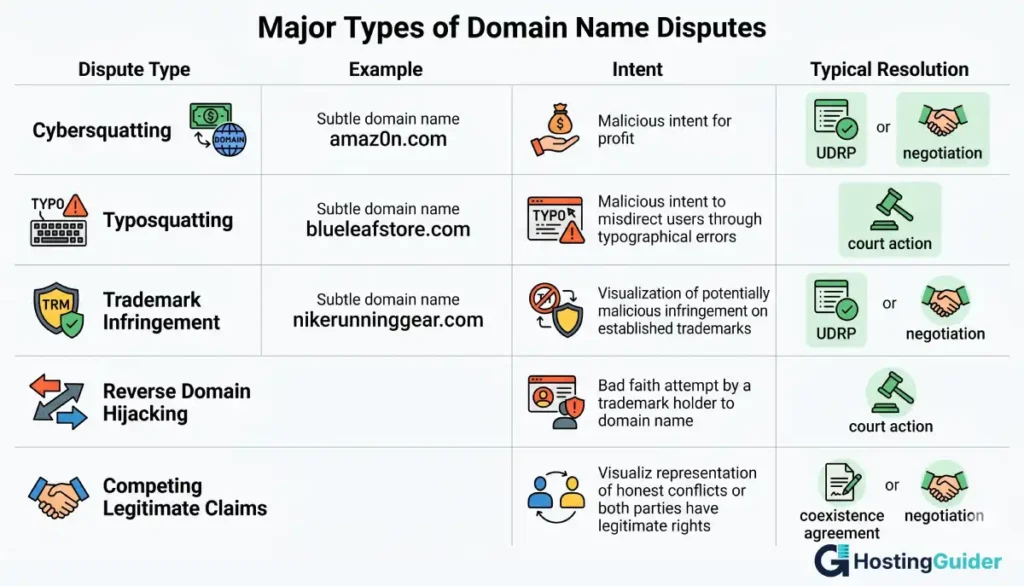
Not all domain disputes are the same. Here are the main types you will encounter:
Cybersquatting
This is the most common type. A person registers a domain name that matches a well known brand or trademark specifically to profit from it. The cybersquatter has no connection to the brand. Their goal is usually to sell the domain back to the brand owner at an inflated price, or to generate traffic from visitors who typed the wrong URL.
Real example: A small business owner launches a bakery called Maple Bloom Bakery and starts building a following on social media. Before she registers mapleboombakery.com, a cybersquatter registers it and demands 5,000 dollars to hand it over. She never authorized the registration and has no prior connection to the squatter.
Typosquatting
This involves registering a domain that is a common misspelling of a popular brand name. The goal is to capture traffic from users who type the URL slightly wrong.
Real example: A user means to visit a major retailer but accidentally types amaz0n.com with a zero instead of the letter o. A typosquatter owns that domain and uses it to display ads or redirect to a competing site.
Trademark Infringement
This happens when someone registers a domain that uses a trademarked name without authorization, even if they have a legitimate looking business around it.
Real example: A seller registers nikerunninggear.com and uses it to sell counterfeit sports equipment. Nike holds the trademark. The domain is both trademark infringement and likely fraud.
Reverse Domain Hijacking
This is less common but worth knowing. It happens when a legitimate domain owner is falsely accused of cybersquatting by a large company trying to take their domain for free instead of paying market value.
Real example: A person registered the domain sunshinetravel.com in 2005 for their small travel blog. A large travel company later forms a brand called Sunshine Travel and files a UDRP complaint to take the domain, even though the blog owner had it first and has legitimate use.
Competing Legitimate Claims
Sometimes two businesses genuinely have similar names but operate in different countries or industries. Both may have legitimate reasons to use the same domain.
Real example: A software company in the US and a consulting firm in Australia both operate under the name TechBridge. When the .com version of that domain comes up for dispute, both can argue legitimate rights.
What is the UDRP
The Uniform Domain Name Dispute Resolution Policy, known as the UDRP, is the main international framework for resolving domain name disputes. All ICANN-accredited registrars must follow the UDRP, and it applies to all generic top level domains including .com, .net, and .org. ICANN
The UDRP was designed to be faster and cheaper than going to court. Cases are typically decided within two to three months from start to finish, with fixed fees set by the dispute resolution provider. WIPO
The most widely used UDRP provider is the World Intellectual Property Organization, known as WIPO. Other accredited providers include the National Arbitration Forum (NAF) and the Czech Arbitration Court (CAC).
The UDRP only has two possible outcomes:
- The domain is transferred to the complainant
- The domain is cancelled
The UDRP cannot award money. If you want financial damages from a cybersquatter, you need to go to court instead.
The 3 Things You Must Prove to Win a UDRP Case
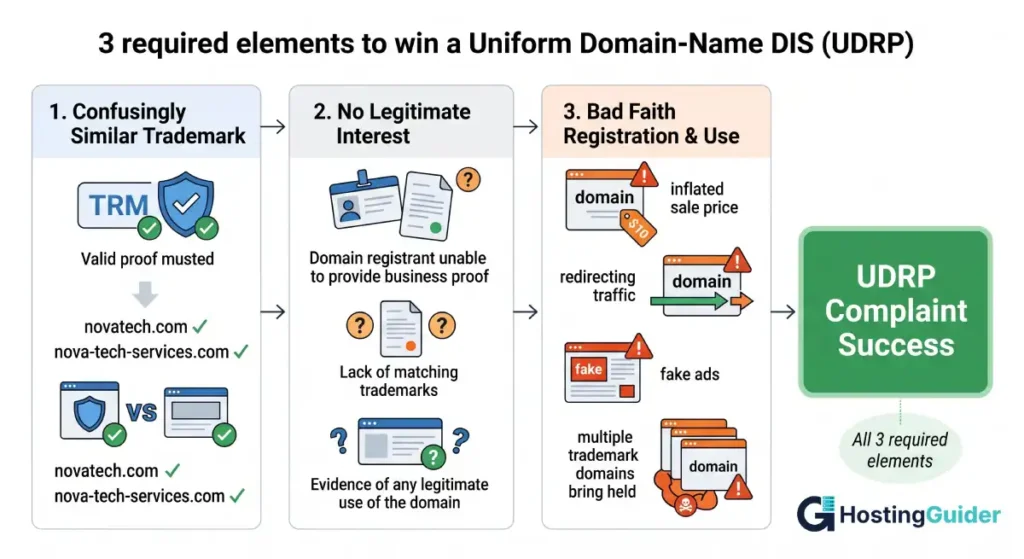
This is where most people either win or lose. To succeed in a UDRP complaint, you must prove all three of the following. Proving only two is not enough.
1. The domain is identical or confusingly similar to your trademark
You need an existing trademark, either registered or established through use, that the disputed domain matches or closely resembles. The comparison is between your trademark and the domain name itself, ignoring the extension.
Examples that would qualify:
- Your trademark is NOVA TECH and the domain is novatech.com (identical)
- Your trademark is NOVA TECH and the domain is nova-tech-services.com (confusingly similar)
- Your trademark is NOVA TECH and the domain is novvahtech.com (typosquatting variation)
Examples that may not qualify:
- Your trademark is APPLE (the fruit) and the domain is applejuiceblog.com (descriptive, unrelated use)
2. The domain holder has no rights or legitimate interests in the domain
You must show that the person who registered the domain has no valid reason to own it. They are not commonly known by that name, they have no trademark of their own, and they are not making legitimate non-commercial use of it.
This is often the hardest part to prove because the burden of evidence shifts. You make the initial case, and then the registrant can respond with their own evidence of legitimate use.
3. The domain was registered and is being used in bad faith
Both conditions must be true: bad faith at the time of registration AND bad faith in current use. Registering a domain in bad faith and then doing nothing with it may still qualify, but you need to show intent.
Signs of bad faith include:
- Offering to sell the domain at a price far above registration cost
- Using the domain to direct traffic to competitors
- Displaying ads that profit from your brand name
- Registering multiple domains containing well known trademarks
- Providing false contact information at registration
How to File a UDRP Complaint Through WIPO (Step by Step)
This walkthrough uses WIPO because it is the most widely used and recognized provider globally. Every click path, form field, and decision point is covered here so you know exactly what to do.
Before You Open Any Form: Build Your Evidence Folder First
Do not go to the WIPO website yet. Start here.
Create a folder on your computer called Domain Dispute Evidence. Inside it, create these five subfolders:
- 01 – Trademark Proof
- 02 – Domain Screenshots
- 03 – Bad Faith Evidence
- 04 – WHOIS Records
- 05 – My Brand History
Now fill each one.
Subfolder 01 – Trademark Proof
If you have a registered trademark, download the registration certificate from your national trademark office. In the US that is USPTO.gov. Search your trademark name, open the record, and save the PDF.
If you do not have a registered trademark, you can still file. You need to show what is called common law rights. Collect:
- Screenshots of your website with the earliest date you can find
- Wayback Machine archives of your site (go to web.archive.org, type your domain, save screenshots of the oldest version)
- Press mentions, reviews, or articles mentioning your brand name
- Social media account creation dates
- Business registration documents showing your brand name
Subfolder 02 – Domain Screenshots
Go to the disputed domain right now and take full-page screenshots of everything on it. Use a tool like GoFullPage (free Chrome extension) to capture the entire page, not just the visible area.
Also, go to web.archive.org, type the disputed domain, and screenshot the oldest cached version of that site. This shows what it looked like before the dispute started, which matters enormously if the registrant changes the site after getting your complaint.
Subfolder 03 – Bad Faith Evidence
This is your most important subfolder. Collect anything that shows the registrant is acting in bad faith:
- Screenshot of any email or message where they offered to sell you the domain and state the price they asked
- Screenshot of the site showing competitor ads or links
- Screenshot of the site showing your brand name or logo being used
- Screenshot of any contact form on the site that collects visitor information under your brand name
- A record showing the domain was registered after your brand launched (check the registration date in the WHOIS record and compare it to your brand launch date)
Subfolder 04 – WHOIS Records
Use our Domain WHOIS Lookup tool or go to lookup.icann.org, type the disputed domain, and save the full WHOIS record. This shows the registraow to Protect Your Domain Before a Dispute Star
r, registration date, and sometimes contact details. Do this today because WHOIS records can change.
Subfolder 05 – My Brand History
Gather proof that your brand existed and was known before the domain was registered. This can include:
- Invoices or receipts sent under your brand name with dates
- Email threads using your brand domain
- Social media post history
- Google Analytics data showing traffic to your real site before the dispute domain was registered
- Product packaging photos with your brand name and a date
Once all five folders are filled, you are ready to go to WIPO.
Part 1: Go to WIPO and Start Your Complaint
Step 1: Go to the WIPO complaint center
Open your browser and go to: https://www.wipo.int/portal/en/
You will see a page called Domain Name Dispute Resolution for Complainants. Read the eligibility section to confirm your case qualifies. Then click File a Complaint.
Step 2: Create a WIPO account
If you do not have a WIPO account, click Create Account. Fill in your name, email address, and a password. Verify your email. This account is where you will track your case status throughout the process.
Step 3: Start the online complaint form
After logging in, click File a New UDRP Complaint. WIPO uses an online form split into multiple sections. Do not try to complete it all in one sitting. The form saves your progress so you can return.
Part 2: Fill in the Complaint Form Section by Section
Section 1: Complainant Details
This is your information. Fill in:
- Full legal name (use your company name if filing on behalf of a business)
- Mailing address
- Email address (use a reliable personal or business email you check daily)
- Phone number
Who is the authorized representative? If you are filing yourself, leave this blank. If a lawyer is filing on your behalf, they fill in their details here.
Section 2: The Disputed Domain Name
Type the exact domain name in dispute. Include the extension. Example: yourbranddomain.com
If you are disputing multiple domains at once (for example, yourbrand.com and yourbrand.net are both squatted), list all of them here. Adding more domains in one filing costs slightly more but is far cheaper than filing separately for each.
Section 3: The Registrar
Enter the name of the registrar where the disputed domain is currently registered. You found this in the WHOIS record you saved in Subfolder 04.
WIPO will contact the registrar directly once the complaint is filed. You do not need to contact the registrar yourself before filing.
Section 4: Your Trademark Details
This section is where most first time filers make mistakes. Fill in every trademark you are relying on. For each trademark, provide:
- The exact trademark text or mark
- The registration number (from Subfolder 01)
- The country of registration
- The registration date
- The goods or services covered
If you are relying on common law rights instead of a registered trademark, select that option and describe your evidence. Be specific. Write something like:
Example of what to write for common law rights:
“The complainant has used the mark MAPLELEAF DESIGN in commerce since March 2019 in connection with graphic design services. The mark has been used continuously on the complainant’s website mapleleafdesign.com, across social media platforms with a combined following of over 14,000 followers, and in commerce with clients across the United States and Canada. Evidence is provided in Annexes 3 through 7.”
Section 5: The Three Element Arguments
This is the most important part of the form. You must write a separate argument for each of the three UDRP elements. Here is exactly how to approach each one:
Element 1 Argument: Identical or Confusingly Similar
Keep this section short and direct. Compare your trademark to the disputed domain and explain why they are the same or confusingly similar.
Example of what to write:
“The disputed domain name yourbranddomain.com is identical to the complainant’s registered trademark YOURBRAND (US Trademark Registration No. 5XXXXXXX). The domain incorporates the trademark in its entirety. The addition of the generic word domain does not distinguish the domain name from the complainant’s mark. See Annex 1 for the trademark registration certificate.”
Element 2 Argument: No Rights or Legitimate Interests
Show that the registrant has no valid reason to own this domain. Use the evidence from your research.
Example of what to write:
“The respondent has no rights or legitimate interests in the disputed domain name. The complainant has not authorized, licensed, or permitted the respondent to use the YOURBRAND trademark or to register any domain name incorporating that mark. The respondent is not commonly known by the name YOURBRAND and operates no legitimate business under that name. The disputed domain resolves to a page displaying pay per click advertisements for services that compete directly with the complainant, which does not constitute a bona fide offering of goods or services. See Annex 4 for screenshots of the respondent’s website captured on [date].”
Element 3 Argument: Registered and Used in Bad Faith
This is your strongest section. Use every piece of evidence you collected.
Example of what to write:
“The disputed domain was registered on [registration date], which is [X months/years] after the complainant began using the YOURBRAND mark in commerce and [X months] after the complainant’s trademark registration. The respondent could not have been unaware of the complainant’s well established mark at the time of registration.
The disputed domain currently resolves to a website displaying pay per click advertisements for competing services, demonstrating that the respondent is intentionally attempting to attract internet users for commercial gain by creating a likelihood of confusion with the complainant’s mark. This constitutes bad faith use under paragraph 4(b)(iv) of the UDRP.
Furthermore, prior to filing this complaint, the respondent contacted the complainant via email on [date] offering to sell the domain for [amount], a price far exceeding the cost of registration. This offer to sell constitutes additional evidence of bad faith registration under paragraph 4(b)(i). See Annexes 5 and 6.”
Section 6: Remedies Requested
Select one of two options:
- Transfer the domain to you (the most common choice)
- Cancellation of the domain (less common, usually chosen when you do not want anyone to have it)
In almost every case, choose Transfer. Cancellation just releases the domain back to the public where anyone can register it again.
Section 7: Mutual Jurisdiction
Select where you are willing to submit to court jurisdiction if the respondent wants to challenge the decision in court. You typically select either the registrar’s location or your own location.
Section 8: Annexes
This is where you upload everything from your evidence folder. WIPO accepts PDF files. Label each annex clearly before uploading:
- Annex 1: Trademark registration certificate
- Annex 2: WHOIS record for disputed domain
- Annex 3: Screenshots of disputed domain website (dated)
- Annex 4: Screenshots of Wayback Machine archive of disputed domain
- Annex 5: Email from respondent offering to sell the domain
- Annex 6: Screenshots showing competitor ads on disputed domain
- Annex 7: Evidence of complainant brand use before domain registration
Number them in the order you reference them in your complaint text. Panels read annexes while reading your arguments. If your annex numbering does not match what your text refers to, it creates confusion and weakens your case.
Part 3: Pay and Submit
Step 1: Review everything
Before paying, read your complaint from the top. Check that:
- Every annex is uploaded and numbered correctly
- Every reference to an annex in your text matches the actual annex number
- Your trademark details are exactly right including the registration number
- The disputed domain is spelled correctly including the extension
- Your contact email is accurate
Step 2: Select your panel type
Choose between a single expert or a three member panel.
A single expert is cheaper (around 1,500 USD for up to 5 domains) and is sufficient for clear-cut cybersquatting cases. A three-member panel (around 4,000 USD) makes sense for high-value cases, complex arguments, or when you expect a strong response from the other side.
Step 3: Pay the fee
WIPO accepts credit card payment directly on the platform. You will receive a payment confirmation email. Keep this for your records.
Step 4: Submit
Click Submit Complaint. WIPO sends you a case number immediately. Save that number. Every future communication about your case references it.
Part 4: After You Submit
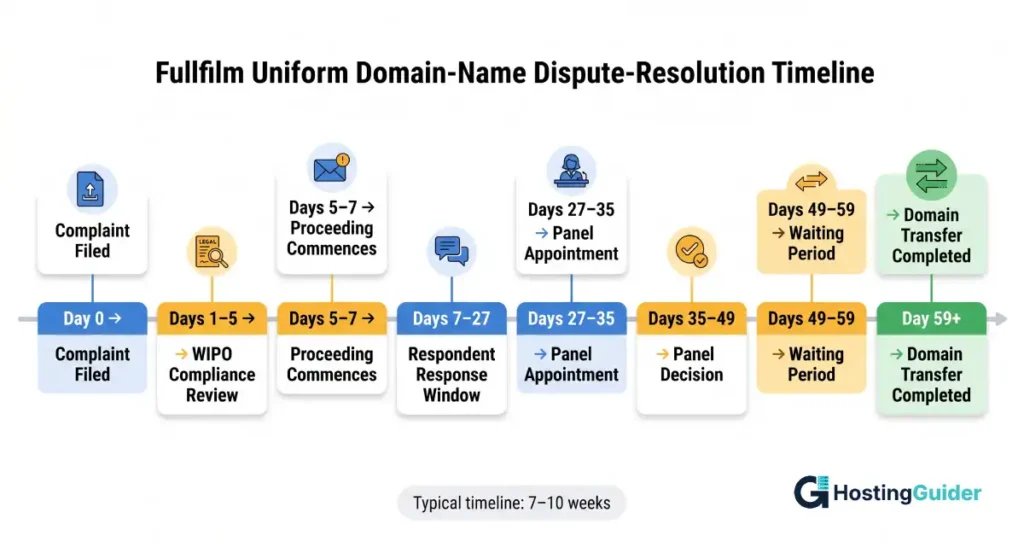
What happens in the first 5 days
WIPO reviews your complaint for administrative compliance. They check that all required fields are filled, annexes are attached, and fees are paid. If something is missing, they email you with a deficiency notice and give you a short window to fix it.
What happens in days 5 to 10
Once your complaint passes compliance review, WIPO officially commences the proceeding. They send a formal notice to the respondent (the domain holder) and to the registrar. The registrar is instructed to lock the domain so it cannot be transferred or changed during the proceeding.
What to do now: watch your email and the domain
Check your WIPO case portal daily. The respondent has 20 days from commencement to file a response. If they respond, WIPO uploads their response to your case file and you can read it. You do not get to reply to their response unless the panel specifically requests it, so make sure your original complaint covers everything.
If they do not respond within 20 days, the proceeding moves straight to panel appointment.
What happens at the decision stage
Once the response period closes, WIPO appoints a panel. The panel reads both submissions and all evidence. They issue a written decision within 14 days of appointment. WIPO sends you the decision by email and posts it publicly on the WIPO domain decisions database.
If you win
The registrar receives instruction from WIPO to transfer the domain. There is a 10 business day waiting period during which the respondent can seek a court order to stop the transfer. In the vast majority of cases, they do not. After 10 days, the domain transfers to a registrar account you specify.
As soon as you get control of the domain, do these things immediately:
- Point it to your real website or set up a redirect to your main domain
- Turn on domain lock at the new registrar
- Enable WHOIS privacy
- Set auto renew so you never accidentally let it lapse
If you lose
The domain stays with the current holder. You can still pursue court action if you believe the panel made an error or if you have additional evidence that was not available during the UDRP proceeding. A UDRP loss does not permanently bar you from court.
Quick Reference: UDRP Timeline
| Day | What Happens |
|---|---|
| Day 0 | You submit the complaint and pay the fee |
| Days 1 to 5 | WIPO compliance review |
| Day 5 to 7 | WIPO formally commences the proceeding and notifies the respondent |
| Days 7 to 27 | Respondent has 20 days to file their response |
| Days 27 to 35 | WIPO appoints the panel |
| Days 35 to 49 | Panel reviews and issues decision (within 14 days of appointment) |
| Days 49 to 59 | 10 business day implementation waiting period |
| Day 59 onward | Domain transfers to you if you won |
Total time from filing to transfer: approximately 7 to 10 weeks for a typical case.
UDRP vs Going to Court: Which is Better
The UDRP is not the only option. Here is how to choose between it and traditional litigation.
| Factor | UDRP | Court Litigation |
|---|---|---|
| Cost | 1,500 to 4,000 USD | Tens of thousands of dollars |
| Time | 2 to 3 months | 1 to 3 years |
| Outcome | Transfer or cancel only | Transfer, cancel, or money damages |
| Jurisdiction | International | Depends on court location |
| Appeal | Only through court | Full appeals process |
UDRP proceedings are ideal when the primary goal is quick recovery of a domain name. Court litigation may be more appropriate when the dispute involves broader trademark infringement, fraud, or significant financial harm to the brand. Trestle Law
When to use UDRP:
- You want the domain back quickly and affordably
- The case clearly involves cybersquatting or bad faith
- You do not need financial damages
When to go to court:
- You want financial compensation
- The cybersquatter has caused ongoing brand damage that goes beyond the domain
- The UDRP complaint was already denied and you want to appeal through a court
Real Case Examples
Example 1: Clear cybersquatting win
A US based software company discovers that someone registered their exact brand name as a .com domain and is using it to display competitor ads. The company holds a registered trademark. They file through WIPO with evidence of the trademark, screenshots of the site showing competitor ads, and a record of the domain being registered one week after the company’s product launch. The panel finds bad faith obvious and orders the transfer. Total time: 7 weeks.
Example 2: Complaint denied
A large retail brand files a UDRP complaint against the owner of a domain containing a common English word that also appears in the brand name. The domain owner runs a legitimate blog about that topic and registered the domain five years before the brand launched. The panel finds no bad faith and denies the complaint. The retail brand failed to prove the registrant had no legitimate interest in the name.
Example 3: Reverse domain hijacking finding
A corporation files a complaint against a small business owner who has used a domain for 12 years for their legitimate local business. The corporation recently trademarked a similar name and wants the domain without paying for it. The panel denies the complaint and notes that the filing itself was an abuse of the process, a finding known as reverse domain hijacking.
These examples show why building a strong case with solid evidence matters more than the size or reputation of the company filing.
How to Protect Your Domain Before a Dispute Starts
Resolving a domain dispute costs time, money, and stress. Prevention costs about 10 dollars a year.
Register your domain early. As soon as you decide on a brand name, register the .com version before anything else. Do not wait until after the logo is done or the product is built.
Register common variations. If your brand is MapleBloom, register maplbloom.com, maple-bloom.com, and mapleblooms.com. This closes the doors that typosquatters and cybersquatters use most.
Register your country code version. If you operate in the UK, register .co.uk. If you are in Australia, register .com.au. Competitors or squatters can use country code versions to confuse your local audience.
Register your trademark. A registered trademark gives you the clearest rights in a UDRP case. Without it, you can still win using evidence of brand use, but a registration makes the process much cleaner. Visit the USPTO website for US trademark registration.
Monitor your brand name. Set up a Google Alert for your brand name and domain. If you suspect someone has registered a domain similar to yours, run a quick domain WHOIS lookup to check the registration date and registrar. Use WIPO’s brand monitoring tools or a service like Brandwatch to get notified if someone registers a similar domain.
Keep your registrar account secure. Enable two factor authentication. Keep your registrant email up to date. Turn on domain lock. A compromised registrar account is the fastest way to lose a domain you legitimately own.
FAQ’s
What is a domain name dispute?
A domain name dispute is a conflict between two parties over who has the right to use a specific domain name. The most common case is cybersquatting, where someone registers a domain that matches a trademark they don’t own, then tries to sell it back or redirect its traffic. These disputes are resolved through the UDRP process, mediation, or a court case.
What do I need to prove to win a UDRP case?
To win a UDRP case, you must prove three things. First, the domain is identical or confusingly similar to your trademark. Second, the current owner has no rights or legitimate interests in the domain. Third, the domain was registered and is being used in bad faith. If you can’t prove all three, the complaint fails, even if the domain matches your brand name.
How long does a UDRP domain dispute take?
A UDRP case usually takes about 7 to 10 weeks from filing to the final result. That is much faster than going to court, which often takes 1 to 3 years. The domain owner has 20 days to respond, and the panel has 14 days to decide once it’s appointed. After the decision, there is a 10 business day waiting period before the domain is transferred or cancelled.
How much does it cost to file a UDRP complaint?
Filing a UDRP complaint with WIPO costs about $1,500 for a single-member panel covering up to 5 domain names. A three-member panel costs about $4,000. These are fixed provider fees. If you hire a lawyer to prepare the complaint, you pay their fees on top.
What is cybersquatting and is it illegal?
Cybersquatting means registering a domain that matches someone else’s trademark or brand without permission, usually to sell it back or profit from its traffic. In the United States, it is illegal under the Anticybersquatting Consumer Protection Act (ACPA). Trademark owners can sue in federal court for damages of up to $100,000 per domain.
Can I get my domain back without going to court?
Yes. The UDRP process lets you recover a domain without going to court. You file a complaint with an approved provider such as WIPO and prove the three required elements. If the panel rules for you, the domain is transferred to you. It’s faster and cheaper than a lawsuit, but UDRP can only transfer or cancel a domain. It can’t award money damages.
What happens if I lose a UDRP case?
If you lose as the complainant, the domain stays with its current owner. You can still take the case to court if you have stronger evidence. If the panel decides you filed in bad faith, trying to take a domain you have no right to, it can issue a finding of Reverse Domain Name Hijacking against you.
How do I prevent domain name disputes?
The best protection is to register your domain before you launch your brand publicly. Also register common misspellings, other extensions, and relevant country-code versions. Register your trademark officially, since that gives you the clearest legal rights. Turn on your registrar’s security features, watch for new domains similar to yours, and act quickly when you find one.
Final Thoughts
Domain name disputes are not rare edge cases for big corporations. They happen to small businesses, freelancers, and new brands every day. WIPO handled a record number of domain dispute cases in 2025, confirming that cybersquatting and fraudulent domain use continue to grow alongside the internet itself. WIPO
The UDRP gives you a real, affordable path to get your domain back without spending years in court. But the strongest position is never having to use it. Register your brand domain the day you decide on your name. Register variations. Secure your trademark. Those three steps close the gaps that bad actors look for.
If a dispute has already started, act fast. Evidence disappears and domains change hands quickly. Document everything, choose your provider, and file a clean, well organized complaint backed by solid proof.
For official UDRP rules and accredited provider details, visit ICANN’s dispute resolution policy page as the starting point.