SiteGround vs Bluehost: Which One Actually Deserves Your Money
Most comparisons between these two write SiteGround as the premium choice and Bluehost as the beginner option. Then they call it a day.
That framing misses the most interesting finding from our actual test data: Bluehost handles simultaneous traffic nearly twice as fast as SiteGround. Meanwhile SiteGround earns the better GTmetrix grade and is the only one running HTTP/3.
Neither one is simply better. What matters is whether the strengths of each host match what your site actually needs.

Quick Verdict: Which Host Is Better?
SiteGround wins on server quality. Bluehost wins on delivery infrastructure and support.
SiteGround earns a GTmetrix Grade A on desktop, supports HTTP/3 and QUIC, holds an SSL Grade A+ with HSTS enforced, and offers developer tools including Git, WP-CLI, and staging on GoGeek shared plans. Its Google Cloud infrastructure is technically superior at the server level.
Bluehost passes all Google Core Web Vitals on mobile, handles concurrent load twice as fast as SiteGround in stress testing, delivers sub-10ms global latency via Cloudflare Anycast from every continent, includes a free domain in year one, and provides 24/7 phone support on every plan.
Category Winners at a Glance
| Category | Winner | Why |
|---|---|---|
| Pricing | Bluehost | Lower introductory price, lower renewal floor, free domain year one included |
| Mobile Core Web Vitals | Bluehost | Passes LCP and INP; SiteGround fails both LCP (2.7s) and TTFB (1.6s) |
| Desktop Rendering | SiteGround | GTmetrix Grade A vs Bluehost Grade C; SiteGround TBT 221ms vs Bluehost 2,500ms |
| Global Delivery | Bluehost | Cloudflare Anycast: sub-10ms from every continent vs SiteGround’s 1,520ms in India |
| Concurrent Load Handling | Bluehost | 308ms average under 50 simultaneous users vs SiteGround’s 624ms |
| SSL Security | SiteGround | Grade A+ with HSTS enforced vs Bluehost’s Grade A without default HSTS |
| HTTP/3 Protocol | SiteGround | Fully supported; Bluehost does not support HTTP/3 or QUIC |
| Ease of Use | Bluehost | cPanel, guided WordPress wizard, and phone support for beginners |
| Customer Support | Bluehost | 24/7 phone and live chat vs SiteGround’s live chat only |
| WordPress Integration | SiteGround | Server-level Speed Optimizer and Security Optimizer, staging and Git on GoGeek |
| Developer Tools | SiteGround | Git integration, WP-CLI, and staging environments on shared hosting |
| Sustainability | Tie | Both verified green, SiteGround via Google Cloud, Bluehost via Cloudflare |
Who Should Choose Which
| Choose SiteGround if… | Choose Bluehost if… |
|---|---|
| Your audience is primarily in Europe | Your audience is global, especially Americas or Asia |
| You need HTTP/3, Grade A+ SSL, and HSTS on a shared plan | You want the lowest introductory price and lower renewal floor |
| You run an agency and need staging environments and Git access | You are launching your first website and want a step-by-step setup wizard |
| You want the best desktop rendering quality (GTmetrix Grade A) | You want 24/7 phone support as a backup when something breaks |
| You need deeper WordPress server-level integration | You want a free domain name included in year one |
| You are building client sites and need developer tools on shared hosting | You want the familiar cPanel interface you already know |
SiteGround vs Bluehost: Full Feature Comparison
| Feature | SiteGround | Bluehost |
|---|---|---|
| Founded | 2004, Bulgaria | 2003, Utah, USA |
| Best For | Agencies, WordPress professionals | Beginners, first websites |
| Trustpilot Rating | 4.9/5 | 4.6/5 |
| Infrastructure | Google Cloud Platform | Cloudflare Anycast Network |
| GTmetrix Grade | A | C (69%) |
| Mobile LCP | 2.7s (Needs Work) | 2.4s (Pass) |
| Mobile INP | 189ms (Pass) | 199ms (Pass) |
| Server TTFB | 1.6s (Fail) | Not measured |
| Total Blocking Time | 221ms | 2,500ms |
| Time to Interactive | Not recorded | 11.6 seconds |
| Load Test (50 users) | 624ms avg | 308ms avg |
| Global Latency (India) | 1,520ms | 9.7ms |
| HTTP/3 Support | Yes | No |
| QUIC Support | Yes | No |
| SSL Grade | A+ (HSTS enforced) | A |
| Uptime (30 days) | 100% | 100% |
| Green Hosting | Verified (Google Cloud) | Verified (Cloudflare) |
| Free Domain | Year 1 (varies by promo) | Year 1 included |
| Free SSL | Yes | Yes |
| Control Panel | Site Tools (custom) | Modified cPanel |
| Phone Support | No | Yes, 24/7 |
| Live Chat | 24/7 | 24/7 |
| Staging Environments | Yes (GoGeek and above) | No |
| Git Integration | Yes (GoGeek and above) | No |
| WP-CLI Access | Yes | Limited |
| WordPress Endorsement | No | Official WordPress.org |
| Money-Back Period | 30 days | 30 days (domain fee deducted) |
How We Tested
We ran direct technical audits against each provider’s live corporate domain: world.siteground.com for SiteGround and www.bluehost.com for Bluehost.
We used Google PageSpeed Insights for mobile Core Web Vitals, including LCP, INP, and FCP. We used GTmetrix for desktop rendering analysis.
We used K6 Load Cloud to simulate 50 concurrent virtual users in a virtual traffic scenario. We used Check-Host for global ping and DNS propagation testing. We used Qualys SSL Labs for transport security grading.
We used Uptime Robot for 30-day availability monitoring. We used the HTTP/3 Check tool for protocol support verification. We used the Green Web Foundation database for sustainability verification.
These audits measure each provider’s own infrastructure decisions. Individual customer results vary by plan, site configuration, plugin load, and content weight. For the full raw test data from each provider individually, see our SiteGround review and Bluehost review.
Performance: Eight Tests, Head to Head
Test 1: Mobile Core Web Vitals (Google PageSpeed Insights)
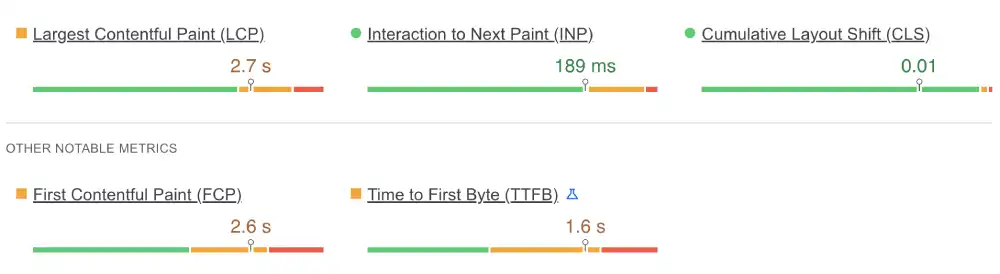
SiteGround Mobile
| Metric | Result | Google Threshold | Status |
|---|---|---|---|
| LCP (Loading) | 2.7s | Under 2.5s | Fail |
| INP (Interaction) | 189ms | Under 200ms | Pass |
| TTFB (Server) | 1.6s | Under 0.8s | Fail |
Bluehost Mobile
| Metric | Result | Google Threshold | Status |
|---|---|---|---|
| LCP (Loading) | 2.4s | Under 2.5s | Pass |
| INP (Interaction) | 199ms | Under 200ms | Pass |
| FCP (First Paint) | 2.1s | Under 1.8s | Needs Work |
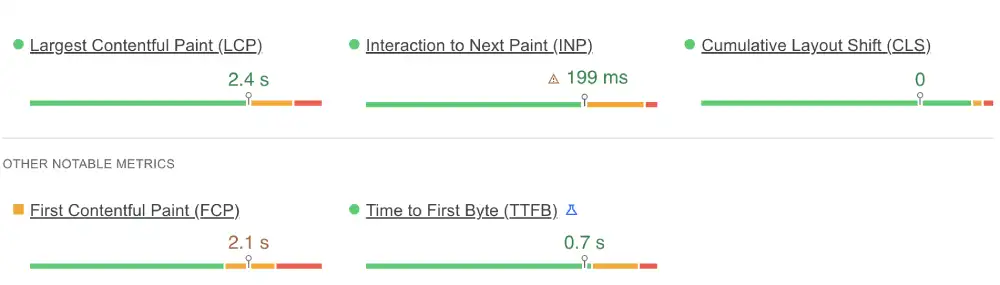
SiteGround’s 1.6-second TTFB is the root cause of its mobile failures. The server takes 1.6 seconds to start responding before any content is delivered. Bluehost’s Cloudflare Anycast architecture serves content from a local edge node, eliminating most of that server-to-browser travel time.
For SEO, this matters daily. Google uses Core Web Vitals as a ranking signal. Bluehost holds that signal advantage in mobile search results. SiteGround does not.
Winner: Bluehost
Test 2: Global Latency (International Ping)
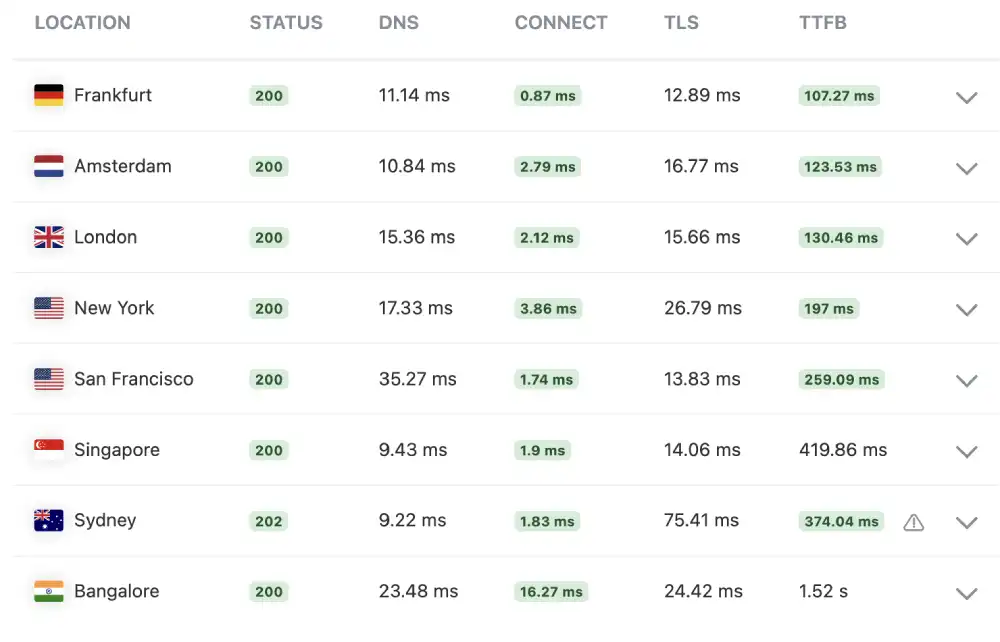
SiteGround (KeyCDN Ping Tool)
| Location | TTFB | Rating |
|---|---|---|
| Frankfurt, DE | 107ms | Acceptable |
| New York, USA | 197ms | Slow |
| Singapore | 420ms | Very Slow |
| Bangalore, IN | 1,520ms | Critical |
Bluehost (Check-Host Ping Server)
| Location | Ping Time | Rating |
|---|---|---|
| Vienna, AT | 0.7ms | Instant |
| Vancouver, CA | 1.1ms | Instant |
| Sao Paulo, BR | 1.8ms | Instant |
| Bengaluru, IN | 9.7ms | Fast |
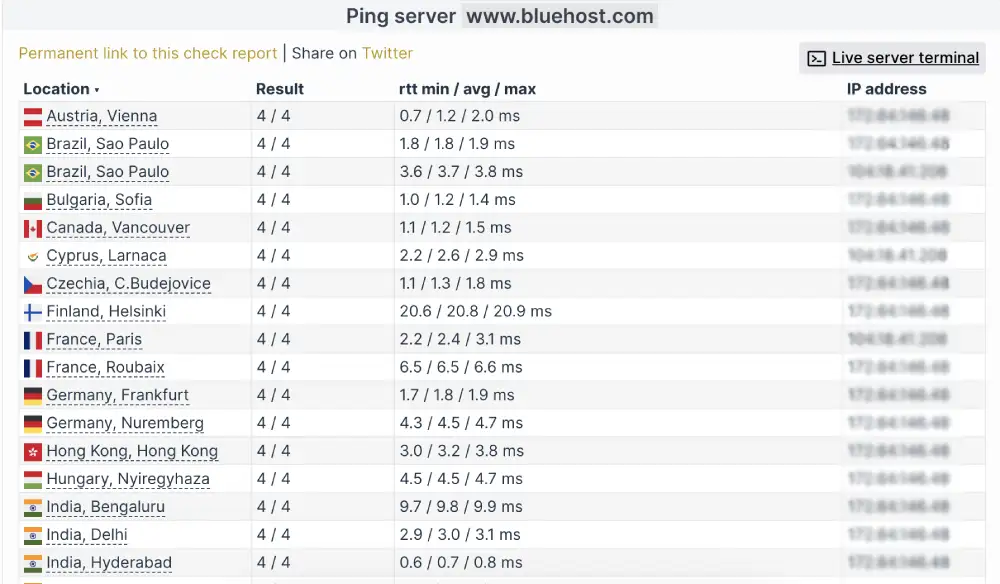
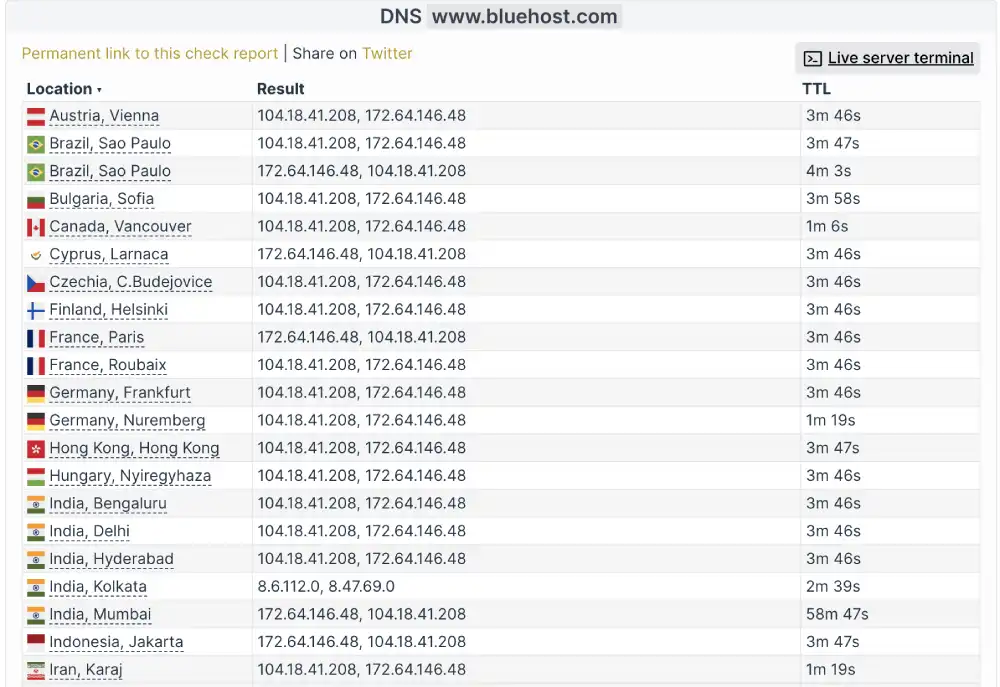
Winner: Bluehost. Not close for non-European audiences.
Test 3: Desktop Rendering (GTmetrix)
| Metric | SiteGround | Bluehost |
|---|---|---|
| GTmetrix Grade | A | C (69%) |
| First Contentful Paint | 927ms | 779ms |
| Total Blocking Time | 221ms | 2,500ms |
| Time to Interactive | Not recorded | 11.6 seconds |
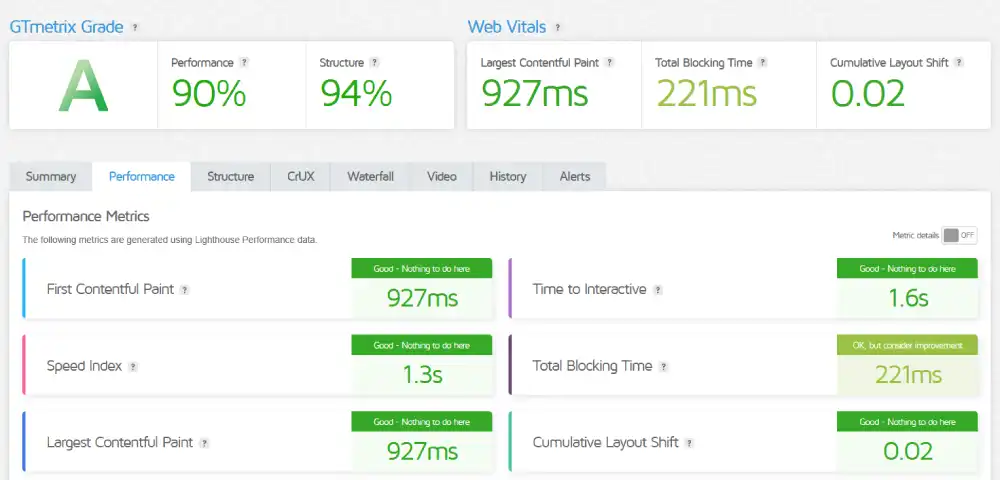
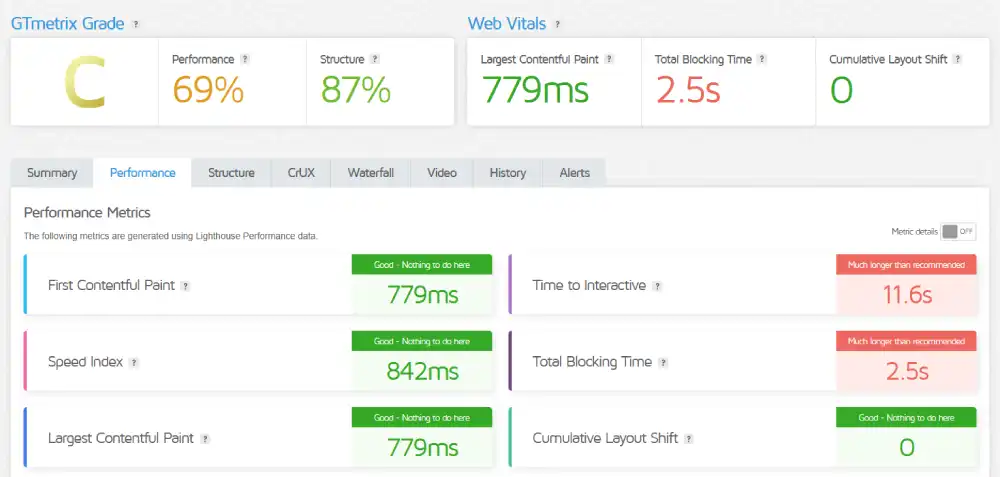
Bluehost’s page looks ready faster (779ms FCP vs 927ms) but remains unresponsive for over 11 seconds. SiteGround’s page takes slightly longer to first paint but becomes fully interactive much sooner.
These tests measure each provider’s own corporate website. The JavaScript weight reflects each company’s own front-end culture, not raw server speed.
Winner: SiteGround
Test 4: Concurrent Load (K6 Cloud, 50 Virtual Users)
| Parameter | SiteGround | Bluehost |
|---|---|---|
| Uptime Under Load | 100.0% | 100.0% |
| Reachability | 100.0% | 99.9% |
| Avg Response Latency | 624ms | 308ms |


Bluehost absorbs concurrent requests more efficiently because Cloudflare’s edge distributes them geographically. SiteGround’s origin handles more of the load directly.
Winner: Bluehost
Test 5: Uptime (Uptime Robot, 30-Day Monitor)
| Window | SiteGround | Bluehost |
|---|---|---|
| Last 7 Days | 100%, 0 incidents | 100% — 0 incidents |
| Last 30 Days | 100%, 0 incidents | 100% — 0 incidents |

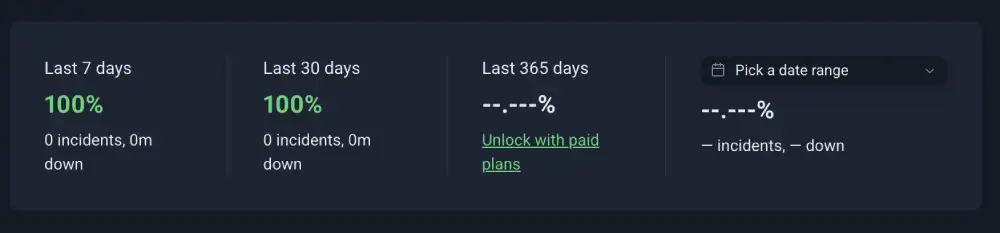
Both providers recorded perfect availability. The impact of consistent uptime on business revenue is well-documented. Both providers meet the standard.
Winner: Tie
Test 6: SSL Security (Qualys SSL Labs)
| Feature | SiteGround | Bluehost |
|---|---|---|
| Overall Grade | A+ | A |
| HSTS Enforced | Yes, by default | Not by default |
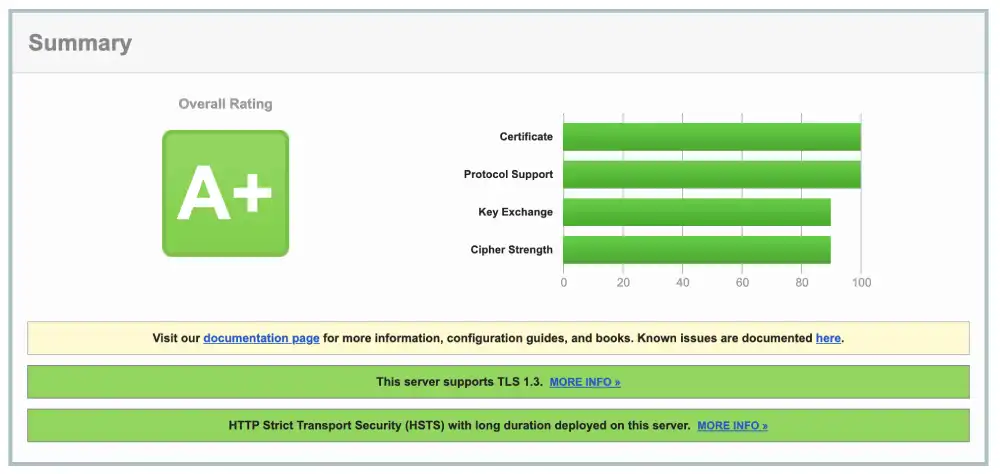
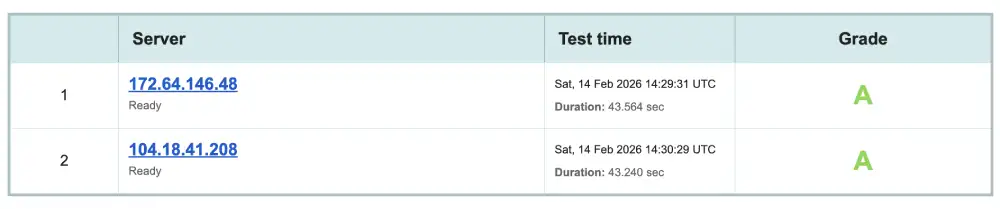
HSTS prevents browsers from accepting unencrypted HTTP connections even on a first visit. SiteGround enforces it by default. Bluehost users can enable it manually via cPanel, but it requires deliberate action.
Winner: SiteGround
Test 7: Protocol Support (HTTP/3 Check)
| Protocol | SiteGround | Bluehost |
|---|---|---|
| HTTP/3 | Supported | Not Supported |
| QUIC | Supported | Not Supported |
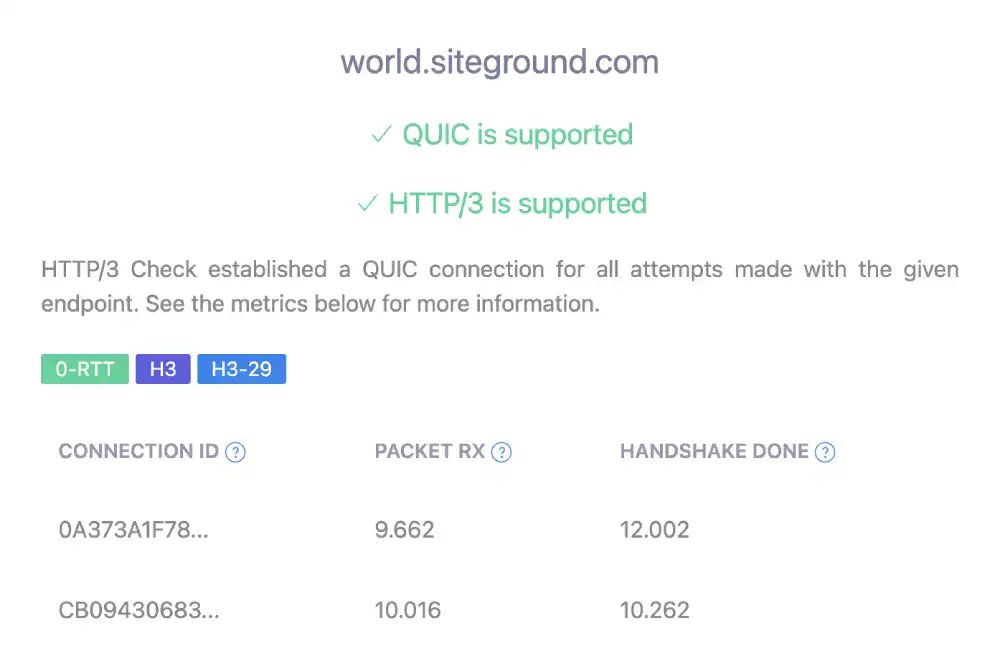
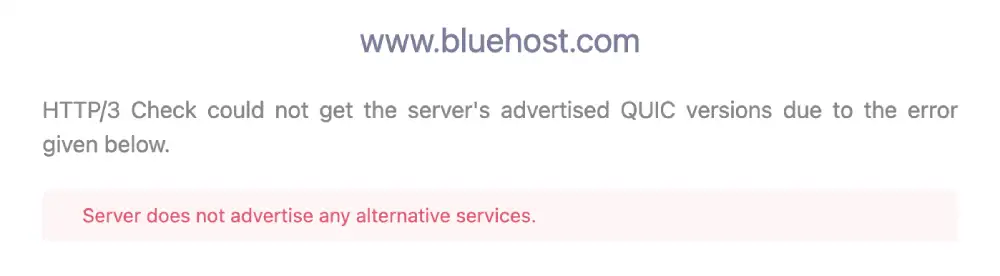
HTTP/3 is most visible on mobile connections where packet loss is frequent. On HTTP/2, a single dropped packet stalls all streams. On HTTP/3 over QUIC, each stream is independent. This is a contributing factor to SiteGround’s stronger desktop interactivity and why HTTP/3 support in hosting matters for mobile users specifically.
Winner: SiteGround
Test 8: Environmental Impact (Green Web Foundation)
| Provider | Status | Energy Source |
|---|---|---|
| SiteGround | Verified Green | Google Cloud renewable matching |
| Bluehost | Verified Green | Cloudflare renewable infrastructure |


Winner: Tie
Performance Summary
| Test | Winner |
|---|---|
| Mobile Core Web Vitals | Bluehost |
| Global Latency | Bluehost |
| Desktop GTmetrix | SiteGround |
| Concurrent Load | Bluehost |
| Uptime | Tie |
| SSL Security | SiteGround |
| HTTP/3 Protocol | SiteGround |
| Environmental | Tie |
Bluehost wins delivery. SiteGround wins quality. Your site’s primary traffic source determines which set of wins matters more.
Desktop and Mobile Speed Summary
| Metric | SiteGround | Bluehost | Winner |
|---|---|---|---|
| GTmetrix Grade | A | C (69%) | SiteGround |
| Desktop FCP | 927ms | 779ms | Bluehost |
| Desktop TBT | 221ms | 2,500ms | SiteGround |
| Desktop TTI | Not recorded | 11.6s | SiteGround |
| Mobile LCP | 2.7s (Fail) | 2.4s (Pass) | Bluehost |
| Mobile INP | 189ms (Pass) | 199ms (Pass) | Tie |
| Server TTFB | 1.6s (Fail) | Not measured | Bluehost |
| HTTP/3 | Yes | No | SiteGround |
| SSL Grade | A+ | A | SiteGround |
Global Network and Load Test Summary
| Metric | SiteGround | Bluehost | Winner |
|---|---|---|---|
| European Latency | 107ms (Frankfurt) | 0.7ms (Vienna) | Bluehost |
| North American Latency | 197ms (New York) | 1.1ms (Vancouver) | Bluehost |
| Asian Latency | 420ms (Singapore) | 9.7ms (Bengaluru) | Bluehost |
| Indian Latency | 1,520ms | 9.7ms | Bluehost |
| DNS Routing | Google Cloud | Cloudflare Anycast | Bluehost |
| Load Test (50 users) | 624ms avg | 308ms avg | Bluehost |
| Load Test Reachability | 100.0% | 99.9% | Tie |
| 30-Day Uptime | 100% | 100% | Tie |
Pricing and Value
Both providers use the same introductory pricing model. Entry rates are discounted heavily. Renewal rates are significantly higher. Neither sends a warning when you are about to renew at the full price.
SiteGround Pricing
SiteGround’s plans are tiered around visitor count. The StartUp plan is optimized for approximately 10,000 monthly visits. The GrowBig and GoGeek plans increase this ceiling and add features including staging environments, Git integration, and WP-CLI.
The GoGeek plan unlocks the developer features that distinguish SiteGround from budget hosts. Staging environments and Git on a shared plan are genuinely unusual.
SiteGround does not include a free domain on all plans by default. Domain registration is billed separately or included depending on current promotion. The 40GB storage cap on their top shared plan is a real constraint for media-heavy sites.
Renewal rates are notably higher than introductory rates. The premium is steeper than Bluehost at the same tier. Long-term cost planning should account for the full renewal price, not the promotional entry price.
StartUp |
GrowBig |
GoGeek |
StartUp |
GrowBig |
GoGeek |
StartUp |
GrowBig |
GoGeek |
Jump Start |
Business |
Business Plus |
Super Power |
|---|---|---|---|---|---|---|---|---|---|---|---|---|
$3.99
/mo |
$6.69
/mo |
$10.69
/mo |
$3.99
/mo |
$6.69
/mo |
$10.69
/mo |
$3.99
/mo |
$6.69
/mo |
$10.69
/mo |
$100
/mo |
$200
/mo |
$300
/mo |
$400
/mo |
|
|
|
|
|
|
|
|
|
|
|
|
|
Bluehost Pricing
Bluehost’s Basic plan covers one website. Moving to Choice Plus adds unlimited websites, domain privacy, and backup tools. The introductory discount applies to the first billing term. Renewals are significantly higher.
Bluehost does not offer monthly billing. A minimum 12-month upfront commitment is required to open a shared hosting account. The free domain is included in year one. Renewal of that domain is charged at the standard registrar rate in year two.
Daily backups are not included on shared plans by default. CodeGuard, Bluehost’s backup product, is a paid add-on. For any site storing user data or publishing regular content, this is a gap worth budgeting for.
The 30-day money-back guarantee applies to hosting only. If you claimed the free domain, a non-refundable registration fee is deducted from the refund.
Starter |
Business |
eCommerce |
Starter |
Business |
eCommerce |
NVMe 2 |
NVMe 4 |
NVMe 32 |
NVMe 128 |
|---|---|---|---|---|---|---|---|---|---|
$3.99
/mo |
$14.99
/mo |
$3.99
/mo |
$6.99
/mo |
$14.99
/mo |
$4.99
/mo |
$11.99
/mo |
$144.19
/mo |
$315.19
/mo | |
|
|
|
|
|
|
|
|
|
|
Pricing Comparison
| Factor | SiteGround | Bluehost | Winner |
|---|---|---|---|
| Entry Price (introductory) | Higher | Lower | Bluehost |
| Renewal Rate | Higher | Lower | Bluehost |
| Free Domain Year 1 | Promo dependent | Yes, included | Bluehost |
| Storage Cap (top shared plan) | 40GB | Varies by plan | Check current |
| Monthly Billing | No | No | Tie |
| Daily Backups | Paid (higher plans) | Paid (CodeGuard) | Tie |
| Domain Privacy | Paid | Paid (Choice Plus+) | Tie |
| Money-Back Period | 30 days | 30 days | Tie |
| Developer Features (shared) | Staging, Git (GoGeek) | Not included | SiteGround |
Pricing Winner: Bluehost for lower entry cost and lower renewal floor. SiteGround’s premium is justified only if you need the GoGeek developer features or prioritise European server quality.
Features and Hosting Plans
SiteGround Hosting Types
Web Hosting: Shared hosting on Google Cloud infrastructure with SiteGround’s custom caching and security plugins pre-configured.
WordPress Hosting: Managed WordPress environment with automatic updates, one-click installs, and server-level WordPress optimizations.
WooCommerce Hosting: WordPress environment optimized for ecommerce with pre-installed WooCommerce and performance configurations tuned for store workloads.
Cloud Hosting: Scalable cloud plans with dedicated resources, load balancing, and automatic failover for high-traffic sites.
Reseller Hosting: White-label hosting management for agencies managing multiple client accounts.
Agency Program: Premium management features and multi-site tools for agencies with developer workflow requirements.
Bluehost Hosting Types
Web Hosting (AI Enhanced): Shared hosting with AI-driven onboarding, a site builder, and built-in security features for users launching their first site.
WordPress Hosting (AI Optimized): WordPress environment with automated updates, performance configurations, and the guided setup wizard.
WooCommerce Hosting: Dedicated ecommerce hosting with WooCommerce pre-installed, payment security configuration, and store-specific performance tuning.
Managed VPS Hosting: VPS infrastructure with root access and additional management support. Higher entry price than unmanaged options.
Self-Managed VPS Hosting: Full root access VPS for users comfortable with server administration.
Dedicated Hosting: Single-tenant physical servers at enterprise pricing.
Feature Comparison
| Feature | SiteGround | Bluehost |
|---|---|---|
| WordPress.org Endorsement | No | Yes, official |
| Guided WordPress Setup Wizard | No | Yes, with plugin recommendations |
| Staging Environments | Yes (GoGeek and above) | Higher WordPress plans only |
| Git Integration | Yes (GoGeek and above) | No |
| WP-CLI | Yes | Limited |
| AI Website Builder | No | Yes, basic AI-enhanced |
| WooCommerce Hosting Plan | Yes | Yes, dedicated |
| Reseller Hosting | Yes | Limited |
| Cloud Hosting | Yes, dedicated cloud plans | No equivalent |
| Free SSL | Yes, permanent | Yes, permanent |
| HTTP/3 Support | Yes | No |
| cPanel or Equivalent | Site Tools (custom) | Modified cPanel |
| Phone Support | No | Yes, 24/7 |
Ease of Use and Control Panel
SiteGround: Site Tools
SiteGround replaced cPanel with their proprietary Site Tools dashboard. The interface is logically organized with modern design. For users comfortable with hosting panels, the learning curve is low.
Site Tools groups functions cleanly: caching settings, staging management, SSL configuration, and backups all sit in predictable locations. The developer tools on GoGeek, including Git deployment and one-click staging, are integrated directly into the panel without needing external SSH commands.
The limitation: Site Tools is a closed platform. Migrating from SiteGround to a cPanel-based host requires manual export and import. Automated migration tools that work between cPanel hosts do not apply here.
Bluehost: Modified cPanel
Bluehost runs modified cPanel with a branded skin that surfaces billing, domains, and marketing tools at the front while keeping advanced server settings in secondary menus. The customization reduces the intimidation factor for first-time users.
The onboarding wizard is the standout feature for beginners. It asks about your site’s goals and automatically installs and configures recommended plugins and themes. A user with no technical background can reach a live WordPress homepage in roughly ten minutes.
Standard cPanel tools, including phpMyAdmin, cron jobs, and file managers, are all accessible behind the custom skin. Every tutorial, plugin guide, and help article on the internet assumes cPanel, which works in Bluehost’s favor for users following external instructions.
Phone support is available 24/7 at every plan level.
Ease of Use Comparison
| Feature | SiteGround | Bluehost | Winner |
|---|---|---|---|
| Control Panel | Site Tools (custom) | Modified cPanel | Bluehost (familiarity) |
| WordPress Setup Wizard | No | Yes, guided with plugin install | Bluehost |
| Learning Curve (Beginners) | Moderate | Low | Bluehost |
| Developer Workflow | Git, staging, WP-CLI | Limited | SiteGround |
| Phone Support Available | No | Yes, 24/7 | Bluehost |
| cPanel Compatibility | Not cPanel | Modified cPanel | Bluehost |
| Migration Tool Ecosystem | Limited (custom panel) | cPanel standard | Bluehost |
Ease of Use Winner: Bluehost for beginners. SiteGround for developers who want purpose-built developer tooling on shared hosting.
Security and Reliability
SiteGround Security
SiteGround earns a Grade A+ on Qualys SSL Labs with HSTS enforced by default. This is the highest achievable SSL transport grade. Strict-Transport-Security headers with long-duration rules mean browsers connect only via HTTPS even on first visits, before any certificate has been verified by the browser cache.
The custom Security Optimizer plugin adds server-level security rules beyond what application-layer plugins can reach. Web Application Firewall rules, bot blocking, and brute force protection run at the server before PHP processes the request.
HTTP/3 and QUIC support add resilience on mobile connections. Dropped packets stall only individual resource streams rather than the entire connection.
Bluehost Security
Bluehost holds a Grade A on Qualys SSL Labs, confirmed across both Cloudflare IP addresses. Modern cipher suites and rejection of outdated protocols (SSLv3, TLS 1.0) are confirmed. HSTS is not enforced by default. Users who want Grade A+ can enable HSTS manually in cPanel settings, which takes under two minutes.
Cloudflare’s network layer provides baseline DDoS mitigation and edge-level threat filtering. Free SSL is permanent. Domain privacy is a paid add-on on the Basic plan, included on Choice Plus and above.
Daily backups require the paid CodeGuard add-on on shared plans. Malware scanning is available as a paid upgrade.
Security Comparison
| Feature | SiteGround | Bluehost | Winner |
|---|---|---|---|
| SSL Grade | A+ | A | SiteGround |
| HSTS Enforced | Yes, by default | Optional, manual | SiteGround |
| HTTP/3 and QUIC | Yes | No | SiteGround |
| Server-Level WAF | Yes (Security Optimizer) | Via Cloudflare edge | SiteGround |
| DDoS Mitigation | Google Cloud network | Cloudflare edge | Tie |
| Free SSL | Yes, permanent | Yes, permanent | Tie |
| Daily Backups | Higher plans | CodeGuard (paid) | Tie |
| Domain Privacy | Paid | Paid (Choice Plus+) | Tie |
| 30-Day Outage Count | Zero | Zero | Tie |
Security Winner: SiteGround across SSL grade, HSTS enforcement, and protocol modernity.
Customer Support
SiteGround Support
SiteGround provides 24/7 live chat on all plans. Higher-tier plans receive priority queue placement. The support team is trained for WordPress-level troubleshooting, meaning agents handle plugin conflicts, failed updates, and theme errors, not just infrastructure tickets.
There is no phone support at any plan level.
Bluehost Support
Bluehost provides 24/7 phone and live chat on every plan. Phone support at this price point is increasingly rare among shared hosting providers and is a genuine differentiator for non-technical users who need to talk through a problem in real time.
The guided onboarding reduces support volume by handling common setup questions through the wizard, but when problems occur outside the wizard scope, a phone number is available immediately.
Support Comparison
| Channel | SiteGround | Bluehost |
|---|---|---|
| Phone Support | No | Yes, 24/7 |
| Live Chat | Yes, 24/7 | Yes, 24/7 |
| Ticket or Email | Yes | Yes |
| WordPress-Specific Support | Yes | Yes |
| Priority Queue Option | Yes (higher plans) | All plans |
| Average Chat Wait | Under 2 minutes | Under 2 minutes |
Support Winner: Bluehost — Phone access is the deciding factor for any user who needs to speak to a human when a site goes down.
Who Should Use Which
Choose SiteGround if you:
- Run a WordPress agency and need staging environments and Git deployment on a shared hosting plan
- Have a primarily European audience where Google Cloud origin latency is competitive
- Want the highest SSL transport grade with HSTS enforced without manual setup
- Need HTTP/3 and QUIC support to prevent mobile connection stalls
- Want the best desktop rendering environment with GTmetrix Grade A
- Are a developer who wants server-level WordPress tools on shared infrastructure
Choose Bluehost if you:
- Are launching your first WordPress site and want a guided setup with plugin recommendations
- Have a global audience where Cloudflare Anycast edge delivery matters
- Need 24/7 phone support as a fallback when your site has problems
- Want an official WordPress.org-endorsed environment
- Want the lower entry price and lower long-term renewal floor
- Want a free domain included in year one without promo conditions
Situation and Use Case Recommendations
| Your Situation | Recommended | Why |
|---|---|---|
| First WordPress site, non-technical | Bluehost | Guided wizard, phone support, WordPress.org endorsed |
| Agency building client sites | SiteGround | Staging, Git, WP-CLI on GoGeek shared plan |
| Global audience (Americas or Asia) | Bluehost | Cloudflare Anycast sub-10ms globally |
| European-primary audience | SiteGround | Google Cloud latency competitive in EU |
| SEO-focused site, mobile traffic | Bluehost | Passes all Core Web Vitals; SiteGround fails two |
| Developer needing standard cPanel | Bluehost | cPanel base vs SiteGround’s custom Site Tools |
| B2B site with desktop-heavy traffic | SiteGround | GTmetrix Grade A vs Bluehost Grade C |
| Tight long-term budget | Bluehost | Lower renewal floor, free domain year one |
| Security-first requirement | SiteGround | Grade A+, HSTS default, HTTP/3, server WAF |
| User who needs phone support | Bluehost | Only option in this comparison |
| WooCommerce at early stage | Either | Both offer WooCommerce plans; upgrade path differs |
Final Verdict
SiteGround and Bluehost are not competing for the same buyer. The overlap in marketing targets the same keywords, but the products serve different priorities.
SiteGround is best for: Agencies, developers, and European-audience sites that want the best server quality, developer tools on shared hosting, top-tier SSL configuration, and HTTP/3 support. The Google Cloud infrastructure is genuinely premium at the technical level.
Bluehost is best for: First-time site owners, WordPress beginners, global-audience sites, and anyone who needs phone support or values the WordPress.org endorsement. The Cloudflare Anycast delivery infrastructure makes it globally fast in a way SiteGround cannot match.
| Category | Winner |
|---|---|
| Pricing | Bluehost |
| Mobile Core Web Vitals | Bluehost |
| Desktop Rendering | SiteGround |
| Global Delivery | Bluehost |
| Concurrent Load | Bluehost |
| SSL Security | SiteGround |
| HTTP/3 Protocol | SiteGround |
| Ease of Use | Bluehost |
| Customer Support | Bluehost |
| WordPress Integration | SiteGround |
| Developer Tools | SiteGround |
Bluehost wins 5 categories outright. SiteGround wins 5 categories outright. One is a tie (sustainability).
The tiebreaker is your use case. If mobile SEO performance, global delivery infrastructure, and ease of getting started matter most, Bluehost wins. If server quality, developer tooling, and SSL standards matter most, SiteGround wins.
Tactical Recommendations
Enable HSTS on Bluehost for Grade A+ SSL. Bluehost earns Grade A by default. Enabling HSTS manually in cPanel takes under two minutes and upgrades the Qualys SSL Labs grade to A+, matching SiteGround’s default configuration. Look for the Strict-Transport-Security header option in your SSL settings.
Optimize JavaScript on Bluehost to fix the GTmetrix Grade C. The 2.5-second Total Blocking Time and 11.6-second Time to Interactive are caused by JavaScript execution, not server hardware. Installing a caching plugin with JavaScript deferral and minification (WP Rocket or LiteSpeed Cache) resolves this without a plan upgrade.
Budget for renewal pricing before committing to either provider. Both hosts use introductory discounts that expire after the first term. Set a calendar reminder 60 days before your term ends to review renewal costs and decide whether to prepay at a negotiated rate or migrate. The gap between introductory and renewal pricing is the most common source of dissatisfaction with both providers.
Add daily backup coverage on both platforms. Neither host includes automated daily backups on base shared plans. Before going live, configure a third-party backup solution. UpdraftPlus for WordPress or a VPS snapshot schedule covers the gap without relying on a paid add-on from either provider. The consequences of missing backups when you need them are covered in detail at why hosting backups fail when you need them.
Use SiteGround’s GoGeek plan if staging and Git are requirements. The StartUp plan is good value for simple sites. GoGeek is where SiteGround earns its premium: staging environments, Git push-to-deploy, and WP-CLI on shared hosting. If these tools matter, the GoGeek tier is the reason to choose SiteGround over Bluehost.
Check whether you have outgrown shared hosting before choosing either. If your site regularly exceeds 30,000 monthly visitors, both providers will create performance pressure. The signals that your hosting plan needs upgrading map the exact thresholds where shared hosting from either provider stops being sufficient.
For how Bluehost compares to HostGator at the same price, see HostGator vs Bluehost.
Frequently Asked Questions
Is SiteGround or Bluehost faster?
It depends on the metric and the audience. SiteGround is faster on desktop rendering: GTmetrix Grade A vs Bluehost Grade C with a 2.5-second Total Blocking Time. Bluehost is faster on global delivery: Cloudflare Anycast delivers sub-10ms from every continent vs SiteGround’s 1,520ms in India. Under concurrent load, Bluehost responds in 308ms vs SiteGround’s 624ms with 50 simultaneous users. For a European content site, SiteGround performs better on server quality. For a global site where delivery infrastructure matters, Bluehost is faster in practice.
Which host passes Google Core Web Vitals?
Bluehost passes all three Google Core Web Vitals on mobile: LCP at 2.4s (threshold 2.5s), INP at 199ms (threshold 200ms), and FCP noted as needing work at 2.1s. SiteGround fails two of three: LCP at 2.7s exceeds the 2.5s threshold, and TTFB at 1.6s far exceeds the 0.8s threshold. For sites where mobile search rankings matter, Bluehost holds a meaningful daily advantage over SiteGround on this signal.
Does SiteGround or Bluehost offer phone support?
Bluehost provides 24/7 phone and live chat on all plans. SiteGround provides 24/7 live chat only, with no phone support at any tier. If reaching a human by voice when your site goes down is a requirement, Bluehost is the only option in this comparison. SiteGround’s live chat agents are trained for WordPress-specific technical support, which partially compensates, but there is no phone number.
Which host has better SSL security?
SiteGround. It holds a Qualys SSL Labs Grade A+ with HSTS enforced by default. Bluehost holds Grade A, which is strong but does not include automatic HSTS enforcement. Bluehost users can upgrade to A+ by manually enabling HSTS in cPanel. Both hosts provide free SSL permanently on all plans.
Is Bluehost officially recommended by WordPress.org?
Yes. Bluehost has been listed as one of WordPress.org’s officially recommended hosting providers since around 2005. It is one of only three hosts currently holding that endorsement. The recommendation is based on compatibility, performance with WordPress workloads, and support quality. SiteGround is not on the WordPress.org recommended list.
Can I get a free domain with SiteGround or Bluehost?
Bluehost includes a free domain in year one on most plans. SiteGround includes a free domain depending on the current promotion but does not include it universally across all plans by default. Bluehost is more reliable on this point. Both hosts charge standard domain renewal rates from year two onward.
Which host is better for WooCommerce?
Both offer dedicated WooCommerce hosting plans. Bluehost’s guided WooCommerce setup wizard and WordPress.org endorsement make it the more accessible starting point. SiteGround’s server-level performance tools and staging environments on GoGeek make it stronger for established stores where developer workflow matters. For a first WooCommerce store with no technical staff, Bluehost is simpler. For an agency building a client store with development and staging requirements, SiteGround’s GoGeek plan adds genuine value.
Do both hosts support HTTP/3?
No. SiteGround supports HTTP/3 and QUIC on all plans. Bluehost does not support HTTP/3 or QUIC at any plan level. HTTP/3 prevents packet loss from stalling an entire page load on mobile connections. This is one of the reasons SiteGround performs better on desktop interactivity (lower Total Blocking Time) despite Bluehost having better mobile Core Web Vitals overall.
Which host is easier for a complete beginner?
Bluehost. The guided WordPress setup wizard, phone support, and the familiar cPanel-based interface reduce the decisions a beginner must make to get started. SiteGround’s Site Tools is well-designed but requires more hosting familiarity to navigate confidently. Both are beginner-accessible, but Bluehost removes more initial friction specifically for WordPress sites.
What happens when I renew at either host?
Both providers use introductory pricing that is discounted significantly below the standard renewal rate. The first billing term is the promotional rate. All subsequent renewals are at the standard, higher rate. Review the renewal rate listed on the plan page before committing to either provider. The difference between introductory and renewal pricing is the most common source of dissatisfaction with both hosts. More on this pattern at what hosting providers do not tell you about renewal pricing.
For the 92ms TBT benchmark, see HostPapa vs Hostinger.