ClickFunnels built a $100 million business by convincing entrepreneurs to pay $97 per month for a drag-and-drop page builder.
WordPress can build the exact same funnel for under $30 per month total.
The question is not which one works. Both work. The question is what you give up at each price point, whether ClickFunnels’ conversion-first architecture is worth seven times the cost, and whether the word “funnel” even belongs in your business model before you spend a dollar on either platform.
This comparison is not about ecommerce stores or blog platforms. That is a different decision. This is for coaches, course creators, consultants, digital product sellers, and entrepreneurs running paid traffic to landing pages. If your business grows by converting visitors into leads and leads into buyers through a defined sequence of pages, this guide is written for you.
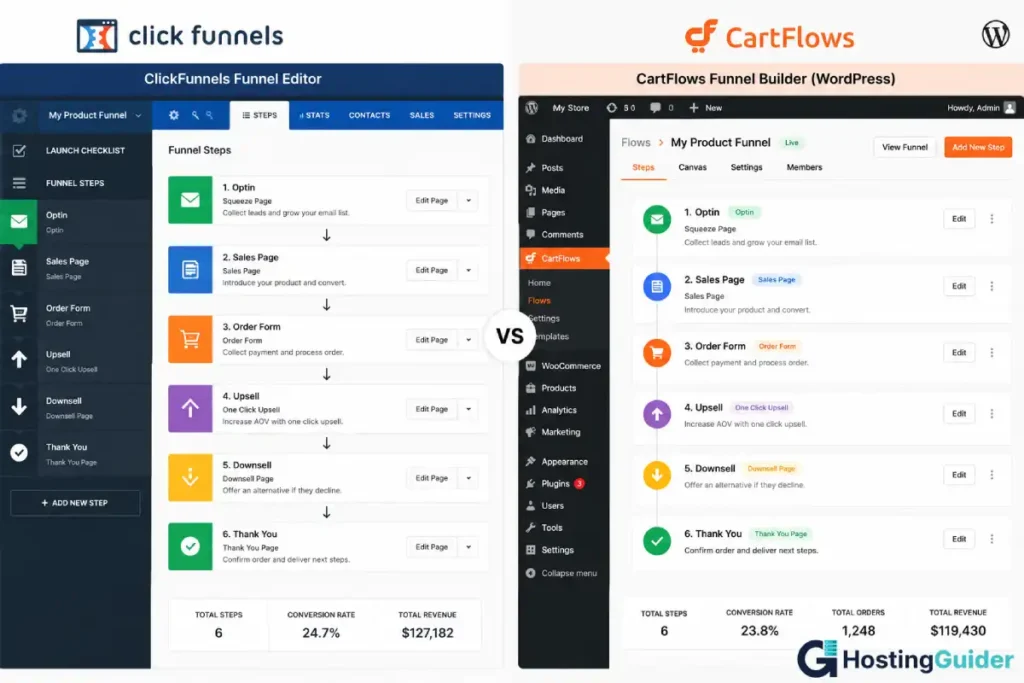
Table of Contents
What ClickFunnels Actually Is (and What It Is Not)?
Before comparing platforms, understand what ClickFunnels is designed to do, because most comparisons skip this and then wonder why the results do not make sense.
ClickFunnels is not a website builder. It does not build websites. It builds conversion sequences.
A funnel on ClickFunnels looks like this: a visitor lands on a squeeze page, enters their email, is taken to a sales page, clicks buy, sees an order bump, is shown a one-click upsell, and lands on a thank-you page with a next-step offer. Every page in that sequence exists for one purpose: to move the visitor to the next action. There is no navigation menu. There are no blog posts. There is no about page. There is a path.
ClickFunnels is built by Russell Brunson, who popularised the concept of the value ladder in the marketing world. Every feature in the platform exists to support that philosophy: bring someone in at low cost, deliver value, offer more, offer more again.
What ClickFunnels is best for:
- Online courses and info products
- Coaching and consulting packages
- High-ticket service offers with application funnels
- Lead magnets and email list building
- Webinar registration and replay sequences
- Membership sites with upsell sequences
- Digital product launches with time-limited offers
What ClickFunnels is not for:
- Traditional business websites with multiple pages and navigation
- SEO-driven content strategies
- Ecommerce stores with large product catalogues
- Businesses where organic search drives the majority of growth
WordPress is a general-purpose platform. With the right plugins, it builds the same funnel sequences ClickFunnels builds. It also builds websites, blogs, ecommerce stores, membership sites, course platforms, and anything else you need. The difference is that WordPress requires assembly. ClickFunnels is pre-assembled for one job.
ClickFunnels vs WordPress: Quick Comparison
| Feature | ClickFunnels | WordPress + Plugins |
|---|---|---|
| Funnel builder | Built-in | CartFlows, OptimizePress, Thrive |
| Hosting | Included | Separate purchase |
| Email automation | Built-in | External tool (Mailchimp, ActiveCampaign) |
| A/B split testing | Built-in | Plugin required |
| Course builder | Built-in (2.0) | LearnDash, TutorLMS, LifterLMS |
| Membership sites | Built-in | MemberPress, Paid Memberships Pro |
| SEO capability | Very poor | Excellent |
| Page templates | Conversion-focused | Wide variety |
| Analytics | Built-in funnel analytics | Google Analytics + plugin |
| Pricing | $97 to $297/month | $20 to $50/month total |
| Transaction fees | None | None |
| Ecommerce depth | Basic | Full (WooCommerce) |
| Developer access | None | Full |
| Data ownership | Platform-controlled | Full |
| SEO blogging | Not possible | Native |
Who Each Platform Was Built For
The ClickFunnels vs WordPress decision starts here.
Understanding the target user makes the right choice obvious for most people.
ClickFunnels was built for the entrepreneur who hates tech and loves selling. Russell Brunson wrote DotCom Secrets to teach this person how to sell online. ClickFunnels was built to remove every technical barrier between that person and their first online sale. You do not need to know what hosting is. You do not install plugins. You drag elements onto a page, connect a payment processor, and send traffic. The platform assumes you are running paid ads and optimising for conversion per dollar of ad spend.
WordPress was built for everyone, and funnel plugins extended it for conversion-focused businesses. A WordPress user building funnels has made a different trade: they want the lower cost, the SEO capability, the design flexibility, and the ability to run a full business on one platform rather than stitching a website together on one tool and building funnels on another.
The practical question: are you running a funnel-only business with paid traffic, or are you running a full online business that includes funnels as one component?
If funnels are your entire model, ClickFunnels is simpler. If funnels are one part of a broader digital presence that includes SEO content, a main website, and an ecommerce component, WordPress handles all of it under one roof.
Ease of Use and Funnel Setup: ClickFunnels vs WordPress
ClickFunnels Setup
Create an account. Choose a funnel template. Customise pages in the drag-and-drop editor. Connect Stripe or PayPal. Add your email integration. Launch.
No hosting decisions. No plugin conflicts. No server to configure. A non-technical entrepreneur can have a working opt-in funnel live in three to four hours. The editor is visual and forgiving. Templates are pre-configured with the conversion elements in the right places: headline above the fold, benefit bullets before the call to action, trust signals near the buy button.
The learning curve is in the strategy, not the tool. ClickFunnels makes it easy to build a funnel. It does not teach you what to put in the funnel. That is the part most new users underestimate.
WordPress Funnel Setup
Install WordPress. Install WooCommerce (for selling). Install CartFlows or your chosen funnel builder. Choose a conversion-focused theme or page builder. Build your pages. Configure checkout flow and upsell sequences. Connect your email marketing tool.
More steps. More decisions. But the plugin ecosystem means every step can match or exceed ClickFunnels functionality.
The honest setup time for a non-technical person building their first WordPress funnel: one full day, not three to four hours. With a developer or technical confidence, the gap narrows. With a managed WordPress host that pre-configures the environment, the gap narrows further.
Ease of Use Comparison Table
| Task | ClickFunnels | WordPress + CartFlows |
|---|---|---|
| Initial setup | 3 to 4 hours | Half a day to full day |
| Building an opt-in funnel | Easy | Moderate |
| Adding an upsell step | Easy | Easy (CartFlows) |
| Connecting payment processor | Easy | Easy (WooCommerce) |
| Email integration | Easy (native or third-party) | Plugin + API connection |
| A/B test setup | Easy (built-in) | Requires additional plugin |
| Updating funnel design | Easy | Easy (with page builder) |
ClickFunnels vs WordPress setup winner: ClickFunnels for initial speed to launch. WordPress for long-term flexibility.
Funnel Templates and Page Design: ClickFunnels vs WordPress
ClickFunnels Templates
ClickFunnels ships with hundreds of pre-built funnel templates tested across millions of dollars in ad spend. The templates follow proven conversion architecture: the two-step opt-in, the video sales letter page, the webinar registration sequence, the product launch funnel, the application funnel for high-ticket coaching.
These templates are not just design starting points. They are functional conversion hypotheses built from real campaign data. A new user picking the webinar funnel template gets a page layout that thousands of other marketers have already split-tested and refined. The starting point is high.
The design limit: ClickFunnels templates look like ClickFunnels templates. Marketers who have been in the space for more than a year can identify a ClickFunnels page immediately. For some audiences, the association with aggressive internet marketing is a trust negative. Premium brands, consulting firms, and service businesses that compete on relationship and credibility sometimes find the aesthetic works against them.
WordPress Funnel Templates
Elementor, Thrive Architect, OptimizePress, and CartFlows all ship with conversion-focused templates. The range is wider than ClickFunnels because the ecosystem is larger. Clean, minimal landing pages that look nothing like a “funnel” are achievable without custom development.
The design ceiling on WordPress is unlimited. A designer or developer can produce a conversion page on WordPress that no ClickFunnels template can match in brand quality or visual sophistication. The starting point is lower, but the ceiling is higher.
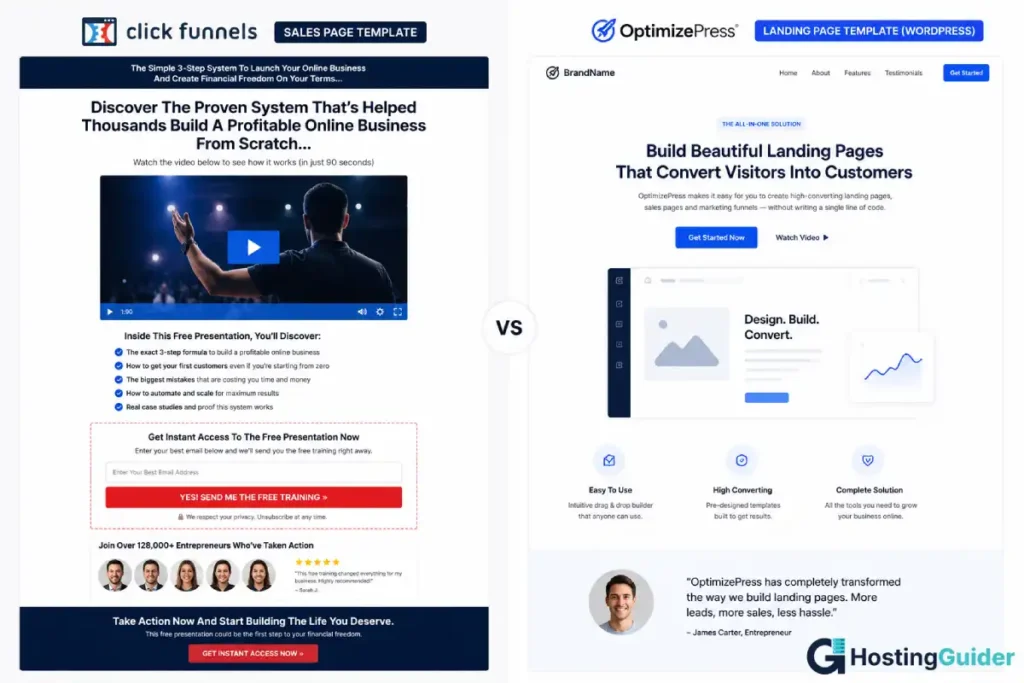
Winner: ClickFunnels for proven direct-response templates. WordPress for brand quality and design range.
A/B Testing and Conversion Optimization: ClickFunnels vs WordPress
This category is where ClickFunnels earns its price for serious media buyers.
ClickFunnels A/B Testing
ClickFunnels has native split testing built into every funnel step. Set up two variations of a headline, a button colour, a page layout, or an offer. Split traffic between them. View conversion rates per variation in the dashboard. Pick the winner. The entire process requires no third-party tools and no developer.
For a business running $5,000 to $10,000 per month in paid ad spend, the ability to split test every funnel element directly from the platform is a meaningful operational advantage. Every percentage point of conversion improvement multiplies directly across ad spend.
WordPress A/B Testing
WordPress does not have native split testing. It requires a dedicated plugin or external tool.
Google Optimize was the default free option until Google shut it down in 2023. Current options include Nelio A/B Testing, Thrive Optimize (part of Thrive Suite), and VWO. Nelio is the most capable free option. Thrive Optimize is the cleanest integration if you are already using Thrive Architect as your page builder.
The additional cost and setup friction is real. A/B testing on WordPress requires another plugin, another subscription, and another tool to learn. For a media buyer who tests constantly, this overhead matters.
Winner: ClickFunnels for media buyers who split test frequently. WordPress can match it but requires additional tools and cost.
Email Marketing and Automation: ClickFunnels vs WordPress
ClickFunnels Email (Follow-Up Funnels)
ClickFunnels 2.0 includes a built-in email marketing and automation tool. You build sequences, tag contacts based on behaviour, and trigger automations based on funnel actions. For a basic list-based business, the built-in tool is functional.
The limits surface quickly: the deliverability of ClickFunnels email is lower than dedicated email marketing platforms. Inbox placement rates from ClickFunnels-native email are measurably worse than Mailchimp, ActiveCampaign, or ConvertKit for most lists. Serious email marketers with large lists typically connect ClickFunnels to an external platform anyway, making the built-in tool redundant for anyone beyond beginner scale.
WordPress Email Integration
WordPress has no native email marketing tool. It connects to every major email platform through API integrations built into the funnel plugins or through dedicated connection plugins like Mailchimp for WordPress or FluentCRM.
ActiveCampaign is the most commonly paired tool for WordPress funnel builders who need serious automation. FluentCRM is a full CRM and email automation tool that runs inside WordPress itself, making it a genuine ClickFunnels email alternative at a fraction of the cost.
The trade-off: WordPress email setup requires more initial configuration. The result is better deliverability and more powerful automation than ClickFunnels’ native email for anyone building a serious list.
Winner: Depends on scale. ClickFunnels for simplicity at launch. WordPress with FluentCRM or ActiveCampaign for deliverability and automation depth.
Courses, Memberships, and Digital Products: ClickFunnels vs WordPress
ClickFunnels 2.0 Course Builder
ClickFunnels 2.0 added a native course and membership platform. You can build structured courses with lessons and modules, gate content behind payment or subscription, and deliver the experience inside the ClickFunnels environment.
For a business that sells one or two courses and wants everything under one ClickFunnels account, this is convenient. The course experience is functional. It is not the richest learning environment compared to dedicated platforms.
WordPress Course and Membership Options
The WordPress course plugin ecosystem is deeper than any other platform. LearnDash is the industry standard for serious course creators. TutorLMS is a strong free alternative. LifterLMS is optimised for coaching programmes and certification paths. MemberPress handles recurring membership subscriptions. Paid Memberships Pro handles community access models.
Each of these plugins has more features than ClickFunnels’ native course builder. LearnDash alone has conditional content release, gamification, assignments, certificates, group management, and deep WooCommerce integration for course bundles with physical products.
ClickFunnels vs WordPress course winner: WordPress. The dedicated course and membership plugin ecosystem is significantly deeper than ClickFunnels’ native course builder.
SEO: The Sharpest Gap in This Comparison
This section alone decides the platform choice for a large proportion of online businesses.
ClickFunnels pages cannot rank on Google. This is not an exaggeration. ClickFunnels pages are hosted on ClickFunnels subdomains or custom domains with no blog architecture, no internal linking structure, no indexable content hierarchy, and no SEO tooling. The platform was designed for paid traffic. Organic search was not a design consideration.
If you build your entire business on ClickFunnels and pause your ad spend, your traffic goes to zero. There is no organic floor. There is no content library that generates leads while you sleep. There is no domain authority accumulating over time.
WordPress SEO Capability
WordPress is the dominant platform for organic search because its architecture was built around content publishing. With Yoast SEO or RankMath, you control every technical SEO element: meta titles, descriptions, schema markup, canonical tags, XML sitemaps, redirect management, and keyword optimisation on every page and post.
A WordPress funnel business can run both a paid traffic funnel and a content SEO strategy simultaneously. Blog posts drive organic traffic. Those visitors enter funnel sequences. The paid acquisition cost drops because the organic baseline exists.
Over a two to three year horizon, a WordPress business with a content strategy has a compounding asset. A ClickFunnels-only business has a running cost with no organic accumulation.
This is the single most important difference in the ClickFunnels vs WordPress comparison for any business that plans to exist for more than two years.
ClickFunnels vs WordPress SEO winner: WordPress by a margin that compounds every month.
Pricing: What You Actually Pay in the ClickFunnels vs WordPress Comparison
ClickFunnels is one of the most expensive SaaS tools in the marketing space relative to what it does. Understanding the total cost of both platforms changes the decision for many buyers.
ClickFunnels Pricing
| Plan | Monthly (monthly billing) | Monthly (annual billing) | Key Features |
|---|---|---|---|
| Basic | $147/month | $127/month | 1 website, 20 funnels, basic features |
| Pro | $197/month | $157/month | 3 websites, 100 funnels, A/B testing |
| Funnel Hacker | $297/month | $208/month | Unlimited funnels, priority support |
Key points:
- No transaction fees on any plan
- Hosting is included
- Email marketing included but with deliverability limitations
- Annual billing saves roughly 15 to 30% depending on plan
- Course builder and membership included on all plans in ClickFunnels 2.0
WordPress Funnel Stack Pricing
| Item | Annual Cost |
|---|---|
| WordPress software | Free |
| Managed WordPress hosting | $200 to $600/year |
| CartFlows Pro (funnel builder) | $299/year |
| Elementor Pro or Thrive Suite (page builder) | $59 to $299/year |
| FluentCRM (email automation) | $129/year |
| LearnDash (if selling courses) | $199/year |
| A/B testing plugin (optional) | $0 to $179/year |
Total annual cost: approximately $890 to $1,700/year depending on tools chosen. Monthly equivalent: $74 to $142/month.
ClickFunnels Basic: $147/month ($1,764/year).
At the entry level, a full WordPress funnel stack and ClickFunnels cost approximately the same annually. The WordPress stack does more: SEO capability, deeper course tools, better email deliverability, and WooCommerce for product sales. ClickFunnels is simpler to operate.
At the Pro and Funnel Hacker tiers ($197 to $297/month), ClickFunnels becomes significantly more expensive than an equivalent WordPress stack with no corresponding feature advantage for most businesses.
The only scenario in the ClickFunnels vs WordPress pricing comparison where ClickFunnels is clearly justified: a high-volume funnel business spending over $20,000/month on paid ads where the simplicity of the platform and the built-in A/B testing save more in time and conversion lift than the price premium costs.
Performance and Page Speed: ClickFunnels vs WordPress
Page speed affects conversion rates directly. A one-second delay in page load time reduces conversions by an average of 7%. For a funnel running paid traffic at $50 to $100 cost per lead, slow pages are expensive.
ClickFunnels Performance
ClickFunnels hosts all pages on its infrastructure. The performance is consistent but not outstanding. ClickFunnels pages are known among paid media buyers for being slower than well-optimised WordPress landing pages. The platform delivers adequate speed without requiring any configuration, but it does not give you the tools to improve beyond its defaults.
ClickFunnels uses a global CDN but the page weight from its editor-generated code is higher than a clean, purpose-built WordPress landing page. Heavy use of images, videos, and complex page elements on ClickFunnels pages can push load times above 3 seconds, which becomes a conversion problem at scale.
WordPress Funnel Performance
WordPress page speed on a funnel is fully in your control. A lightweight landing page built with Elementor or Thrive on managed WordPress hosting with a caching layer active loads in under 2 seconds. Our testing of top managed WordPress hosts shows TTFB values of 78ms to 107ms on managed platforms. With a CDN in front and image compression active, a WordPress landing page regularly outperforms a comparable ClickFunnels page on Core Web Vitals.
The caveat: this performance requires configuration. A bloated WordPress page with 20 plugins, no caching, and an unoptimised theme performs worse than ClickFunnels by a significant margin. Caching and server-level optimisation are the two levers that determine WordPress page speed. Without them, the default is slow.
Winner: WordPress with good hosting for performance ceiling. ClickFunnels for consistent speed without configuration.
If You Choose WordPress: The Plugin Stack You Need
A WordPress funnel business needs the right tools selected and configured before you launch your first campaign. The wrong plugin combinations create conflicts, slow page loads, and broken checkout flows.
Core funnel stack for WordPress:
CartFlows handles the funnel architecture: opt-in pages, order bumps, one-click upsells, and thank-you pages built on top of WooCommerce checkout. For most businesses starting on WordPress funnels, this is the closest functional equivalent to ClickFunnels at a fraction of the cost.
For hosting, the platform underneath your funnel determines the page speed and uptime your paid traffic lands on. Our comparison of Cloudways vs Liquid Web covers the two most relevant options for funnel businesses at different scales. Liquid Web includes auto-scaling PHP workers that handle traffic spikes from campaign launches without dropping connections. Cloudways offers managed cloud from $11 per month with five cloud provider options.
For premium managed WordPress that handles security, backups, and performance automatically, our Kinsta vs WP Engine comparison covers the two dominant platforms used by agencies and serious funnel businesses. Both include staging environments for testing funnel changes before pushing live.
For businesses just getting started, our SiteGround vs Cloudways comparison covers the most common entry-level managed WordPress choice. SiteGround handles everything automatically with Grade A performance out of the box.
Who Should Choose ClickFunnels
Choose ClickFunnels if:
- Your entire business model is funnel-based with no organic or SEO component
- You run significant paid ad spend (over $5,000/month) and value built-in A/B testing without additional tools
- You are launching your first digital product and want the fastest possible path from zero to first sale
- You have no technical knowledge and no budget for a developer or managed hosting setup
- You sell high-ticket coaching or consulting through application funnels where the template library matches your workflow
- You want one platform subscription that handles hosting, funnel building, email, and course delivery without assembling a stack
Who Should Choose WordPress
Choose WordPress if:
- Organic search is any part of your growth strategy now or within the next two years
- You run a full digital business that needs both a main website and funnel pages
- You sell courses and need a richer learning experience than ClickFunnels’ native builder provides
- You want full ownership of your audience data, email list, and customer records
- Your funnel business will grow into ecommerce and you need WooCommerce integration
- You want the flexibility to switch hosting providers, funnel tools, or email platforms without rebuilding from scratch
- Your brand requires design quality beyond what ClickFunnels templates can deliver
The One Question That Decides It
Answer this honestly: will you ever want Google to find your business without you paying for the click?
If yes, WordPress. Full stop. ClickFunnels cannot be fixed with a plugin or a workaround to solve the SEO problem. It was not designed for organic traffic and it will not deliver it.
If your entire acquisition model is paid traffic and you never plan to build a content strategy, ClickFunnels simplifies your operation at a cost that may be justified by the time it saves and the conversion infrastructure it provides out of the box.
Most businesses that start on ClickFunnels and grow eventually move to WordPress. The ClickFunnels vs WordPress migration is painful. Building on WordPress from the start is easier. The migration is painful. Building on WordPress from the start is easier than migrating away from ClickFunnels after three years of funnel history, email lists, and course content.
Final Verdict
The ClickFunnels vs WordPress verdict: ClickFunnels excels at one thing: getting a non-technical entrepreneur from zero to a working conversion funnel in the shortest possible time. For that specific use case, it is genuinely good. The price is high. The limitations are real. But for a first-time course creator or coach launching under time pressure, the tool works.
WordPress is the better long-term platform for almost every other scenario. The plugin ecosystem matches or exceeds ClickFunnels on funnel architecture, course delivery, membership management, and email automation. It does all of this at lower cost and with the SEO capability that ClickFunnels fundamentally cannot provide.
Choose ClickFunnels if: you are optimising for speed to first sale, you run paid-traffic-only campaigns, and you value a pre-assembled all-in-one tool over flexibility and cost.
Choose WordPress if: you are building a business asset, not just a funnel. SEO, content, email ownership, data portability, and cost at scale all point to WordPress.
Final Summary Table
| Category | Winner | Notes |
|---|---|---|
| Speed to launch | ClickFunnels | Hours vs half a day |
| Funnel templates | ClickFunnels | Proven direct-response layouts |
| Page design quality | WordPress | Unlimited with page builder |
| A/B testing | ClickFunnels | Native, no extra tools |
| Email marketing | WordPress | Better deliverability at scale |
| Course builder depth | WordPress | LearnDash vs native CF builder |
| SEO capability | WordPress | ClickFunnels has none |
| Pricing at launch | Comparable | Both around $100 to $150/month |
| Pricing at scale | WordPress | ClickFunnels $297/month at high tier |
| Performance ceiling | WordPress | With managed hosting and caching |
| Data ownership | WordPress | Full |
| Ease of use | ClickFunnels | Pre-assembled stack |
| Long-term value | WordPress | Compounding SEO asset |
Frequently Asked Questions
Can ClickFunnels replace a WordPress website?
No. ClickFunnels builds conversion funnels, not websites. It has no blog, no navigation structure, no SEO capability, and no ability to build the kind of multi-page web presence that a business website requires. If you need a homepage, an about page, a services page, a blog, and a contact form, you need a different platform. ClickFunnels handles the funnel sequence. You would still need a website elsewhere.
Is ClickFunnels worth the money?
At $97 to $147 per month (the current Basic plan), ClickFunnels is worth the money for businesses running paid traffic campaigns where the speed to launch and built-in A/B testing save measurable time and ad spend. For businesses with any organic component, the lack of SEO capability makes the cost very difficult to justify against a WordPress stack that costs less and does more.
ClickFunnels vs WordPress: Can WordPress Replace ClickFunnels?
Yes, functionally. CartFlows replicates the core ClickFunnels funnel architecture: opt-in pages, one-click upsells, order bumps, and thank-you sequences built on WooCommerce checkout. Elementor or Thrive Architect handles the visual page design. FluentCRM or ActiveCampaign handles email sequences. The assembled stack costs less than ClickFunnels Basic annually and adds SEO capability that ClickFunnels cannot provide.
ClickFunnels vs WordPress: Which Is Better for Selling Online Courses?
WordPress with LearnDash or TutorLMS. ClickFunnels 2.0 added a native course builder, but it lacks the depth of dedicated course plugins. LearnDash includes conditional drip content, gamification, quiz and assignment tools, certificates, group management, and WooCommerce integration for course bundles. ClickFunnels’ course builder covers the basics. LearnDash covers everything a serious course business needs.
Does ClickFunnels have good SEO?
No. ClickFunnels was designed for paid traffic. Pages built in ClickFunnels do not rank in Google search results. There is no blogging capability, no internal link structure, and no content hierarchy that search engines index. If SEO is part of your growth plan, ClickFunnels cannot support it.
ClickFunnels vs WordPress: What Is the Best ClickFunnels Alternative?
CartFlows is the closest direct alternative. It builds the same opt-in, upsell, and checkout sequence structure that ClickFunnels uses, running on top of WooCommerce. Paired with Elementor Pro for page design and FluentCRM for email automation, the combination covers every core ClickFunnels use case at a significantly lower monthly cost and with full SEO capability added.
Can I Use Both ClickFunnels and WordPress Together?
Yes, and many businesses do. A common setup uses WordPress for the main website, blog, and SEO content, and ClickFunnels for specific high-converting launch funnels or paid traffic campaigns where the template speed matters. The two platforms are not mutually exclusive. The cost of running both ($147/month for ClickFunnels plus $20 to $30/month for WordPress hosting) is the main reason businesses eventually consolidate onto WordPress with CartFlows.