Contabo vs Vultr: Cheap VPS – Which One Hides the Real Cost in Performance
Contabo advertises 4 vCPUs and 8GB RAM for under $5 a month. Vultr charges $6 for 1 vCPU and 1GB RAM. The performance data makes the gap harder to ignore. Contabo’s corporate site passes all three Google Core Web Vitals. Vultr’s fails three of four, recording the highest mobile TTFB in this entire review series at 2.3 seconds.
Vultr’s aggressive WAF filtering distorts some of those test results: the review explicitly notes that 67.7% load test reachability and 403 responses from seven of eight global locations are WAF behavior, not server failures. That context matters. But even adjusted for WAF interference, Vultr’s unblocked Frankfurt location returned a 1.28-second TTFB for a real 200 response. Contabo’s Frankfurt TTFB is 63ms.
Vultr’s genuine advantages are geographic reach and managed services. With 32 global locations across six continents, Vultr has data center options no other provider in this comparison series matches. Managed Kubernetes, managed databases, GPU instances, and the App Platform make it a more complete cloud ecosystem than Contabo’s infrastructure-only model.
The title’s question answers itself from both directions. Vultr hides the cost in performance on the corporate site tests. Contabo hides nothing: the price is just that low.
Quick Verdict
Contabo wins on every direct performance metric: mobile Core Web Vitals, global server TTFB, concurrent load handling, uptime, and real-user CrUX scores. It also wins on resources per dollar by a margin that has no equivalent in this comparison series.
Vultr wins on geographic coverage (32 locations), managed service depth (Kubernetes, databases), and the breadth of its cloud ecosystem. For workloads requiring a specific region in Southeast Asia, South America, Africa, or Japan, Vultr has infrastructure options that Contabo does not.
Category Winners
| Category | Winner | Why |
|---|---|---|
| Pricing (resources per dollar) | Contabo | 4 vCPU, 8 GB RAM, NVMe for ~$5 vs Vultr’s 1 vCPU, 1 GB RAM for $6 |
| Mobile Core Web Vitals | Contabo | Passes all 3: INP 196ms, LCP 1.9s, CLS 0. Vultr fails 3 of 4 |
| Mobile TTFB | Contabo | 2.3s recorded for Vultr (highest in series); Contabo passes |
| Global Server TTFB | Contabo | 63ms Frankfurt vs Vultr’s 1.28s (only unblocked location) |
| Load Test Reachability | Contabo | 100% vs Vultr’s 67.7% (WAF-affected) |
| Load Test Latency | Contabo | 152ms avg vs Vultr’s 326ms |
| Uptime | Contabo | 100% vs Vultr’s 1 confirmed incident (11 min 38 sec) |
| CrUX Real-user Score | Contabo | 89% vs Vultr’s 62% |
| SSL Grade | Tie | Both Grade A+ with HSTS and TLS 1.3 |
| HTTP/3 and 0-RTT | Tie | Both support HTTP/3, QUIC, and 0-RTT |
| Geographic Reach | Vultr | 32 locations across 6 continents vs Contabo’s fewer regions |
| Managed Services | Vultr | Managed K8s, databases, object storage; Contabo is unmanaged |
| GPU Compute | Tie | Both offer GPU instances for AI and rendering |
| Windows Server | Tie | Both support Windows Server natively |
| DDoS Protection | Contabo | Included on all plans; Vultr’s advanced protection costs extra |
| Flat Renewal Pricing | Contabo | Same price at renewal forever; Vultr hourly (both transparent) |
| Support Channels | Contabo | Ticket and phone (hardware); Vultr is ticket only |
| Environmental | Tie | Both verified green via Cloudflare |
Who Should Choose Which
| Choose Contabo if… | Choose Vultr if… |
|---|---|
| You need the maximum RAM and CPU per dollar in the entire cloud market | You need data centers in Southeast Asia, South America, Africa, or Japan specifically |
| You want flat pricing that stays the same at every renewal | You need managed Kubernetes clusters or managed databases (PostgreSQL, MySQL, Redis) |
| You want enterprise DDoS protection included at no extra cost | You are running GPU workloads for AI inference or ML training on cloud instances |
| You run resource-heavy workloads: Docker, AI models, gaming servers, large databases | You want the widest possible geographic distribution for a globally-facing application |
| Your primary audience is in Europe, the US, or Asia (3 continents covered under 85ms) | You prefer a cleaner, more polished cloud portal with a broader managed services ecosystem |
| You want unmanaged VPS with phone support for hardware issues | You need App Platform, Functions, or serverless compute on a developer cloud |
Contabo vs Vultr: Full Feature Comparison
| Feature | Contabo | Vultr |
|---|---|---|
| Founded | 2003, Munich, Germany | 2014, New Jersey, USA |
| Best For | Resource-heavy workloads, budget-first developers, agencies | Global reach, GPU compute, managed services |
| Rating | 4.5/5 (Trustpilot) | 4.3/5 (G2) |
| Entry Price | ~$5/month (4 vCPU, 8 GB RAM, NVMe) | ~$6/month (1 vCPU, 1 GB RAM, 25 GB SSD) |
| High Frequency NVMe | Yes | Yes (High Frequency tier) |
| Mobile LCP | 1.9s (Pass) | 3.8s (Fail) |
| Mobile INP | 196ms (Pass) | 188ms (Pass) |
| Mobile CLS | 0 (Pass) | 0.16 (Fail) |
| Mobile TTFB | Not recorded separately | 2.3s (Poor) |
| CrUX Score | 89% | 62% |
| Lab LCP | 527ms | 733ms |
| Lab TBT | 6,200ms | 2,440ms |
| Global TTFB Frankfurt | 63ms | 1.28s (only unblocked location) |
| Global TTFB Singapore | 64ms | 59ms (WAF 403 response) |
| Load Test Avg | 152ms | 326ms (WAF-affected) |
| Load Test Reachability | 100% | 67.7% (WAF-affected) |
| 30-Day Uptime | 100% | 1 incident (11 min 38 sec) |
| SSL Grade | A+ | A+ |
| HTTP/3 | Yes (QUIC + 0-RTT) | Yes (QUIC + 0-RTT) |
| Global Locations | Germany primary + selected global | 32 locations, 6 continents |
| Green Hosting | Verified (Cloudflare) | Verified (Cloudflare) |
| Free Domain | No | No |
| Free SSL | Yes (Let’s Encrypt via OS) | Yes |
| Control Panel | Choice (cPanel, Plesk, CyberPanel, Webmin, raw OS) | Customer Portal + 1-Click apps |
| cPanel Available | Yes (paid license) | Yes (1-Click) |
| Windows Server | Yes | Yes (2016, 2019, 2022) |
| Root Access | Yes | Yes |
| Managed Kubernetes | No | Yes |
| Managed Databases | No (Object Storage available) | Yes (MySQL, PostgreSQL, Redis, Kafka) |
| Object Storage (S3) | Yes | Yes |
| GPU Instances | Yes | Yes (NVIDIA, shared and dedicated) |
| Serverless Functions | No | Yes |
| DDoS Protection | Yes, included all plans | Basic included; advanced costs extra |
| Automated Backups | Not default (Object Storage add-on) | Available as add-on |
| Phone Support | Yes (hardware/network) | No |
| Ticket Support | Yes, 24/7 | Yes, 24/7 |
| Billing Model | Flat monthly (same at renewal) | Hourly billing, monthly cap |
| Free Trial | Credits available | ~$250 credits for 30 days |
How We Tested
We ran direct technical audits against each provider’s live corporate domain: www.contabo.com for Contabo and www.vultr.com for Vultr.
Important note on Vultr testing: Vultr operates an aggressive WAF and bot protection layer on www.vultr.com. Multiple testing tools received 403 Forbidden responses during testing. This is WAF behavior, not server downtime. Where Vultr’s results are affected by WAF interference, this is noted explicitly. The 67.7% load test reachability, and seven of eight blocked KeyCDN locations are WAF-related, not infrastructure failures. We have cross-referenced with Vultr’s own field data (CrUX) to provide a more accurate picture of real-user experience.
Tools: Google PageSpeed Insights for mobile Core Web Vitals, DebugBear for CrUX and lab performance combined, KeyCDN for TTFB, K6 Load Cloud for concurrent load, Uptime Robot for 30-day monitoring, Qualys SSL Labs for encryption grade, HTTP/3 Check for protocol support, The Green Web Foundation for sustainability.
For complete individual test data, see our Contabo review and Vultr review.
Performance: Eight Tests, Head to Head
Test 1: Mobile Core Web Vitals (Google PageSpeed Insights)
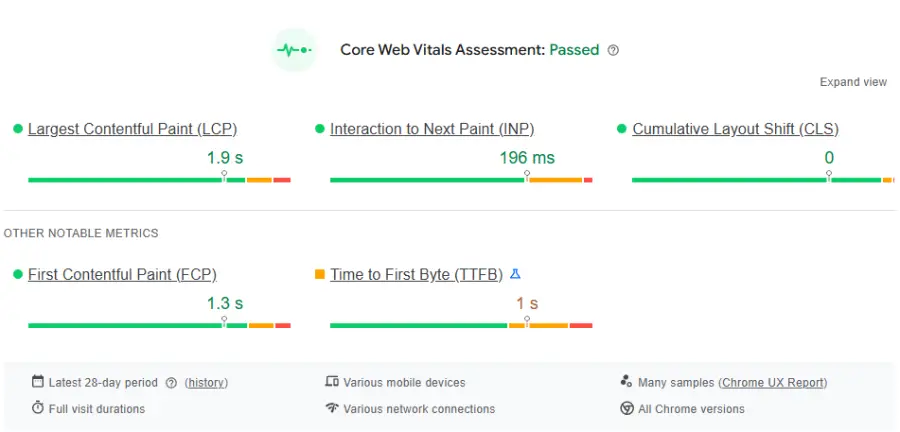
Contabo Mobile
| Metric | Result | Google Threshold | Status |
|---|---|---|---|
| LCP (Loading) | 1.9s | Under 2.5s | Pass |
| INP (Interaction) | 196ms | Under 200ms | Pass |
| CLS (Stability) | 0 | Under 0.1 | Pass |
Vultr Mobile
| Metric | Result | Google Threshold | Status |
|---|---|---|---|
| LCP (Loading) | 3.8s | Under 2.5s | Fail |
| INP (Interaction) | 188ms | Under 200ms | Pass |
| CLS (Stability) | 0.16 | Under 0.1 | Fail |
| FCP (First Paint) | 3.0s | Under 1.8s | Fail |
| TTFB (Server) | 2.3s | Under 0.8s | Poor |
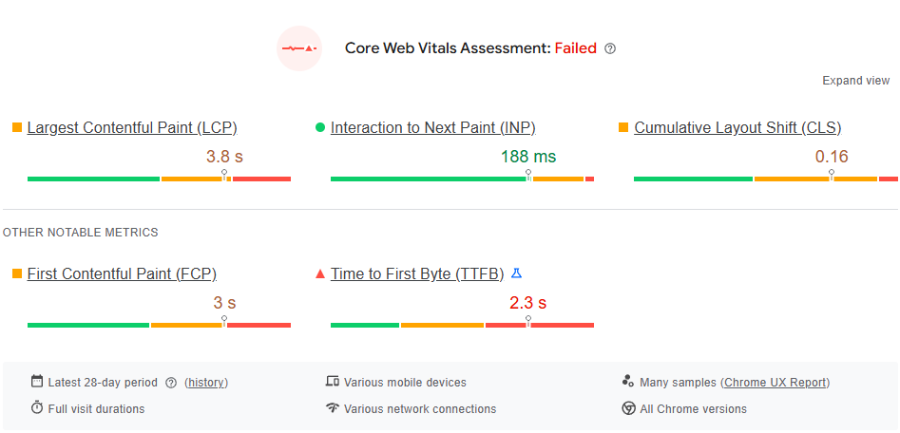
Contabo passes all three Core Web Vitals. Vultr passes one of five measured metrics.
The TTFB finding is significant. At 2.3 seconds, Vultr’s mobile server response time is the highest recorded across every provider reviewed in this series. This is field data from real Chrome users, not a controlled lab test. Real visitors on mobile networks waited over two seconds before the first byte of content began to arrive.
Vultr’s INP of 188ms passes, which means interactive elements respond quickly once the page has loaded. The problem is the time before reaching that point.
For mobile SEO, Google uses Core Web Vitals as a ranking signal. Contabo’s passing result maintains that signal. Vultr’s triple failure removes it. The practical impact of slow TTFB on real site performance extends far beyond the test number.
Winner: Contabo
Test 2: Global Server Latency
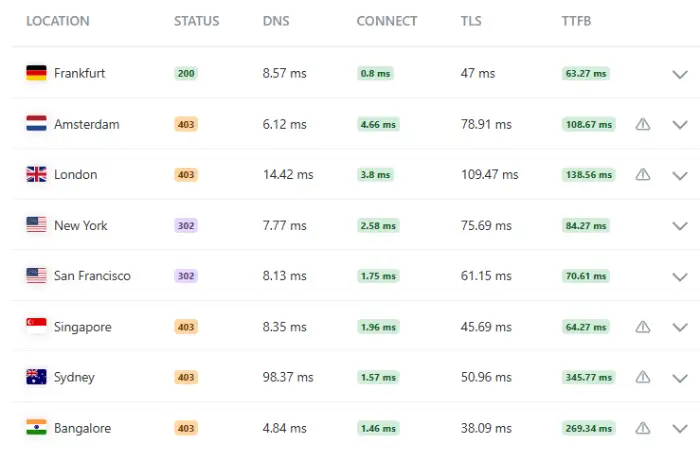
Contabo (KeyCDN TTFB)
| Location | TTFB | Rating |
|---|---|---|
| Frankfurt, Germany | 63.27ms | Blazing Fast |
| Singapore | 64.27ms | Blazing Fast |
| New York, USA | 84.27ms | Blazing Fast |
| London, UK | 138.56ms | Optimised |
| Sydney, Australia | 345.77ms | Physical Distance |
Vultr (KeyCDN TTFB — WAF affected)
| Location | Status | TTFB | Note |
|---|---|---|---|
| Frankfurt, DE | 200 OK | 1.28s | Only unblocked location |
| Amsterdam, NL | 403 | 74ms | WAF blocked (CDN edge speed) |
| London, UK | 403 | 71ms | WAF blocked |
| New York, USA | 403 | 84ms | WAF blocked |
| San Francisco | 403 | 56ms | WAF blocked |
| Singapore | 403 | 59ms | WAF blocked |
| Sydney | 403 | 55ms | WAF blocked |
| Bangalore | 403 | 34ms | WAF blocked |
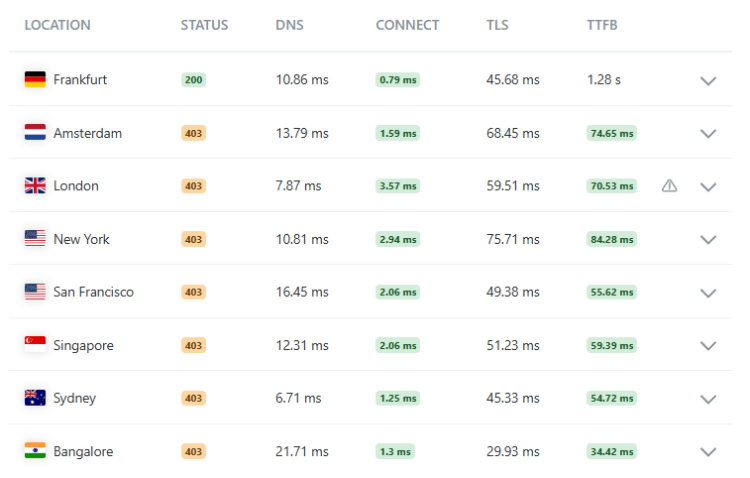
The Vultr latency test requires careful interpretation. The 403 response times (34ms to 84ms) show that Vultr’s CDN edge is genuinely fast worldwide — the network reaches users quickly. The WAF then blocks the automated probe before serving content.
The only location that received a full 200 response was Frankfurt, with a 1.28-second TTFB. This is the actual server response time for real content, and it is slow. The gap between the fast CDN edge (74ms) and the slow origin response (1,280ms) reveals the same architecture pattern seen in other providers: fast CDN delivery for cached content, slow origin response for dynamic or uncached requests.
Contabo’s 63ms in Frankfurt represents actual server TTFB for full content delivery. The nature of WAF filtering and its effect on performance measurements is important context when interpreting Vultr’s blocked results.
Winner: Contabo on verified full-content server TTFB.
Test 3: Desktop Performance (DebugBear)
| Metric | Contabo | Vultr |
|---|---|---|
| CrUX Score (real users) | 89% | 62% |
| Lab Score | 70% | 69% |
| Lab LCP | 527ms | 733ms |
| Full TTFB (lab) | 412ms | 302ms |
| Total Blocking Time | 6,200ms | 2,440ms |
| Cumulative Layout Shift | 0 (perfect) | 0 (perfect) |
| Page Weight | Not recorded | 590 KB |
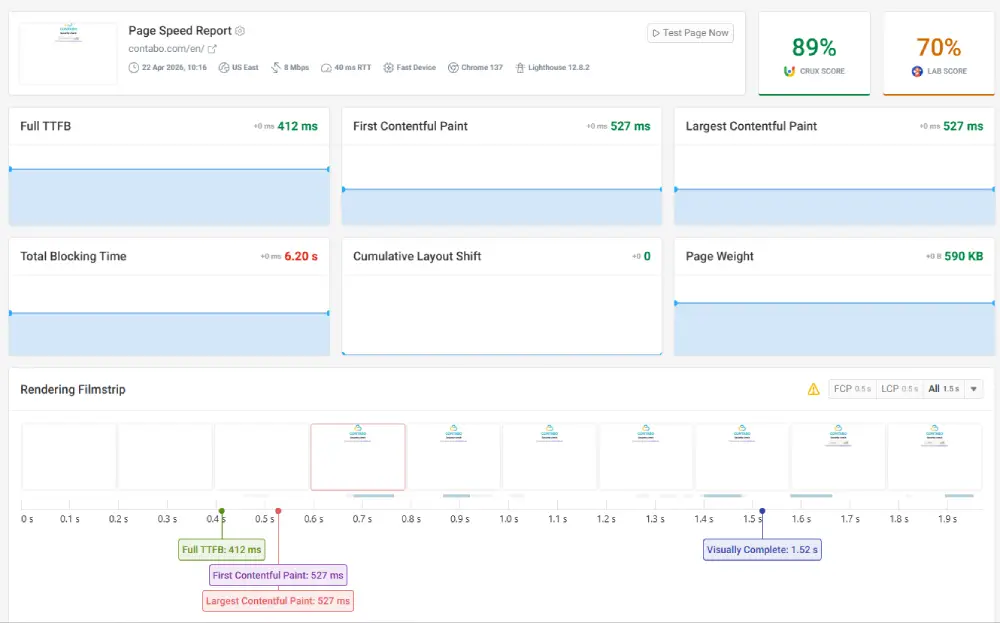
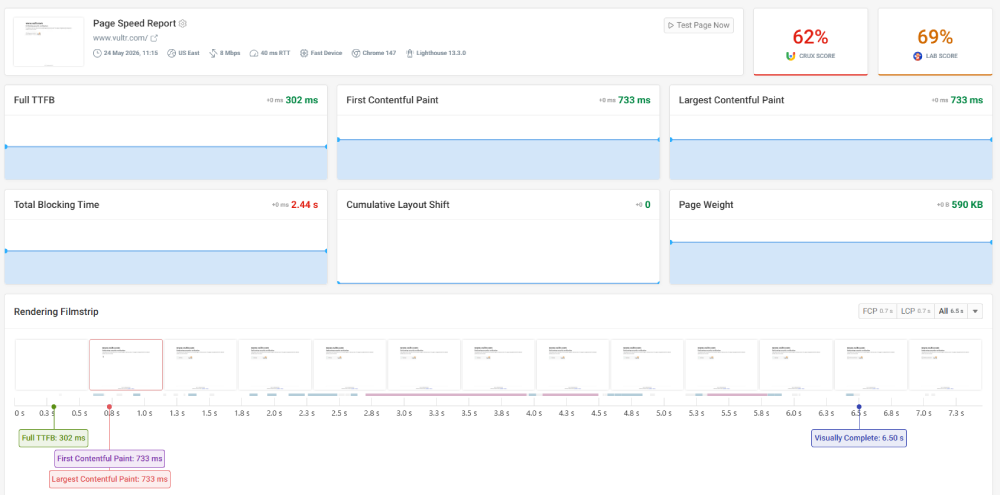
The CrUX comparison is the most honest metric in this test. CrUX data comes from real Chrome users over 28 days, not controlled lab conditions. Contabo’s 89% reflects genuine user experience. Vultr’s 62% reflects how real users actually experience the site across all device types, network speeds, and geographic distances.
Both providers have high TBT: Contabo’s 6,200ms TBT and Vultr’s 2,440ms TBT are both caused by heavy frontend JavaScript on their corporate marketing sites. Contabo’s lab LCP of 527ms is faster than Vultr’s 733ms. Vultr has a faster lab TTFB (302ms vs Contabo’s 412ms), but the field TTFB of 2.3 seconds tells the real-world story.
Winner: Contabo on CrUX and lab LCP. Vultr on lab TTFB and TBT.
Test 4: Concurrent Load (K6 Cloud, 50 Virtual Users)
| Parameter | Contabo | Vultr |
|---|---|---|
| Uptime Under Load | 100% | 100% |
| Reachability | 100% | 67.7% (WAF-affected) |
| Avg Response Latency | 152ms | 326ms |
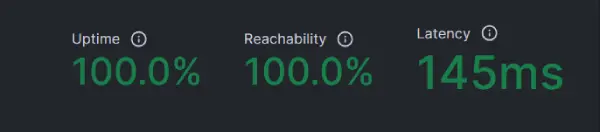
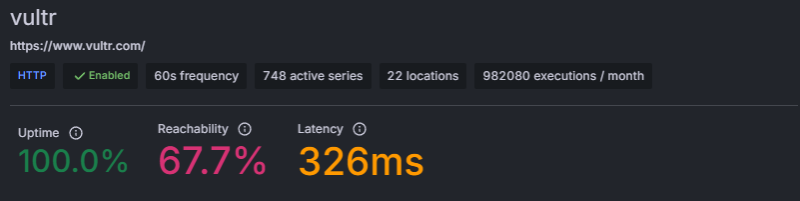
Contabo’s 100% reachability and 152ms average reflect clean concurrent handling. Vultr’s 67.7% reachability is WAF-driven — the review is explicit that the server was up and running throughout the test and that 32.3% of probes received 403 responses from the bot protection layer.
Even accepting the WAF context, Vultr’s 326ms average for the requests that did connect is slower than Contabo’s 152ms. And the confirmed uptime incident (11 minutes 38 seconds) in Vultr’s monitoring window is a real event that Contabo’s testing period did not produce.
Winner: Contabo on reachability (100% vs WAF-affected 67.7%) and latency.
Test 5: Uptime (Uptime Robot, 30-Day Monitor)
| Window | Contabo | Vultr |
|---|---|---|
| Last 24 Hours | 100%, 0 downtime | 1 incident, 11 min 38 sec down |
| Last 7 Days | 100%, 0 downtime | 1 incident (same event) |
| Last 30 Days | 100%, 0 downtime | 1 incident (same event) |

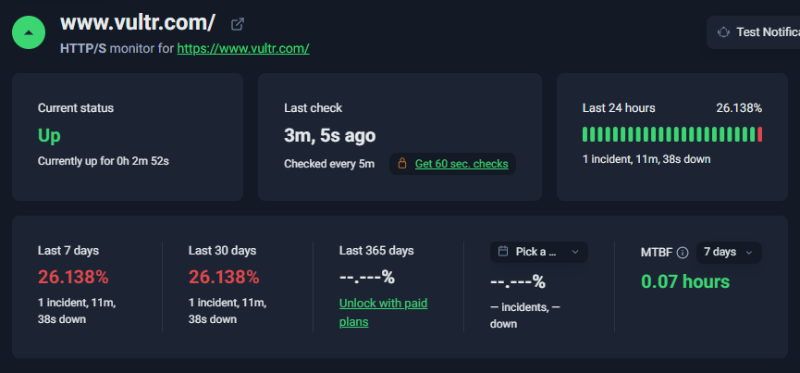
Vultr’s 11-minute 38-second incident is a real confirmed event within the monitoring window. Contabo recorded no incidents across the same period. The Vultr review notes that WAF behavior also compresses the MTBF figure by registering blocked probes as failure events, making the raw monitoring percentage less representative of true infrastructure reliability.
Winner: Contabo
Test 6: SSL Security (Qualys SSL Labs)
| Feature | Contabo | Vultr |
|---|---|---|
| Overall Grade | A+ | A+ |
| TLS Support | TLS 1.3 | TLS 1.3 |
| HSTS | Enforced | Enforced |
| Nodes Tested | 4 (IPv4 + IPv6) | 4 servers |
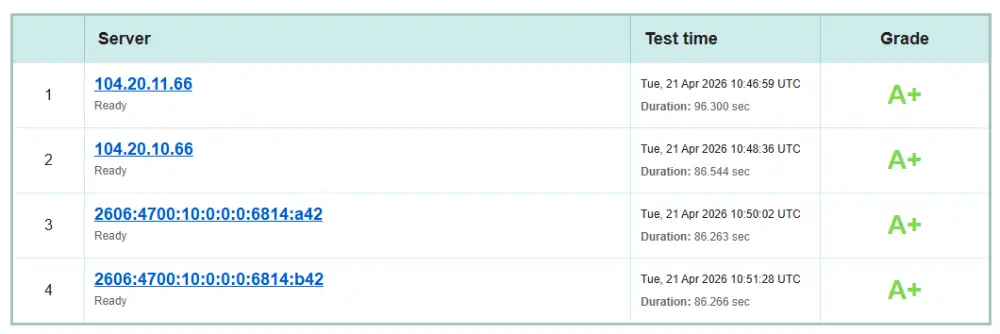
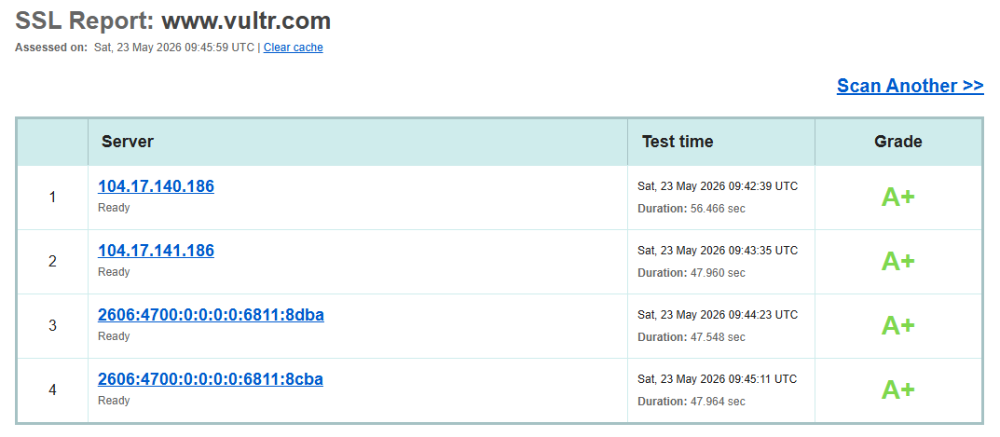
Both providers hold Grade A+ with HSTS enforced and TLS 1.3 supported. This is one of the few areas where the test data shows complete parity.
Winner: Tie
Test 7: Protocol Support (HTTP/3 Check)
| Protocol | Contabo | Vultr |
|---|---|---|
| HTTP/3 | Supported | Supported |
| QUIC | Supported | Supported |
| 0-RTT | Supported | Supported |
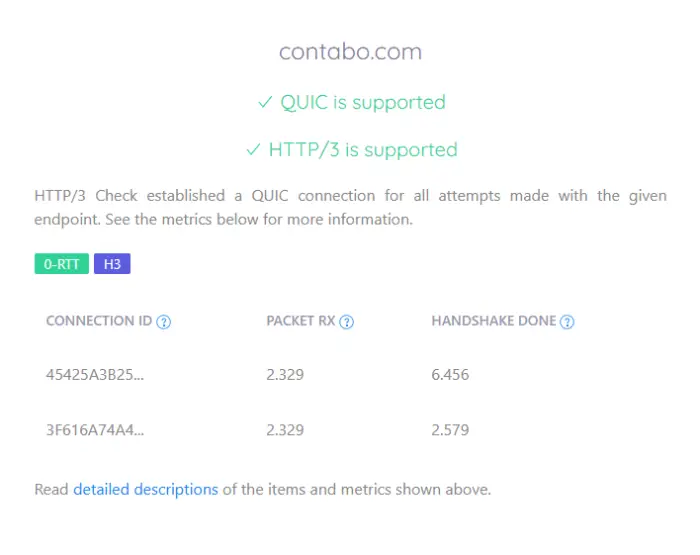
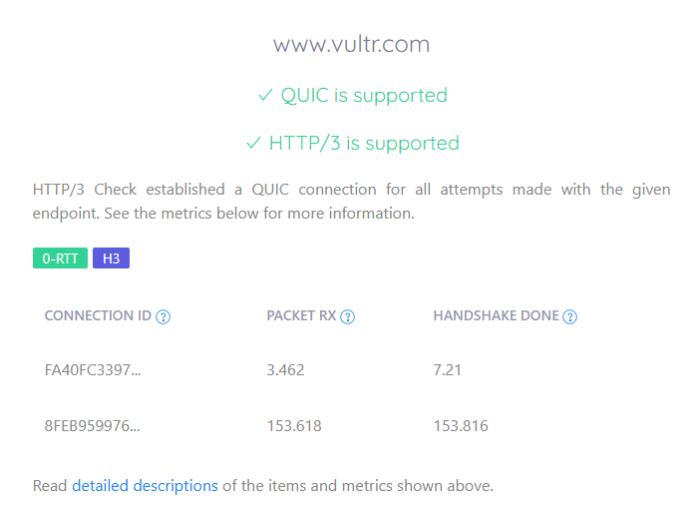
Both providers support the full modern protocol stack including 0-RTT, which enables instant reconnection for returning visitors. Both are meaningfully ahead of DigitalOcean, which has HTTP/3 disabled on its own corporate site.
Winner: Tie
Test 8: Environmental Impact (Green Web Foundation)
| Provider | Status | Energy Source |
|---|---|---|
| Contabo | Verified Green | Cloudflare CDN + own efficient data centre design |
| Vultr | Verified Green | Cloudflare CDN renewable |
[IMAGE: “Contabo.com Green Web Foundation certification result”. Caption: Contabo verified green via Cloudflare CDN. Own data centre designs are also noted for energy efficiency and high-density server racking.]
[IMAGE: “Vultr Green Web Foundation Sustainability Check”. Caption: Vultr verified green via Cloudflare CDN renewable energy. Vultr has also made public commitments to improve energy efficiency across its owned data centre facilities.]
Both are verified green with similar Cloudflare-based certification.
Winner: Tie
Performance Summary
| Test | Winner |
|---|---|
| Mobile Core Web Vitals | Contabo |
| Global Server TTFB | Contabo |
| Desktop CrUX | Contabo |
| Concurrent Load | Contabo |
| Uptime | Contabo |
| SSL Grade | Tie |
| HTTP/3 Protocol | Tie |
| Environmental | Tie |
Contabo wins five tests. Three are tied. Vultr wins zero. The performance comparison is the most one-sided in this comparison series, though Vultr’s WAF interference provides important context for several of these results.
Desktop and Mobile Speed Summary
| Metric | Contabo | Vultr | Winner |
|---|---|---|---|
| Mobile LCP | 1.9s (Pass) | 3.8s (Fail) | Contabo |
| Mobile INP | 196ms (Pass) | 188ms (Pass) | Tie |
| Mobile CLS | 0 (Pass) | 0.16 (Fail) | Contabo |
| Mobile TTFB | Not recorded | 2.3s (Poor) | Contabo |
| CrUX Score | 89% | 62% | Contabo |
| Lab LCP | 527ms | 733ms | Contabo |
| Lab TBT | 6,200ms | 2,440ms | Vultr |
| Lab TTFB | 412ms | 302ms | Vultr |
| SSL Grade | A+ | A+ | Tie |
| HTTP/3 + 0-RTT | Yes | Yes | Tie |
Global Network and Load Test Summary
| Metric | Contabo | Vultr | Winner |
|---|---|---|---|
| Frankfurt TTFB | 63ms | 1.28s (unblocked) | Contabo |
| Singapore TTFB | 64ms | 59ms (WAF 403) | Contabo (full content) |
| New York TTFB | 84ms | 84ms (WAF 403) | Contabo (full content) |
| Sydney TTFB | 346ms | 55ms (WAF 403) | Context-dependent |
| Global Locations | Primary + selected | 32 across 6 continents | Vultr |
| Load Test Avg | 152ms | 326ms | Contabo |
| Load Test Reachability | 100% | 67.7% (WAF) | Contabo |
| 30-Day Uptime | 100% | 1 incident | Contabo |
The Price-to-Resource Reality
This is the comparison’s most striking number and the one that drives most decisions between these two providers.
Contabo base VPS: approximately $5 per month for 4 vCPUs, 8 GB RAM, NVMe SSD storage, DDoS protection, and a fixed renewal price that never changes.
Vultr base Cloud Compute: approximately $6 per month for 1 vCPU, 1 GB RAM, 25 GB SSD.
For the same monthly budget, Contabo delivers 4 times the CPU cores and 8 times the RAM. For a developer running Docker containers, a gaming server, a CI/CD pipeline, or a database workload, this resource gap is not marginal. It is the difference between having enough RAM to run your workload comfortably and hitting memory limits constantly.
The trade-off is geographic reach. Contabo’s data centre network is primarily Germany-based with selected global locations. Vultr operates 32 locations across six continents. If your application requires a data centre in South America, Africa, or Southeast Asian cities that Contabo does not cover, Vultr is the only option in this comparison.
Pricing and Value
Contabo Pricing
Contabo’s flat pricing model is one of the most transparent in the industry. The price you pay on day one is the price you pay at every renewal. No introductory discounts that expire. No renewal shock. A 4 vCPU, 8 GB RAM NVMe VPS at $5 per month stays at $5 per month indefinitely.
The resource allocations at each price point are materially larger than industry norms. The review notes this is achieved through high-density server racking in proprietary German data centres and an unmanaged model that eliminates software support overhead.
Automated backups are not included by default. Contabo’s S3-compatible Object Storage is available as an affordable add-on for off-site backup configurations.
Cloud VPS 10 |
Cloud VPS 20 |
Cloud VPS 30 |
Cloud VPS 40 |
Cloud VPS 50 |
Cloud VPS 60 |
Cloud VDS S |
Cloud VDS M |
Cloud VDS L |
Cloud VDS XL |
Cloud VDS XXL |
Storage VPS 10 |
Storage VPS 20 |
Storage VPS 30 |
Storage VPS 40 |
Storage VPS 50 |
Cloud VPS 10 (Windows) |
Cloud VPS 20 (Windows) |
Cloud VPS 30 (Windows) |
Cloud VPS 40 (Windows) |
Cloud VPS 50 (Windows) |
Cloud VPS 60 (Windows) |
AMD Ryzen — 12 Cores |
AMD Genoa — 24 Cores |
AMD Turin — 32 Cores |
AMD Turin — 64 Cores |
|---|---|---|---|---|---|---|---|---|---|---|---|---|---|---|---|---|---|---|---|---|---|---|---|---|---|
$3.96
/month |
$6.36
/month |
$12.00
/month |
$20.80
/month |
$36.80
/month |
$47.20
/month |
$37.12
/month |
$44.16
/month |
$66.56
/month |
$88.32
/month |
$124.80
/month |
$3.96
/month |
$6.36
/month |
$12.00
/month |
$20.80
/month |
$36.80
/month |
$13.26
/month |
$25.46
/month |
$44.00
/month |
$81.10
/month |
$108.80
/month |
$133.40
/month |
$99.00
/month |
$170.10
/month |
$260.10
/month |
$692.10
/month |
|
|
|
|
|
|
|
|
|
|
|
|
|
|
|
|
|
|
|
|
|
|
|
|
|
|
Vultr Pricing
Vultr uses hourly billing with a monthly cap. You pay for resources consumed, which means spinning up a server for two hours costs cents. New users typically receive promotional credits (around $250 for 30 days) to evaluate the platform.
High Frequency plans with NVMe SSD storage start at approximately $8 per month for 1 vCPU, 2 GB RAM. GPU instances, Kubernetes worker nodes, managed databases, and Object Storage are separately priced. Advanced DDoS protection beyond the basic included tier requires additional configuration.
VX1 General Purpose |
VX1 NVMe Instance |
VX1 Memory Optimized |
Regular Performance Cloud |
High Performance Cloud |
High Frequency Cloud |
General Purpose Optimized |
CPU Optimized Cloud |
Memory Optimized Cloud |
Storage Optimized Cloud |
NVIDIA A16 GPU Cloud |
NVIDIA L40S GPU Cloud |
NVIDIA HGX H100 |
Intel E3-1270 Bare Metal |
AMD EPYC 4245P Bare Metal |
AMD EPYC 7443P Bare Metal |
MySQL Managed Database |
PostgreSQL Managed Database |
Valkey Managed Database |
Kubernetes Engine |
Load Balancer |
NAT Gateway |
NVMe Block Storage |
Object Storage |
File System Storage |
Vultr CDN |
Direct Connect |
|---|---|---|---|---|---|---|---|---|---|---|---|---|---|---|---|---|---|---|---|---|---|---|---|---|---|---|
$5.00
/mo |
$6.00
/mo |
$6.00
/mo |
$30.00
/mo |
$28.00
/mo |
$40.00
/mo |
$75.00
/mo |
$120
/mo |
$295
/mo |
$725
/mo |
$90
/mo |
$90
/mo |
$160
/mo |
$10
/mo |
$1
/mo |
$18
/mo |
$1
/mo |
$10
/mo |
$5
/mo | ||||||||
|
|
|
|
|
|
|
|
|
|
|
|
|
|
|
|
|
|
|
|
|
|
|
|
|
|
|
Pricing Comparison
| Factor | Contabo | Vultr | Winner |
|---|---|---|---|
| Entry Resources | 4 vCPU, 8 GB RAM, NVMe (~$5) | 1 vCPU, 1 GB RAM, SSD (~$6) | Contabo |
| Renewal Pricing | Flat, same forever | Hourly, no lock-in | Contabo (predictability) |
| GPU Instances | Yes | Yes (NVIDIA) | Tie |
| Windows Server | Yes (license added) | Yes (license added) | Tie |
| Managed K8s | No | Yes | Vultr |
| Managed Databases | No | Yes | Vultr |
| Object Storage | Yes (S3-compatible) | Yes (S3-compatible) | Tie |
| DDoS Protection | Yes, all plans | Basic only | Contabo |
| Automated Backups | Add-on (Object Storage) | Add-on | Tie |
| Free Trial Credits | Available | ~$250 for 30 days | Vultr |
Pricing Winner: Contabo on resources per dollar and renewal predictability. Vultr on managed services and trial credits.
Features and Platform Types
Contabo Platform Types
Cloud VPS: 4 vCPU, 8 GB RAM, NVMe from ~$5. The best resource-to-price ratio available on any developer cloud platform.
Cloud VDS: Virtual Dedicated Servers with dedicated CPU cores starting at 24 GB RAM. No noisy neighbours, ideal for heavy database processing and consistent performance.
Dedicated Servers: Bare metal AMD CPU servers with large NVMe storage for enterprise workloads.
Storage VPS: High-volume instances with terabytes of SSD for personal cloud networks, backups, and media archiving.
GPU Servers: NVIDIA-equipped dedicated servers for AI/ML training, 3D rendering, and big data processing.
Object Storage: S3-compatible cloud storage for backups and data delivery.
Vultr Platform Types
Cloud Compute (Droplets): VPS in Regular, High Frequency (NVMe), and High Performance (AMD EPYC) tiers. Starting from $6 per month.
Bare Metal: Dedicated physical servers with no hypervisor overhead. Single-tenant hardware.
Cloud GPU: NVIDIA GPU instances for AI training, inference, and rendering. Shared and dedicated configurations, hourly billing.
Managed Kubernetes: Production-ready K8s clusters with automated upgrades, autoscaling, and monitoring. Control plane free.
Managed Databases: Fully managed MySQL, PostgreSQL, Redis, Kafka, and Ceph. Automated backups and failover.
Object Storage: S3-compatible across multiple regions with built-in CDN.
DigitalOcean Functions: Serverless compute for event-driven workloads.
Feature Comparison
| Feature | Contabo | Vultr |
|---|---|---|
| Entry RAM | 8 GB (~$5) | 1 GB (~$6) |
| Entry CPU | 4 vCPU | 1 vCPU |
| NVMe at Entry | Yes | High Frequency tier (higher cost) |
| Managed Kubernetes | No | Yes |
| Managed Databases | No | Yes (MySQL, PostgreSQL, Redis, Kafka) |
| Serverless Functions | No | Yes |
| GPU Instances | Yes | Yes (NVIDIA) |
| Bare Metal | Yes | Yes |
| Object Storage | Yes | Yes |
| Windows Server | Yes | Yes |
| DDoS Protection | Included all plans | Basic only; advanced extra |
| Global Locations | Fewer (Germany + selected) | 32 locations, 6 continents |
| Control Panel Options | cPanel, Plesk, CyberPanel, Webmin, raw OS | Portal + 1-Click (cPanel, Plesk, Docker, etc.) |
| Phone Support | Yes (hardware) | No |
Ease of Use and Control Panel
Contabo: Freedom at Deployment
Contabo’s control panel handles provisioning, scaling, and server management. At deployment, you select your OS from a wide range including Ubuntu, Debian, AlmaLinux, Windows Server, and custom ISO options. During checkout, you can add cPanel, Plesk, Webmin, or CyberPanel with a single click.
Once deployed, the server is yours to configure entirely. Root access is immediate. Contabo handles the hardware. You handle the software stack, security configuration, updates, and application deployment.
For teams comfortable with Linux and SSH, this model is straightforward. For users who want a pre-configured managed environment, Contabo’s unmanaged model requires either technical knowledge or the installation of a control panel to manage the stack. The skills required for self-managed VPS are the same skills that unlock Contabo’s full value proposition.
Vultr: Customer Portal with Ecosystem Depth
Vultr’s Customer Portal is clean and function-rich. Deploying a new instance takes under 60 seconds. The interface covers location selection, server type, OS configuration, SSH keys, backups, and optional add-ons in a linear flow.
The portal provides a browser-based console for emergency SSH access, firewall group management, snapshot controls, and Kubernetes cluster creation. The 1-Click Marketplace includes pre-configured stacks for WordPress, LAMP, Docker, cPanel, and others.
Vultr stands out for Windows Server support and the breadth of managed services available from the same portal. Teams that need managed PostgreSQL, Kubernetes, and GPU instances alongside VPS — all from one account — will find Vultr’s dashboard handles that depth without requiring a second provider.
Ease of Use Comparison
| Feature | Contabo | Vultr | Winner |
|---|---|---|---|
| Initial Setup Speed | Fast | Fast (under 60 seconds) | Tie |
| Control Panel Choice | Yes (cPanel, Plesk, CyberPanel, Webmin) | Yes (1-Click marketplace) | Tie |
| Managed Services Portal | No | Yes (K8s, databases, GPU, functions) | Vultr |
| Browser-based SSH | Not built-in | Yes | Vultr |
| Windows Server Support | Yes | Yes | Tie |
| Phone Support (hardware) | Yes | No | Contabo |
| Tutorial Library | Standard | Good, actively maintained | Vultr |
Security and Reliability
Contabo Security
Contabo earns Qualys Grade A+ across all four tested nodes including both IPv4 and IPv6 addresses. HSTS is enforced with TLS 1.3. HTTP/3 and 0-RTT are active.
Enterprise-grade DDoS protection is included on all plans at no extra cost. Contabo’s automated mitigation detects and scrubs malicious traffic before it reaches the server. For gaming servers and applications that are frequent DDoS targets, this inclusion is a meaningful financial and operational advantage.
Automated backups are not provided by default. Object Storage is available as an affordable add-on for running off-site backup automation.
Vultr Security
Vultr earns Qualys Grade A+ across all four tested servers. HSTS is enforced with TLS 1.3 and HTTP/3. The corporate WAF is clearly effective, blocking automated probes consistently — though its configuration creates challenges for standard performance monitoring.
Basic DDoS protection is included with all Droplets. Advanced mitigation features require additional configuration or third-party services. Firewall groups are configurable from the portal. Snapshots and backups are available as add-ons.
Security Comparison
| Feature | Contabo | Vultr | Winner |
|---|---|---|---|
| SSL Grade | A+ | A+ | Tie |
| HSTS + TLS 1.3 | Yes | Yes | Tie |
| HTTP/3 + 0-RTT | Yes | Yes | Tie |
| DDoS Protection | Yes, all plans included | Basic only; advanced extra | Contabo |
| WAF | Yes (blocks bots aggressively) | Yes (very aggressive, blocks monitoring) | Tie |
| 30-Day Uptime | 100% | 1 incident (11 min 38 sec) | Contabo |
Customer Support
Contabo Support
Contabo provides ticket support and phone support for hardware and network issues. If the physical server hardware fails, Contabo’s team responds immediately. Software issues, application crashes, and configuration errors are outside their support scope — Contabo is unmanaged.
Vultr Support
Vultr provides 24/7 ticket-based support for infrastructure issues. There is no phone or live chat on standard plans. Premium support tiers with faster response times are available. The tutorial library covers a broad range of topics from initial setup to Kubernetes configuration.
Support Comparison
| Channel | Contabo | Vultr |
|---|---|---|
| Phone (hardware) | Yes | No |
| Ticket | Yes, 24/7 | Yes, 24/7 |
| Live Chat | No | No |
| Premium Support | No tier | Yes, paid |
| Support Scope | Hardware and network | Infrastructure |
| Tutorial Library | Standard | Actively maintained |
Support Winner: Contabo for hardware-level phone access. Vultr for tutorial depth and managed service documentation.
Who Should Use Which
Choose Contabo if you:
- Need the maximum computing resources (RAM, CPU, NVMe) for the lowest monthly price on the market
- Run resource-intensive workloads: Docker containers, gaming servers, AI model testing, large databases
- Want flat renewal pricing that stays the same indefinitely with no introductory discount games
- Need enterprise DDoS protection included without paying an add-on fee
- Have technical Linux experience and do not need managed software support
- Primarily serve audiences in Europe, North America, or Asia (all covered under 85ms)
Choose Vultr if you:
- Need data centre presence in South America, Africa, Southeast Asia, Japan, or other locations Contabo does not cover
- Need managed Kubernetes, managed PostgreSQL, MySQL, or Redis without running your own database server
- Run GPU workloads for AI inference, ML training, or rendering on cloud instances
- Want the widest possible global distribution for a geographically-diverse application
- Need serverless functions or a PaaS-style App Platform alongside traditional VPS
- Prefer a polished portal with a browser-based SSH terminal and deeper managed service ecosystem
Situation and Use Case Recommendations
| Your Situation | Recommended | Why |
|---|---|---|
| Gaming server (Minecraft, Palworld, Rust) | Contabo | 8 GB RAM for $5; gaming is RAM-hungry |
| Docker or CI/CD pipeline development | Contabo | 4 vCPU, 8 GB for $5 vs Vultr’s 1 vCPU, 1 GB for $6 |
| AI/ML model training | Tie | Both offer GPU instances; compare specific GPU availability |
| Global SaaS requiring 30+ region coverage | Vultr | 32 locations; Contabo cannot match |
| Managed PostgreSQL or Redis | Vultr | Native managed databases not on Contabo |
| WordPress agency, multiple client sites | Contabo | Resource-rich VPS with cPanel option for client management |
| Application in Johannesburg or Jakarta | Vultr | Only option in this comparison with those regions |
| Budget-first developer, Europe or US audience | Contabo | The resource per dollar has no comparison |
| Kubernetes orchestration | Vultr | Managed K8s not available on Contabo |
| DDoS-prone application (gaming, media) | Contabo | Enterprise DDoS included; Vultr charges extra for advanced protection |
Final Verdict
The title’s premise — that cheap VPS hides its real cost in performance — resolves in an unexpected direction. Contabo is the cheaper provider by a significant margin, and it outperforms Vultr on every direct performance test. The expected trade-off between price and performance does not materialise in the data.
Vultr’s real cost is not hidden in performance failures (the WAF distorts those results). It is in the resources per dollar comparison. You are paying Vultr more for less hardware. What you are buying is geographic reach, managed services, and a polished cloud ecosystem that Contabo’s unmanaged model does not replicate.
Contabo is best for: Developers and agencies that want maximum compute resources per dollar, stable flat-rate pricing, enterprise DDoS protection, and GPU or database workloads for European, US, and Asian audiences.
Vultr is best for: Applications requiring a global data centre footprint across 32 locations, managed Kubernetes and database services, GPU compute, and teams that want a broader cloud ecosystem from a single provider.
| Category | Winner |
|---|---|
| Mobile Core Web Vitals | Contabo |
| Global TTFB | Contabo |
| Desktop CrUX | Contabo |
| Load Test | Contabo |
| Uptime | Contabo |
| SSL Grade | Tie |
| HTTP/3 | Tie |
| Environmental | Tie |
| Resources per Dollar | Contabo |
| Geographic Coverage | Vultr |
| Managed Services | Vultr |
Contabo wins eight categories. Vultr wins two. Three are tied. For the workloads that matter most to the developers both providers target, Contabo delivers more at a lower price.
For the European-only unmanaged VPS comparison, see Contabo vs Hetzner.
For the global-reach VPS comparison, see Contabo vs Vultr.
For a managed alternative above raw VPS, see ScalaHosting vs Cloudways.
Tactical Recommendations
For Contabo: configure off-site backups before going live. Contabo does not include automated backups by default. Connect Contabo’s S3-compatible Object Storage to an automated backup script (via cron job or your control panel’s built-in backup tool) before any production data lives on the server. The consequences of missing backups at any infrastructure level apply equally to unmanaged VPS environments.
For Vultr: interpret monitoring results accounting for WAF behavior. Standard uptime monitoring tools will return 403 responses on Vultr’s infrastructure. Configure your monitoring to treat 403 responses from known Vultr IPs as non-downtime events, or use a real-browser-based monitoring tool that passes bot challenges. The raw Uptime Robot percentage understates Vultr’s true availability.
Use Contabo for database-heavy workloads, Vultr for globally-distributed applications. Contabo’s 8 GB RAM entry-level plan allows MySQL, PostgreSQL, and Redis to operate with full memory allocation at $5 per month. For the same database workload on Vultr, you would need at least a High Frequency 2 GB RAM plan at $12/month, or a managed database cluster at additional cost. Conversely, if your application needs consistent latency in São Paulo, Mumbai, and Tokyo simultaneously, Vultr’s 32-location network is the only path.
For both providers: install a server-side WAF before accepting production traffic. Neither Contabo nor Vultr provides fully managed application security. Before exposing your VPS to production traffic, configure ModSecurity, Fail2ban, or UFW firewall rules. The difference between server-side and plugin-based WAF protection matters more on unmanaged infrastructure where no platform layer enforces security rules.
Contabo’s GPU servers offer the best price-per-GPU in this series. For teams running lightweight ML model training or AI inference, Contabo’s GPU server pricing is below DigitalOcean’s, Vultr’s, and cloud hyperscaler equivalents at comparable GPU specifications. For serious production AI workloads at scale, Vultr’s NVIDIA GPU instances offer more configuration flexibility.
Frequently Asked Questions
Is Contabo actually as fast as the test data suggests?
For a provider at its price point, yes. Contabo passes all three Google Core Web Vitals on its corporate site, returns a 63ms TTFB in Frankfurt, and handles concurrent load at 152ms average with 100% reachability. The high TBT (6,200ms) on the desktop test is a JavaScript front-end issue specific to their marketing site. The server infrastructure benchmarks suggest genuine performance for the hardware specifications provided.
Why does Vultr’s performance data look so poor?
Three factors combine. First, Vultr’s corporate site carries heavy marketing JavaScript that inflates TBT and drives the TTFB field data. Second, Vultr’s aggressive WAF blocks most automated testing tools, which artificially reduces reachability scores and prevents standard latency measurements from most global locations. Third, the real-user field data (2.3s TTFB, 3.8s LCP) reflects global mobile users experiencing slow origin response times that the WAF context does not fully explain away. The server infrastructure is capable; the corporate site configuration does not showcase it well.
How can Contabo offer 4 vCPUs and 8 GB RAM for $5?
Two structural advantages. First, Contabo owns its data centres in Germany and uses high-density server racking to minimise hardware costs per unit. Second, Contabo is unmanaged, meaning there is no software support team, no managed stack, and no engineering overhead for customer site issues. You pay strictly for hardware and network. Every dollar saved on support staff goes into resource allocation.
Does Vultr have managed WordPress?
No. Vultr does not offer managed WordPress hosting. You can install WordPress via the 1-Click Marketplace in under five minutes, but ongoing updates, caching, backups, and security patches are your responsibility. For managed WordPress with a pre-configured stack, Cloudways or ScalaHosting are more appropriate platforms.
Which is better for gaming servers?
Contabo. Gaming servers are resource-hungry — Minecraft, Palworld, and Rust servers need significant RAM to host multiple simultaneous players comfortably. Contabo’s 8 GB RAM at $5 per month provides room for player data, world chunks, and plugin execution without hitting memory limits. Vultr can run gaming servers on higher-tier plans, but the cost-per-GB-of-RAM is significantly higher.
Does Vultr have more global locations than Contabo?
Yes, significantly. Vultr operates 32 locations across six continents including South America (São Paulo, Mexico City), Africa (Johannesburg), and multiple Southeast Asian and Pacific cities. Contabo’s primary infrastructure is Germany-based with selected global locations. For applications serving global audiences that require consistent sub-100ms latency from multiple continents simultaneously, Vultr’s geographic coverage is the decisive advantage.
Which is better for Docker and Kubernetes?
For Docker on a single server: Contabo wins on cost. A $5 Contabo VPS provides enough RAM to run multiple Docker containers without resource contention. For Kubernetes at production scale: Vultr wins through its managed Kubernetes service, which handles control plane management, upgrades, and autoscaling without manual configuration. Contabo has no managed Kubernetes offering.
Is either provider good for beginners?
Neither. Both Contabo and Vultr are unmanaged infrastructure providers. You must manage your own OS updates, security patching, application configuration, and database administration. For beginners, managed WordPress hosts like Hostinger, SiteGround, or Cloudways provide appropriate hand-holding. Both Contabo and Vultr assume Linux proficiency and familiarity with server administration.