WordPress powers 41.9% of all websites on the internet as of 2026, according to W3Techs. No other content management system comes close. Shopify, the second most popular platform, powers just 5.2% of all websites.
Whether you are deciding which CMS to build on, evaluating managed WordPress hosting options, or researching the eCommerce landscape, these numbers tell a clear story about WordPress’s place on the web.
This page covers the most current WordPress statistics available, organized by market share, version adoption, plugin and theme ecosystem, WooCommerce data, security vulnerabilities, and hosting market size.
Every statistic is sourced from a primary research firm, official platform data, or recognized industry tracking service.
Quick Stats: Key WordPress Numbers for 2026
- WordPress powers 41.9% of all websites globally (W3Techs, 2026)
- WordPress holds 59.4% of the CMS market
- 1.8% of WordPress sites run Version 7 (WordPress.org)
- WordPress 7.0 “Armstrong” was released on May 20, 2026
- 64,000+ free plugins available on WordPress.org
- Elementor used on 13.1% of all websites (~31% of WordPress sites) (W3Techs)
- WooCommerce powers 4.25 million online stores, 33.4% market share (StoreLeads)
- WordPress hosting market size: $8.74 billion (2025) (360iResearch)
- 11,334 new vulnerabilities disclosed in 2025, 91% of which are from plugins (Patchstack)
Table of Contents
Key Takeaways
WordPress’s dominance is real but not unconditional. At 41.9% of all websites, it leads by a wide margin, but that share has declined from its mid-2025 peak of 43.6%.
SaaS builders like Wix and Shopify are growing faster, and that trend is worth watching.
The plugin ecosystem is both WordPress’s greatest strength and its biggest security liability. With over 64,000 free plugins available, WordPress can do almost anything, but 91% of all WordPress vulnerabilities trace back to plugins. Keeping plugins updated is not optional; it is the single most important security task for any WordPress site owner.
WooCommerce remains the dominant eCommerce platform by store count, and the managed WordPress hosting market is growing steadily toward $13 billion by 2032. For site owners who want performance without server management, that market is maturing fast.
WordPress Market Share and Usage
How Many Websites Use WordPress?
WordPress powers 41.9% of all websites on the internet as of 2026, according to W3Techs technology surveys. Among websites using a known CMS, that share rises to 59.4%, meaning roughly six out of every ten CMS-powered websites run on WordPress.
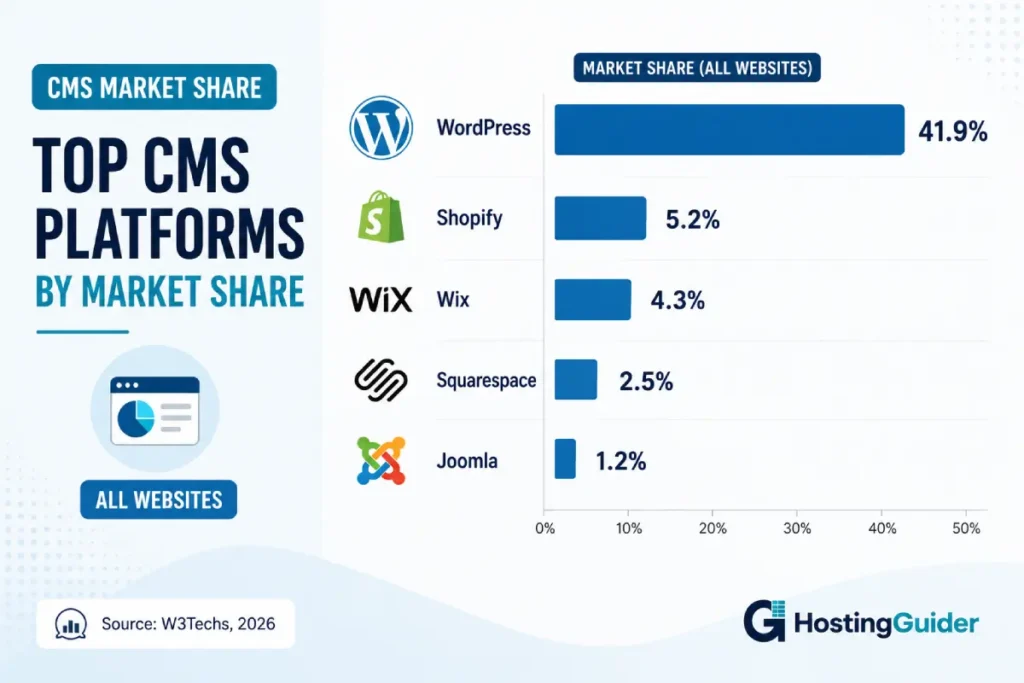
This represents a slight decline from WordPress’s peak of 43.6% in mid-2025. The drop reflects faster growth by SaaS website builders rather than an absolute loss of WordPress sites.
WordPress vs. Competitors
WordPress leads every competitor by a significant margin. The next-closest platforms and their shares of all websites, per W3Techs 2026 data:
| Platform | Share of All Websites | CMS Market Share |
| WordPress | 41.9% | 59.4% |
| Shopify | 5.2% | 7.4% |
| Wix | 4.3% | 6.1% |
| Squarespace | 2.5% | 3.5% |
| Joomla | 1.2% | 1.8% |
Wix has grown its share of all websites by 32.6% year-over-year according to W3Techs tracking.
Shopify’s annual revenue exceeded $11.5 billion in 2025, per Shopify’s own investor reports. Both platforms are growing faster than WordPress in percentage terms. (Source)
However, WordPress’s installed base is so large that even a modest share decline still leaves hundreds of millions of websites on the platform.
Author note: “Managing WordPress hosting for a plugin with 200,000 active installations gives you a ground-level view of how diverse the WordPress ecosystem really is, from tiny personal blogs to enterprise-grade publishing operations. The sheer variety of use cases is why no other CMS has displaced it.” — Shaddam Hossain
WordPress Version Adoption
Current Version Usage
51.32% of all WordPress websites run Version 7, according to WordPress.org usage statistics. Version 6 accounts for just 41.17% of sites, and older versions make up the remainder.
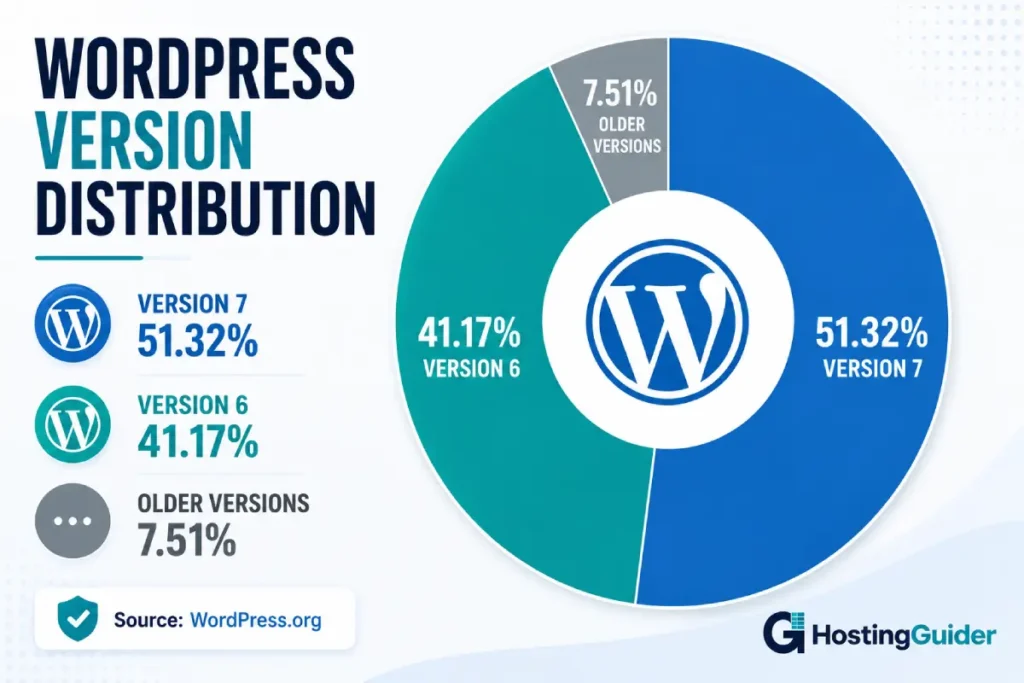
WordPress 7.0 “Armstrong” was released on May 20, 2026, which is the latest major version at the time of this writing. Adoption of new major versions typically accelerates in the months following release.
Why Version Adoption Matters
Sites running outdated WordPress versions face higher security risk. Older core versions may not receive security patches after they reach end-of-life.
The strong Version 7 adoption rate is a positive signal for the ecosystem, but the 7.51% of WordPress sites still running older versions represents millions of potentially vulnerable installations.
For a full guide to keeping your WordPress site secure, see our guide on how to protect your WordPress site.
WordPress Plugin and Theme Ecosystem
Plugin Statistics
The WordPress plugin ecosystem is the largest of any CMS. Key numbers from WordPress.org and W3Techs technology tracking:
- 64,000+ free plugins available in the official WordPress.org directory
- 70,000+ total plugins, including premium marketplace options
- Elementor is used by 13.1% of all websites globally, which equates to approximately 31% of WordPress sites, according to W3Techs, 2026
- WooCommerce is active on approximately 19–20% of WordPress sites, according to W3Techs
- Akismet (spam protection) remains one of the most widely installed plugins globally
The plugin directory receives thousands of new submissions each year. However, not all plugins are actively maintained, which is a significant security consideration covered in the security section below.
Theme Statistics
- 14,000+ free themes available on the WordPress.org theme directory
- Thousands more premium themes available through third-party marketplaces
- Page builder-compatible themes (Elementor, Divi, Avada) dominate commercial theme sales
Plugin Vulnerability Risk
91% of all WordPress vulnerabilities originate in plugins, according to Wordfence’s 2024 Annual WordPress Security Report. Themes account for most of the remaining share, with WordPress core representing a very small fraction of reported issues.
Plugin management is not just a performance decision; it is the single most important security decision for any WordPress site owner. Unused plugins should be deleted, not just deactivated.
WooCommerce Statistics
WooCommerce Market Share
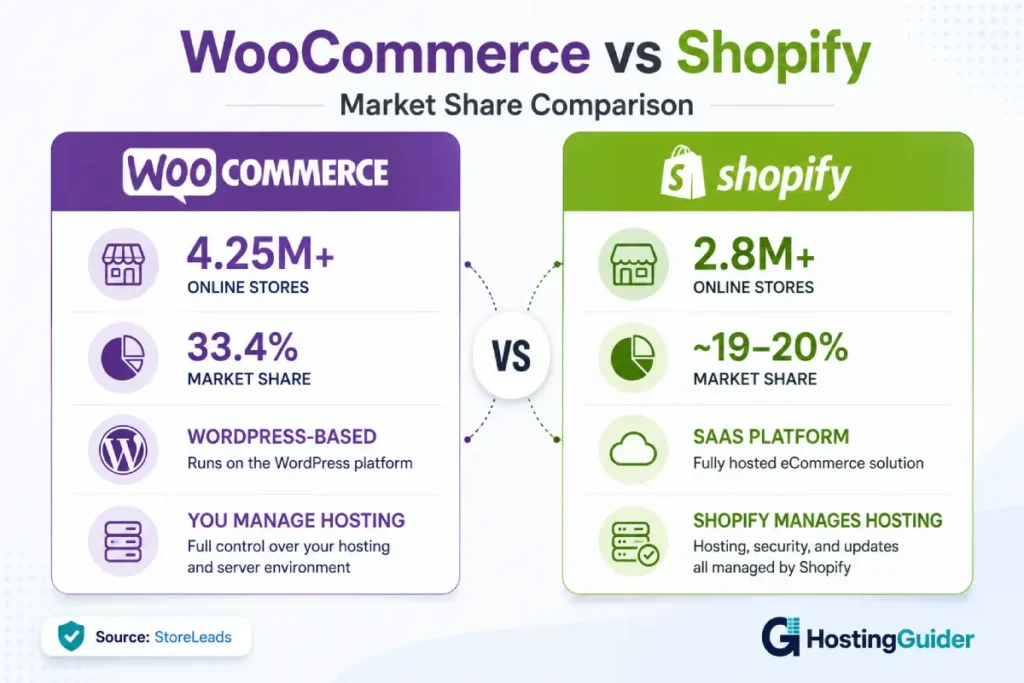
WooCommerce is the most widely used eCommerce platform by store count. As of 2026, it powers 4.25 million active online stores and holds 33.4% of the global eCommerce platform market by store count, according to StoreLeads.
WooCommerce vs. Shopify
| Metric | WooCommerce | Shopify |
| Active stores | 4.25 million | 2.8 million |
| Market share (by store count) | 33.4% | ~19–20% |
| Estimated annual GMV | ~$30–35 billion | $378.44 billion |
| Hosting model | Self-hosted — owner chooses and manages | Managed by Shopify |
| Customization | High | Moderate |
WooCommerce leads in store count, but Shopify leads significantly in gross merchandise volume.
Shopify’s $378.44 billion GMV in 2025, versus WooCommerce’s estimated $30–35 billion, shows that Shopify stores tend to be higher-volume businesses.
Because WooCommerce runs on WordPress, store owners choose and manage their own hosting.
That makes infrastructure decisions more consequential for WooCommerce users than for Shopify users. See our guide to the best WooCommerce hosting providers for tested options.
Managed WordPress Hosting Market
Market Size and Growth
The global WordPress hosting market was valued at $8.74 billion in 2025 and is projected to reach $9.32 billion in 2026, according to 360iResearch. By 2032, the market is expected to reach $13.34 billion at a CAGR of 6.21%.
Managed WordPress solutions have grown faster than generic web hosting, reflecting a market where website owners increasingly prioritize performance and convenience over self-management.
Author note: “When I was optimizing WordPress hosting for themes distributed through Envato ThemeForest, the performance difference between a generic shared plan and a managed WordPress environment was significant; it was not just in speed numbers, but in the hours I stopped spending on server-level issues. That hands-on gap is what drives managed WordPress adoption.” (Shaddam Hossain)
For tested options, see our best managed WordPress hosting guide.
Managed vs. Regular WordPress Hosting
The core difference is who handles server-level WordPress tasks:
| Task | Regular Hosting | Managed WordPress |
| WordPress core updates | Owner | Provider |
| Plugin conflict resolution | Owner | Provider (varies) |
| Security monitoring | Owner | Provider |
| Performance caching | Owner | Provider |
| Malware removal | Owner | Provider (varies) |
| Daily backups | Often manual | Automated |
For a full breakdown, see our article on managed vs. regular WordPress hosting.
WordPress Security Statistics
Vulnerability Data (2025)
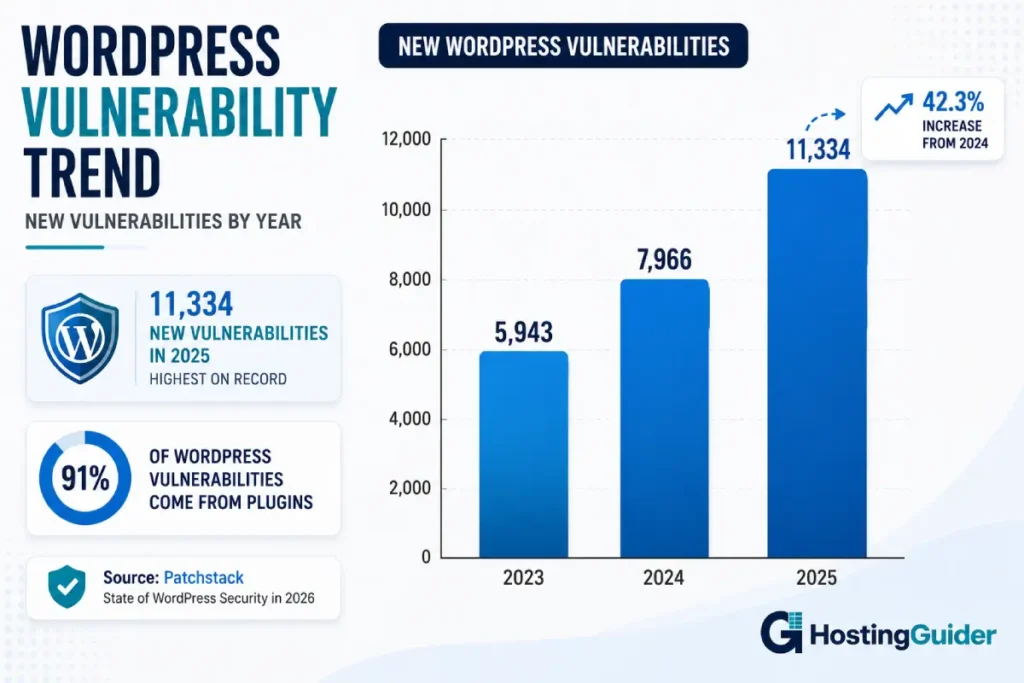
11,334 new WordPress vulnerabilities were disclosed in 2025, a 42% increase over 2024’s total of 7,966, according to Patchstack’s State of WordPress Security in 2026. For comparison, the 2024 total of 7,966 was itself a 34% jump from 5,943 in 2023.
Key findings from Patchstack’s 2025 data:
- 91% of all WordPress vulnerabilities originated in plugins; only two were found in WordPress core all year.
- 46% of disclosed vulnerabilities had no patch available at the time of public disclosure.
- Highly exploitable vulnerabilities rose 113% year over year, with 1,966 (17%) carrying a high-severity score.
- The weighted median time from disclosure to first mass exploitation was just 5 hours.
On the attack-volume side, Wordfence’s most recent annual deep-dive, the 2024 Annual WordPress Security Report, recorded:
- 55 billion password attack attempts blocked in 2024
- 9 billion+ Cross-Site Scripting exploit attempts blocked
- 1.1 billion+ SQL injection exploit attempts blocked
- 81% of disclosed vulnerabilities rated “Medium” severity (CVSS)
- ~35% of 2024 vulnerabilities still unpatched as of 2025
Note that Wordfence’s database recorded a 68% year-over-year rise in disclosures for 2024, versus Patchstack’s 34%; the two firms track different vulnerability databases, so their growth rates differ even though both point to a sharp upward trend.
Infection and Attack Scale
500,000+ websites were infected in 2024, according to Sucuri’s latest Website Threat Research.
Contributor-level access was the most common requirement to exploit WordPress vulnerabilities in 2024, accounting for 34% of all disclosed issues, per Wordfence data.
The growth in vulnerability disclosures is not purely bad news. It partly reflects a maturing security research community and active bug bounty programs; Wordfence alone published 42% of all 2024 WordPress vulnerability disclosures. More vulnerabilities being found and disclosed publicly means more get patched.
For a step-by-step guide to securing a WordPress site, see our guide on how to respond to a WordPress hack and our article on managed WordPress security.
WordPress Performance Context
WordPress sites present specific performance challenges compared to statically generated or SaaS-hosted sites. PHP rendering, database queries, and plugin overhead all add to page load time.
Dotcom-monitor states that only 42% of mobile sites and 63% of desktop sites pass all three Core Web Vitals thresholds. WordPress sites using heavy page builders and multiple plugins frequently fall below the recommended Largest Contentful Paint (LCP) threshold of 2.5 seconds. (Source)
For WordPress sites specifically, hosting choice has a direct measurable impact. Server response time (TTFB) is the one speed factor that hosting directly controls, and it varies significantly between a budget shared host and a managed WordPress provider. For a practical framework on choosing the right hosting for a growing WordPress site, see our guide on how to choose hosting for a growing WordPress site.
Frequently Asked Questions
What percentage of websites use WordPress in 2026?
WordPress powers 41.9% of all websites globally as of 2026, according to W3Techs. Among websites using a known content management system, WordPress holds 59.4% market share; roughly six out of every ten CMS-powered websites run on WordPress.
Is WordPress losing market share?
WordPress peaked at 43.6% of all websites in mid-2025 and has since declined slightly to 41.9% as of 2026. The decline reflects faster growth from SaaS platforms like Wix (up 32.6% YoY per W3Techs) and Shopify, rather than sites actively migrating away from WordPress.
How many WordPress plugins are there in 2026?
There are 64,000+ free plugins in the official WordPress.org directory, and over 70,000 total, including premium options. Elementor is the most widely installed, used on 13.1% of all websites globally (approximately 31% of WordPress sites), according to W3Techs 2026 data.
What version of WordPress do most sites use?
1.8% of WordPress websites run Version 7, according to WordPress.org usage statistics. WordPress 7.0 “Armstrong” was released on May 20, 2026. Sites still running Version 5 or older face higher security risk due to reduced patch support for older versions.
How big is the WooCommerce market share?
WooCommerce powers 4.25 million active online stores and holds 33.4% of the global eCommerce platform market by store count, according to StoreLeads 2026 data. Shopify holds 26.2% market share by store count but leads significantly in gross merchandise volume ($378.44B+ GMV in 2025).
How many WordPress vulnerabilities were found in 2025?
Patchstack documented 11,334 new WordPress vulnerabilities in 2025, a 42% increase from 2024. Of those, 91% originated in plugins, 81% had a medium severity rating, and 35% remained unpatched as of 2025. Wordfence blocked 55 billion password attack attempts in 2024 alone.