Substack takes 10% of everything your paid subscribers pay you. Forever.
On a $5,000 per month paid newsletter, that is $500 per month going to Substack. On a $10,000 per month business, that is $1,200 per year. On a $50,000 per month operation like some of the platform’s top writers run, that is $60,000 per year leaving your business through a single line item that most platform comparison posts mention in a single sentence and never revisit.
Ghost takes zero percent. WordPress takes zero percent.
That one fact does not settle the Substack vs Ghost vs WordPress debate. But it reframes it. Because the comparison is not really about features. It is about what kind of publishing business you are building, who owns the relationship with your readers, and what happens to that business when a platform decides to change its terms.
Most Substack vs Ghost vs WordPress comparisons end with a feature table and “it depends on your goals.” This one starts with the most important question serious content publishers face: who owns your audience, and what happens if that changes?
The Number That Changes Everything
Before the features, understand the economics.
Substack charges 10% of paid subscription revenue plus Stripe’s standard payment processing fee. There is no monthly platform fee. The trade feels good when you are starting: you pay nothing until you earn something.
The trade looks different at scale:
| Monthly Paid Revenue | Substack’s 10% | Annual Cost to Substack |
|---|---|---|
| $500/month | $50/month | $600/year |
| $2,000/month | $200/month | $2,400/year |
| $5,000/month | $500/month | $6,000/year |
| $10,000/month | $1,000/month | $12,000/year |
| $50,000/month | $5,000/month | $60,000/year |
Ghost charges a flat monthly fee with zero revenue cut. Ghost hosted plans start at $9/month. At the $25/month Creator plan, you keep 100% of subscription revenue. The platform never scales its fee with your success.
WordPress charges whatever your hosting costs, plus any plugin fees. Zero percent of subscription revenue.
This is not an argument that Substack is bad. It is a structural fact that changes the calculation differently at different stages. For a writer with 200 paid subscribers at $5/month, Substack’s 10% is $10 per month. For a writer with 5,000 paid subscribers at $10/month, it is $5,000 per month. The percentage is the same. The business impact is completely different.
What Each Platform Actually Is for Publishers in the Substack vs Ghost vs WordPress Debate
Substack
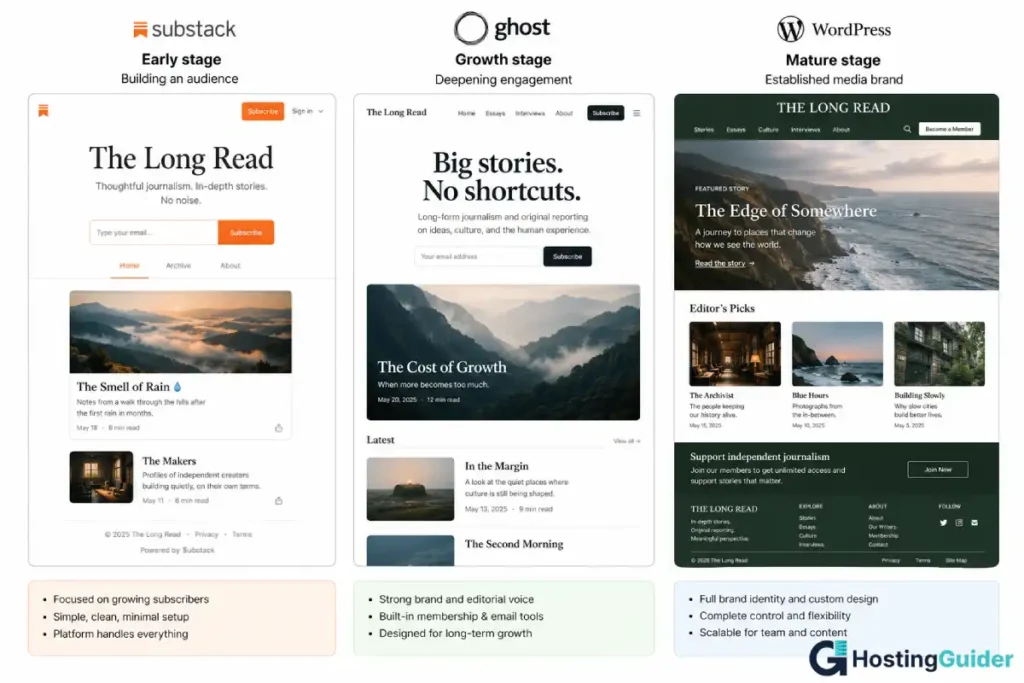
Substack is a publication network with newsletter infrastructure built in. It is not purely a newsletter tool and it is not purely a website. It is a hybrid: part email platform, part social network, part publishing tool.
When you publish on Substack, your content lives at yourname.substack.com (or a custom domain on paid plans). Readers find you through the Substack discovery feed, Notes (Substack’s Twitter-like feature), and recommendations from other Substack writers. The network effect is real. New writers on Substack with no existing audience have a genuine path to first 1,000 subscribers that WordPress does not provide natively.
The platform handles everything: hosting, email delivery, payments, subscriber management. You write and publish. Substack handles the infrastructure.
Ghost
Ghost is an open-source publishing platform with professional CMS features, built-in membership management, and email newsletter delivery. It is positioned as the independent publisher’s alternative to both WordPress (more modern, purpose-built for content) and Substack (more ownership, no revenue cut).
Ghost can be hosted at Ghost.org (managed hosting, monthly fee) or self-hosted on your own server (free software, bring your own hosting). The hosted version removes technical management. The self-hosted version maximises control.
Ghost is genuinely the best-designed pure publishing platform in this comparison. The writing experience is clean. The publication design is professional. The email delivery is built in. And unlike Substack, Ghost is run by a non-profit foundation, which changes the platform risk calculation meaningfully.
WordPress
WordPress is the world’s most used publishing platform, powering over 40% of the internet. It was built for content publishing. With the right plugins, it matches or exceeds every feature in Substack and Ghost while adding capabilities neither platform can match: full SEO control, complete branding freedom, unlimited customisation, and absolute ownership of every piece of data.
The trade-off is complexity. WordPress requires more setup and more ongoing decisions than Substack or Ghost. The trade-off disappears significantly when you use managed WordPress hosting with a newsletter plugin pre-configured. What remains is the most capable and the most owned publishing infrastructure available.
Substack vs Ghost vs WordPress: Quick Comparison
| Feature | Substack | Ghost | WordPress |
|---|---|---|---|
| Revenue cut | 10% of paid subs | Zero | Zero |
| Platform fee | Free (until you earn) | $9 to $199/month | Hosting only ($15 to $50/month) |
| Newsletter included | Yes | Yes | Plugin required |
| Paid memberships | Built-in | Built-in | Plugin required (free options) |
| Custom domain | Yes (paid plans) | Yes | Yes |
| SEO capability | Poor | Moderate | Excellent |
| Discovery network | Yes (Substack Notes) | No | No |
| Design flexibility | Low | Moderate | Unlimited |
| Export capability | Full (posts + subscribers) | Full | Full |
| Self-hosted option | No | Yes | Yes |
| Open source | No | Yes | Yes |
| Non-profit owned | No | Yes (Ghost Foundation) | No (Automattic) |
| Comments/community | Yes (Substack) | Yes (via integration) | Full (plugin) |
| Podcast hosting | Yes | Yes | Plugin required |
| Analytics | Basic | Good | Full (with plugins) |
| Technical complexity | Lowest | Low to moderate | Moderate |
Ownership: The Most Important Question in the Substack vs Ghost vs WordPress Decision
This section is the reason this post exists. Every other comparison skips directly to features.
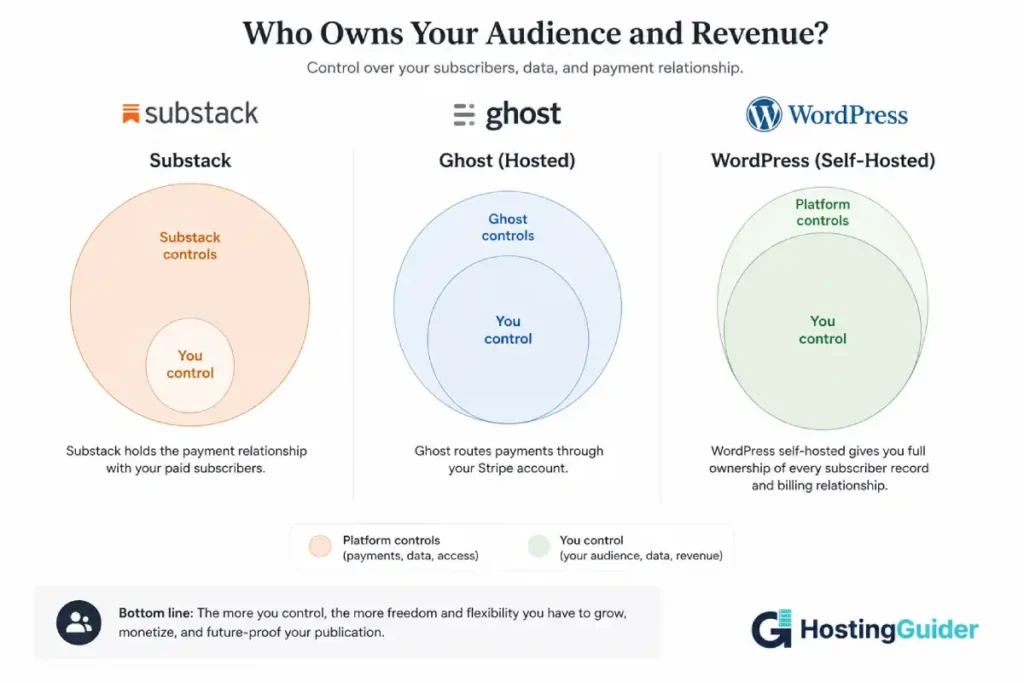
The Substack Ownership Question
Your subscriber list on Substack is exportable. Substack is transparent about this and it is a genuine positive. You can download your full subscriber CSV at any time and take it to another platform. Your posts are exportable as well.
What Substack owns that you do not: the payment relationship.
Your paid subscribers on Substack have a billing relationship with Substack, not with you. If you move your newsletter to Ghost or WordPress tomorrow, your free subscribers come with you as email addresses. Your paid subscribers need to re-subscribe and re-enter payment details on the new platform. In practice, a meaningful percentage will not. Industry estimates suggest 30 to 50% of paid subscribers are lost in a platform migration. On a $5,000 per month newsletter, that is $1,500 to $2,500 per month in churn from the migration itself.
Substack also controls the discovery algorithm that sends your writing to new readers. When Substack changes its recommendation system, your growth changes with it.
The Ghost Ownership Position
Ghost gives you significantly more ownership than Substack. On Ghost.org hosted, your payment relationships run through Stripe directly. Your subscribers’ billing information is in your Stripe account, not Ghost’s. When you move platforms, your paid subscribers can continue with existing billing. Ghost is a layer between you and your audience, not a gatekeeper.
On self-hosted Ghost, you own the full stack. The database, the subscriber records, the content. Nothing belongs to Ghost except the software license (which is open source).
The Ghost Foundation’s non-profit status reduces platform risk further. A VC-backed company like Substack has investors who expect a return. A non-profit like Ghost has a mission to support independent publishing. These are structurally different incentive systems.
WordPress Ownership
On self-hosted WordPress, you own everything. The subscriber email list lives in your database on your server. Payment relationships through WooCommerce or Paid Memberships Pro run through Stripe or PayPal directly. No platform sits between you and your readers’ billing relationship.
Moving hosts is a technical task, not a business risk. Your audience does not notice it happened.
The ownership ranking: WordPress then Ghost then Substack. For a writer building a long-term publishing business, this ranking matters more than any individual feature.
Newsletter and Email: How Substack vs Ghost vs WordPress Each Handle Email Delivery
All three platforms send newsletters to subscribers. The quality differences matter for serious publishers.
Substack Email Delivery
Substack’s email deliverability is good for a platform-hosted service. Writing goes directly from the editor to your subscribers’ inboxes with no configuration. Open rates on Substack-delivered emails average between 30 and 50% for well-maintained lists, which is higher than most email marketing platforms.
The reason is partly deliverability and partly that Substack readers are generally more engaged than marketing email recipients. People who subscribe to a Substack actively want to read it. The intent signal is different from a list built through lead magnets.
Ghost Email Delivery
Ghost’s built-in email delivery uses Mailgun as the sending infrastructure. Deliverability is reliable. The email design is clean and matches the publication aesthetic. On Ghost.org plans, you get a monthly email send limit that scales with your plan tier.
Ghost allows you to segment your list: free subscribers versus paid members can receive different content. The same post can be partially paywalled, with free subscribers seeing the first section and paid members accessing the full piece. This is a conversion tool built into the publishing workflow.
WordPress Newsletter Options
WordPress has no built-in newsletter. You choose your own:
MailPoet is a native WordPress plugin that sends newsletters directly from your WordPress install. Free up to 1,000 subscribers. Clean design. Good deliverability with the premium sending service.
Newsletter plugin is the most widely used free WordPress newsletter solution. Functional, without the design quality of Ghost or Substack.
ConvertKit (now renamed Kit) is the preferred external integration for serious creators. ConvertKit connects to WordPress and handles email delivery, segmentation, automations, and paid subscriptions with a creator-first interface. Many WordPress-based publishers use WordPress as the website and ConvertKit as the email layer.
Substack comparison: WordPress-plus-ConvertKit produces a more powerful email marketing setup than Substack with better segmentation and automation. The setup requires more configuration. The total cost is higher at small scale and lower at large scale compared to Substack.
Monetization: How Revenue Works in the Substack vs Ghost vs WordPress Comparison
Substack Monetization
Substack makes monetization extremely easy. Enable paid subscriptions, set your price, and your existing subscribers see an upgrade prompt. Stripe handles payments. Substack handles the billing relationship.
The simplicity is real. Substack writers have launched paid newsletters and reached $10,000 monthly recurring revenue faster than any other platform because the upgrade path requires no technical decisions and the subscriber base is already engaged.
The cost is the 10% cut, compounded by the platform risk of having Substack in the middle of the payment relationship.
Ghost Monetization
Ghost uses Stripe Connect to handle payments. Your paid subscribers’ billing goes directly to your Stripe account. Ghost charges zero percent. At the $9/month Starter plan, which limits you to 500 members, the math is clear: if you have 100 paid members at $10/month, Ghost costs you $9 per month and Substack costs you $100 per month for identical functionality.
Ghost also supports tiered memberships: free readers, paying members, and annual supporters at different price points. The upgrade prompt within a Ghost publication is customisable in a way Substack’s is not.
WordPress Monetization
WordPress has several paths to paid subscriptions:
Paid Memberships Pro is a free plugin that handles subscription tiers, member-only content, and Stripe or PayPal payments with zero revenue cut.
WooCommerce Subscriptions handles recurring billing for more complex models with product combinations.
MemberPress is a premium solution favoured by serious membership sites.
All of these take zero percent of subscription revenue. The platform cost is the plugin fee (typically $0 to $300/year depending on the solution) plus hosting.
SEO and Content Discovery: The Sharpest Gap in the Substack vs Ghost vs WordPress Comparison
Substack and SEO
Substack content has poor SEO performance for most publishers. The platform generates clean URLs and basic meta tags, but the architecture is built around email delivery, not search discovery. Substack pages load additional JavaScript that affects performance. Schema markup for articles is limited. Internal linking structures for building domain authority are absent from the publisher’s workflow.
More critically, Substack pages compete poorly for informational keywords because Substack itself does not build domain authority for individual publications. Your content lives at yourname.substack.com or a custom domain, but the SEO support behind it is minimal compared to a WordPress site with Yoast SEO, proper schema markup, and a managed host optimising server response time.
For many Substack writers, SEO is irrelevant. They grow through the Substack recommendation network, social media, and word of mouth. But for a content publisher whose readers discover long-form pieces through Google, Substack is a constraint.
Ghost and SEO
Ghost produces clean, fast-loading HTML. Its SEO defaults are better than Substack: proper meta tags, clean URL structures, automatic sitemaps, and fast server response times on Ghost.org managed hosting. Ghost supports Open Graph tags for social sharing and has a simple SEO settings panel.
The limits: Ghost lacks the depth of WordPress’s SEO plugin ecosystem. There is no Yoast SEO equivalent that provides real-time content analysis, schema markup for every content type, and granular technical controls. For a publisher targeting competitive informational keywords, Ghost is adequate but not optimal.
WordPress and SEO
This comparison is not competitive. WordPress is the platform of choice for every serious SEO-driven content operation.
Yoast SEO turns every post into a real-time optimisation session. Schema markup for articles, authors, and FAQs improves rich result eligibility. Full control over sitemaps, canonical tags, redirects, and server-level performance factors enables the kind of technical SEO that compounds into domain authority over years.
The largest news sites, most successful content businesses, and most SEO-dependent publications in the world run on WordPress for this reason.
Substack vs Ghost vs WordPress SEO ranking: WordPress first, Ghost second, Substack a distant third, with a large gap between WordPress and the other two.
Design and Branding: Substack vs Ghost vs WordPress for Independent Publication Identity
Substack Design
Substack received significant design updates in 2023 and 2024. You can now customise publication colours, fonts, cover images, and layout to a meaningful degree. The results are still recognisably Substack. The grid, the spacing, and the subscription box patterns follow platform conventions that identify the site as a Substack immediately to anyone familiar with the platform.
For some writers, this is fine. Being identifiable as a Substack publication signals credibility within the creator economy. For publishers building independent brand identities, the Substack aesthetic is a constraint.
Ghost Design
Ghost ships with several professional themes. The typography is excellent. The default aesthetic is editorial and clean. More importantly, Ghost themes are customisable HTML and CSS. A designer can take a Ghost publication in any visual direction. Custom Ghost themes are available at reasonable prices.
A well-designed Ghost publication looks fully independent. There is no “Powered by Ghost” branding visible to readers. The publication feels like a standalone media property.
WordPress Design
WordPress supports unlimited design customisation. The theme and page builder ecosystem allows a publisher to create any visual identity: from a minimal long-form magazine to a busy news aggregator to a personal brand with high design values. Major publications run custom WordPress themes that bear no similarity to any template.
The gap between WordPress’s design ceiling and Substack’s is the same gap as between a custom property and a furnished rental.
The Daily Writing Experience: Substack vs Ghost vs WordPress for Working Publishers
Writing on Substack
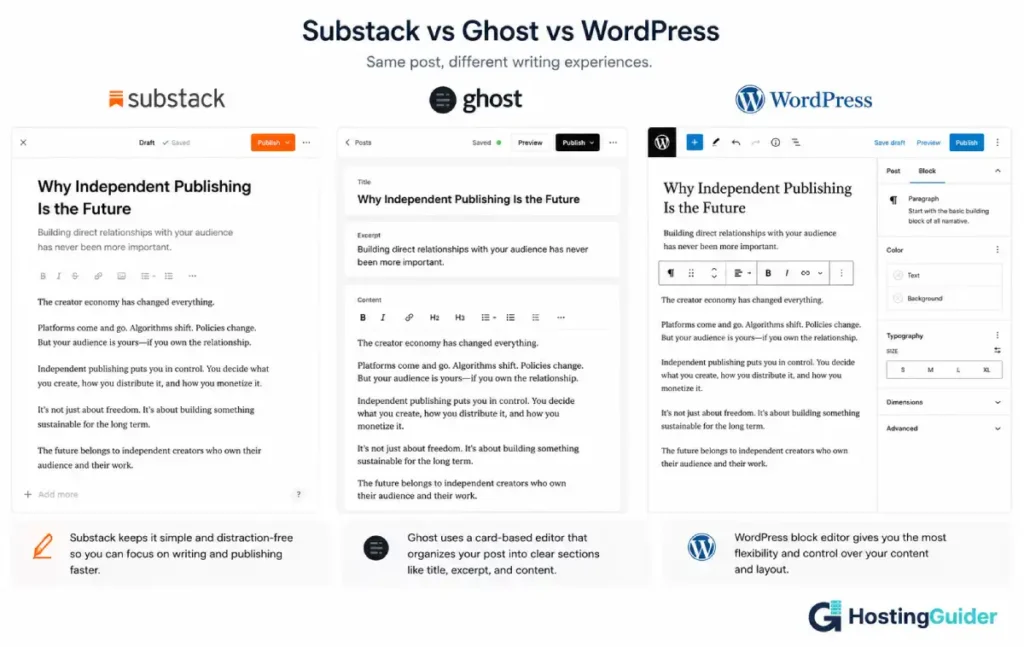
Substack’s editor is optimised for writers. It is clean, fast, and distraction-free. You write. You add images. You embed media. You click send or publish. The entire flow is designed for writers who want to think about writing, not web publishing.
The editor lacks advanced formatting tools. Tables, code blocks, and complex layouts are limited or absent. For writers of prose, this rarely matters. For technical writers or journalists who need richer formatting, it is a limitation.
Writing on Ghost
Ghost’s editor is excellent. It uses a card-based system that handles text, images, galleries, HTML embeds, code blocks, callouts, and bookmark cards in a clean interface. The writing experience feels modern and intentional. Many writers who have used all three platforms rate Ghost’s editor as the best pure writing environment.
Ghost also handles the post scheduling, internal tagging for content organisation, and author profiles within the same clean interface.
Writing on WordPress
The WordPress block editor has improved dramatically. For straightforward prose publishing, it is clean and fast. For complex publishing with varied content types, it is more powerful than either Substack or Ghost: custom block patterns, reusable blocks, full template editing, and direct code access for publishers who need it.
The overhead: WordPress has more menus, more settings, and more decisions visible in the interface. A writer who wants to publish without seeing “SEO Analysis,” “Document Settings,” and “Featured Image” panels needs to configure the editor to hide them.
Pricing: What Scale Actually Costs in the Substack vs Ghost vs WordPress Comparison
Running the actual numbers reveals surprises that most comparisons miss.
Substack Pricing Model
Free platform. 10% of paid subscription revenue. No monthly fee until you earn.
At small scale this feels free. At serious scale it becomes your largest technology expense by a significant margin.
| Paid Subscribers | Average Sub Fee | Monthly Revenue | Substack Cut/Month |
|---|---|---|---|
| 100 | $10 | $1,000 | $100 |
| 500 | $10 | $5,000 | $500 |
| 2,000 | $10 | $20,000 | $2,000 |
| 5,000 | $10 | $50,000 | $5,000 |
There is no cap. The 10% scales indefinitely.
Ghost Pricing Model
| Plan | Monthly (annual) | Member Limit | Staff Users |
|---|---|---|---|
| Starter | $9/month | 500 | 1 |
| Creator | $25/month | 1,000 | 1 |
| Team | $50/month | 10,000 | 5 |
| Business | $199/month | Unlimited | Unlimited |
Zero percent revenue cut on all plans. For a publisher with 2,000 paid members at $10/month earning $20,000/month, the platform cost is $50/month. Substack’s cost on the same revenue is $2,000/month.
WordPress Total Cost for Publishers
| Item | Annual Cost |
|---|---|
| WordPress software | Free |
| Managed WordPress hosting | $150 to $500/year |
| Newsletter plugin (MailPoet free) | Free |
| Paid memberships plugin (PMPro free) | Free to $297/year |
| SEO plugin (Yoast free) | Free |
| Premium theme (one-time) | $0 to $100 |
Total annual range: $150 to $900/year. Monthly: $12 to $75/month. Zero percent revenue cut.
The honest three-year comparison for a publisher earning $5,000/month from paid subscribers:
| Platform | Monthly Platform Cost | 3-Year Total Cost |
|---|---|---|
| Substack | $500 (10% of $5,000) | $18,000 |
| Ghost (Team plan) | $50 | $1,800 |
| WordPress (managed hosting + plugins) | ~$40 | $1,440 |
The 3-year cost difference between Substack and WordPress for a $5,000/month publisher: $16,560. That buys a lot of editorial help.
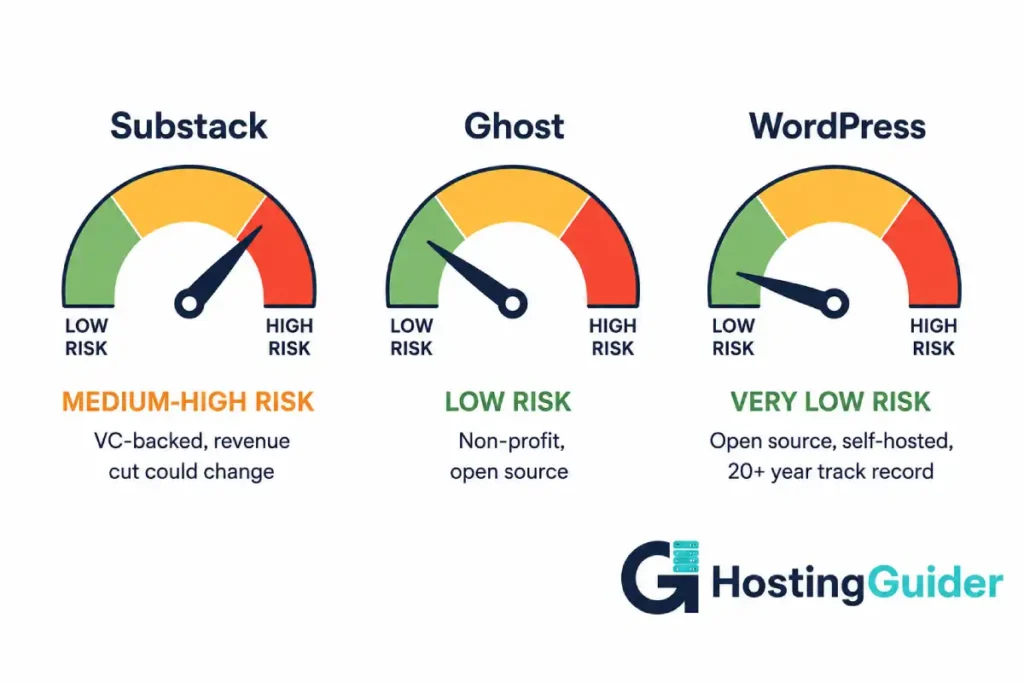
Platform Risk: The Question Substack vs Ghost vs WordPress Publishers Must Answer
This is the question serious publishers should ask before choosing any platform.
Substack Platform Risk
Substack is a venture-capital-backed company. It has raised over $80 million. Investors in a VC-backed company expect a return. The paths to that return include IPO, acquisition, or significant monetisation changes.
Substack has already raised prices. It took 10% from the beginning and has maintained it. Future changes could include higher revenue cuts, advertising requirements, content moderation that affects what you can publish, or feature removal from the free tier.
None of these are inevitable. But the structural incentive for a VC-backed platform is growth and eventual return to investors, not the long-term interests of individual publishers. For writers who have built $50,000/month businesses on Substack, the exposure to these decisions is meaningful.
Ghost Platform Risk
Ghost is run by the Ghost Foundation, a non-profit organisation. Non-profits have structurally different incentives from VC-backed companies. The Foundation’s mission is to support independent publishing. There are no investors to return money to.
This does not make Ghost risk-free. A non-profit can run out of funding. But the failure mode of a non-profit is sunsetting with notice, not pivoting to extract maximum value before an exit. The open-source nature of Ghost means the software survives any platform failure: you can run it yourself forever.
WordPress Platform Risk
WordPress is open-source software maintained by thousands of contributors globally. No single company controls it. Automattic (Matt Mullenweg’s company) is the largest single contributor but cannot unilaterally change the platform’s direction.
Self-hosted WordPress has no meaningful platform risk. If your hosting provider closes, you move to another. If a plugin stops being maintained, you replace it. The software is yours. The data is yours. Nothing can be taken away.
Who Each Platform Is Actually For in the Substack vs Ghost vs WordPress Decision
No hedging. Here are the specific publishing situations each platform serves best.
Substack Is Best For
- A writer with an existing following who wants the fastest path from “I want to charge for my writing” to “my first subscriber is paying me” without a single technical decision
- A journalist or commentator who wants to build within an existing discovery network and benefit from Substack recommendations from established writers
- A publisher whose entire growth strategy is word of mouth, social sharing, and within-platform recommendations rather than SEO
- Someone testing whether a paid audience exists before investing in independent infrastructure
- A writer who is not yet earning enough from subscriptions for the 10% cut to be a significant business decision
Ghost Is Best For
- A serious independent publisher who wants professional publication design, built-in membership management, and zero revenue cut, without the complexity of managing a full WordPress stack
- A writer migrating from Substack who wants to own the payment relationship and keep more revenue at scale
- A publisher who values Ghost’s non-profit ownership model as a form of platform risk management
- Technical writers and long-form journalists who want Ghost’s card-based editor with code blocks, callouts, and clean formatting tools
- A solo publisher without a development team who still wants a more independent setup than Substack
WordPress Is Best For
- Any publisher who intends SEO to be a meaningful growth channel
- A media company or content business building a long-term brand asset, not just a newsletter
- A publisher who needs full flexibility in membership tiers, payment options, and content access rules
- Any operation that will eventually have multiple writers, editors, and contributors with different access levels
- A publisher who wants to own every piece of data, every relationship, and every component of the infrastructure permanently
For non-technical publishers who want managed WordPress with minimal setup complexity, our comparison of DreamHost’s DreamPress vs Pressable covers two platforms built for users who want WordPress capability without server management. Our Kinsta vs WP Engine comparison covers the premium managed tier used by professional publications and agencies.
Final Verdict
The Substack vs Ghost vs WordPress decision is not a features race. Substack wins on ease of launch. Ghost wins on design quality and non-profit ownership model. WordPress wins on SEO, data ownership, long-term cost, and capability ceiling.
What the decision actually comes down to is where you are in your publishing journey and how you plan to grow.
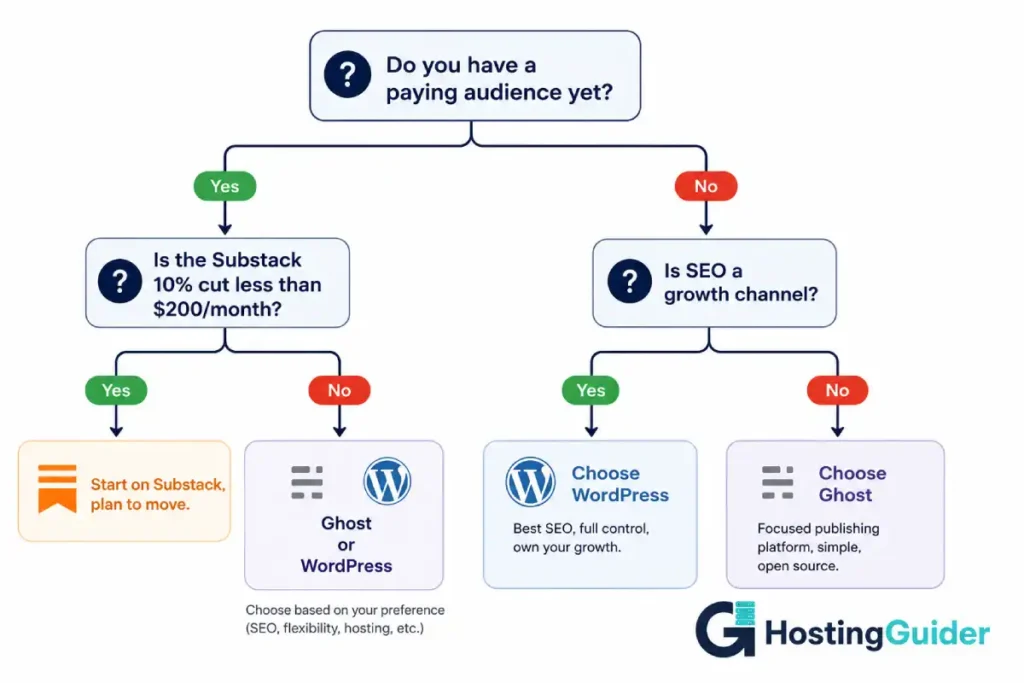
Choose Substack if you are starting, you have an audience, and you want to test paid subscriptions with the lowest possible friction. Accept the 10% cut as a cost of using the distribution network and the simple infrastructure while you validate the model. Plan your exit before you are too embedded to move.
Choose Ghost if you are a serious independent publisher who wants the aesthetic quality and editorial experience of a purpose-built platform, without the revenue cut and with the security of non-profit ownership. Ghost is the platform for writers who take their independence seriously but do not want to manage a WordPress installation.
Choose WordPress if you are building a publishing business, not just a newsletter. The SEO capability alone justifies the additional setup complexity for any publisher whose growth depends on being found by new readers. The zero revenue cut, the complete data ownership, and the unlimited capability ceiling make it the right long-term foundation.
The most common publisher journey: start on Substack to validate, move to Ghost or WordPress when the 10% cut becomes a real business cost. Building on WordPress from the beginning is only harder at launch. After launch, it is better in every dimension that matters for a growing publication.
Final Summary Table
| Category | Substack | Ghost | WordPress |
|---|---|---|---|
| Revenue cut | 10% forever | Zero | Zero |
| Best for launch | Yes | Moderate | Slower start |
| Subscriber ownership | Partial | High | Full |
| Payment relationship | Substack | Your Stripe | Your Stripe |
| SEO capability | Poor | Moderate | Excellent |
| Design flexibility | Low | Good | Unlimited |
| Writing experience | Excellent | Excellent | Good |
| Platform risk | Medium-high | Low | Very low |
| Data portability | Good | Full | Full |
| Three-year cost ($5k/month revenue) | $18,000+ | $1,800 | $1,440 |
| Best for long-term | No | Yes (with caveats) | Yes |
Frequently Asked Questions
Can I move my Substack newsletter to WordPress?
Yes. Substack allows full export of your subscriber list as a CSV and your posts as an export file. Free subscribers transfer cleanly: import their email addresses to MailPoet, ConvertKit, or your chosen email tool and continue sending. Paid subscribers are the challenge. Their billing relationship is with Substack. Moving them requires re-subscription on the new platform. Industry experience suggests 30 to 50% of paid subscribers do not complete the re-subscription process in a migration. Plan the migration carefully with a dedicated re-engagement campaign.
Substack vs Ghost vs WordPress SEO: Is Ghost Better Than Substack for Search Rankings?
Yes. Ghost produces faster-loading pages, cleaner HTML, proper meta tags, and a more SEO-aware architecture than Substack. Ghost is not in the same league as WordPress for technical SEO depth. But for a publisher who wants reasonable search visibility without managing a full WordPress plugin stack, Ghost is the better choice between the two.
Does Substack really take 10% forever?
Yes. Substack charges 10% of paid subscription revenue plus Stripe’s standard transaction fee on every payment, with no cap and no pricing tier that reduces it. There is no plan upgrade that removes the 10%. The only way to stop paying it is to move to a different platform.
Substack vs Ghost vs WordPress: Why Do Serious Publishers Choose WordPress Over Ghost?
Two reasons primarily. First, SEO: a WordPress publication with Yoast SEO, proper schema markup, and a managed host optimised for performance builds domain authority that compounds over years in a way Ghost cannot match. Second, ecosystem depth: when a publication needs custom functionality, specific integrations, or capability beyond standard publishing tools, WordPress’s 60,000+ plugin ecosystem almost always has a solution. Ghost’s plugin ecosystem is significantly smaller.
Is Substack good for writers who do not want paid subscriptions?
Yes. Free Substack is a strong platform for building an email list, publishing regularly, and growing an audience without technical complexity. The 10% cut does not apply until you enable paid subscriptions. Many successful writers use Substack at the free tier for years before monetising. The platform risk still applies, but the financial cost is zero until you earn.
Substack vs Ghost vs WordPress Newsletter Capability: Can WordPress Match Both Platforms?
Yes, with the right setup. MailPoet handles list management and email delivery natively within WordPress. For professional newsletter operations, pairing WordPress with ConvertKit (now Kit) provides better segmentation, automation, and deliverability than Substack or Ghost for established lists. The setup requires more configuration than either Substack or Ghost, but the resulting capability is higher.
Substack vs Ghost vs WordPress Platform Ownership: Why Is Ghost Run by a Non-Profit?
Ghost was founded by John O’Nolan in 2013 with a crowdfunding campaign that raised $300,000. O’Nolan structured Ghost as the Ghost Foundation, a non-profit organisation, specifically to prevent the platform from being acquired, pivoting toward advertising, or prioritising investor returns over publisher interests. The decision was a deliberate rejection of the VC funding model that created Substack. For publishers making long-term platform decisions, the non-profit structure is a meaningful difference in platform risk.