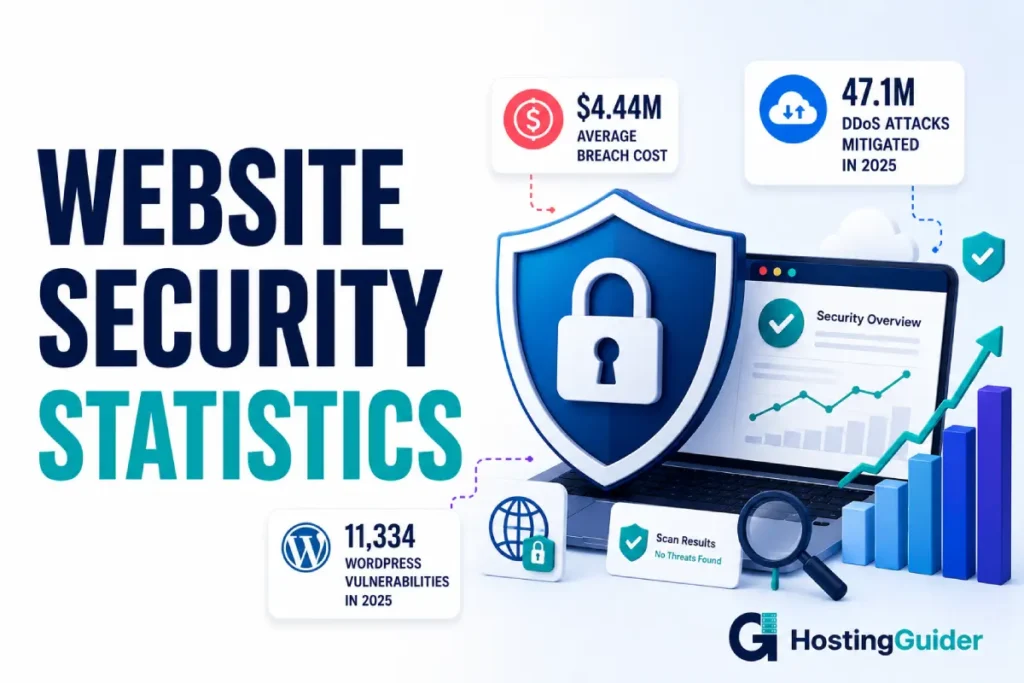
A data breach now costs the average organization $4.44 million, and for the first time in five years, that number actually fell.
Cloudflare mitigated 47.1 million DDoS attacks across 2025, more than double the year before. And 46% of WordPress vulnerabilities disclosed in 2025 had no patch available when they were disclosed.
Website security is not a background concern for IT teams anymore. It directly affects hosting decisions, CMS choices, server configuration, and the cost of running any online business.
This page compiles the most current and verifiable website security statistics available, organized by breach costs, attack frequency, WordPress-specific risks, DDoS data, HTTPS adoption, and the hosting security connection.
Every statistic is sourced from primary research firms, official industry bodies, or security companies’ own published research.
Table of Contents
Quick Stats: Key Website Security Numbers for 2026
- Average global data breach cost: $4.44 million, down 9% year over year (IBM Cost of a Data Breach Report 2025)
- US organizations: average breach cost $10.22 million, a record high and the highest of any country (IBM 2025)
- Healthcare breach average: $7.42 million per incident, the costliest industry for the 14th year running (IBM 2025)
- Average time to identify and contain a breach: 241 days, a nine-year low (IBM 2025)
- Cloudflare DDoS attacks mitigated in 2025: 47.1 million, more than double 2024 (Cloudflare Radar)
- WordPress vulnerabilities in 2025: 11,334, a 42% increase over 2024 (Patchstack)
- HTTPS adoption: 90.0% of all websites now default to HTTPS (W3Techs, June 2026)
- Top 100,000 websites using HTTPS by default: 92.6% (W3Techs)
- Let’s Encrypt: the #1 SSL certificate authority by market share (W3Techs SSL data)
- Human element: involved in roughly 60% of all breaches (Verizon 2025 DBIR)
Key Takeaways
After five straight years of increases, the global cost of a data breach finally dropped in 2025, largely because organizations are detecting and containing breaches faster, helped by AI-driven security tooling. But the headline improvement hides real divergence: US breach costs kept climbing to a record $10.22 million, and the time it takes to detect a breach is still measured in months, not days. At a 241-day average detection-and-containment window, most breaches still cause significant damage before anyone notices.
For website owners specifically, the risk profile differs from enterprise IT. Plugin vulnerabilities, unpatched CMS installations, shared hosting environments, and weak credentials are the most common entry points. These are problems with practical, hosting-related solutions.
The progress on HTTPS adoption is real: 90% of all websites now default to HTTPS, and Chrome telemetry shows the overwhelming majority of page loads are encrypted. But encryption alone does not prevent breaches; it prevents interception in transit. Security runs deeper than an SSL certificate.
Data Breach Costs and Global Impact
Global Average Breach Cost
The global average cost of a data breach fell to $4.44 million in 2025, according to IBM’s Cost of a Data Breach Report 2025.
This represents a 9% decrease from the prior year’s $4.88 million, the first decline in five years, driven largely by faster identification and containment powered by AI-enhanced security tools (IBM analysis).
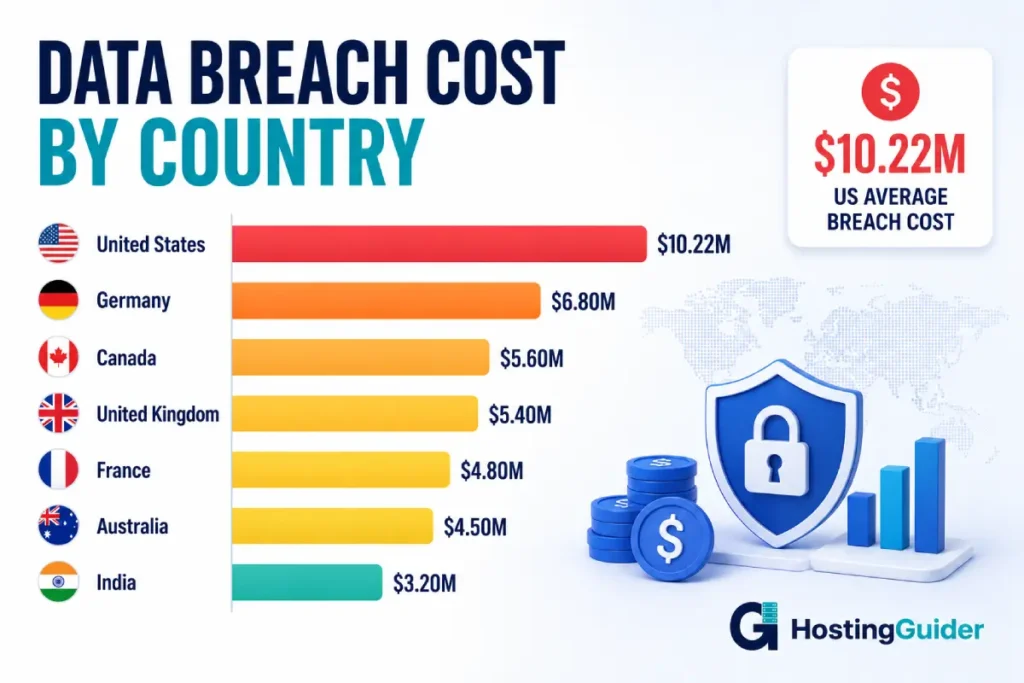
The United States consistently records the highest national breach costs. US organizations paid an average of $10.22 million per breach, a record high, driven by regulatory penalties and slower detection times, and more than double the global average (Source).
Breach Costs by Industry
Industry determines how much a breach costs. The most expensive sectors globally, per IBM’s 2025 report:
| Industry | Average Breach Cost |
| Healthcare | $7.42 million |
| Financial services | $5.56 million |
| Industrial | $5.00 million |
| Public sector | $2.86 million |
| Global Average | $4.44 million |
Healthcare has held the most expensive breach record for 14 consecutive years, according to IBM’s research, even though its average cost dropped sharply from $9.77 million in the prior report.
Detection and Containment Time
One of the most consequential findings in breach research is how long breaches go undetected.
From IBM’s Cost of a Data Breach Report 2025:
- The global average breach lifecycle dropped to 241 days, 181 days to identify plus 60 days to contain, the lowest figure in nine years.
- Breaches involving stolen or compromised credentials take the longest to resolve, at an average of 292 days.
- Breaches contained within 200 days cost an average of $3.87 million, while those exceeding 200 days cost $5.01 million, a $1.14 million penalty for slow detection.
This detection gap has direct implications for website owners. Hosting environments with active malware scanning, anomaly detection, and automated alerting narrow this window significantly.
Cybercrime Scale and Attack Frequency
Overall Cybercrime Economy
Cybercrime costs are growing faster than most industries. Key estimates:
- Cybersecurity Ventures estimated the total global cost of cybercrime at $10.5 trillion for 2025, and forecasts it will climb to $12.2 trillion annually by 2031. If measured as a national economy, cybercrime would rank as the world’s third largest.
- Organizations faced an average of 1,968 cyber attacks per week in 2025, a 70% increase since 2023, according to Check Point’s Cyber Security Report 2026.
- Third-party involvement in breaches doubled from 15% to 30% in a single year, per Verizon’s 2025 Data Breach Investigations Report (DBIR).
Common Attack Vectors
Understanding how attackers get in helps website owners prioritize defenses. The most common initial access vectors across breaches, per Verizon’s 2025 DBIR:
- Credential abuse: 22% of breaches, stolen, leaked, or weak login credentials remain the single dominant entry point.
- Exploitation of vulnerabilities: 20%, unpatched software, plugins, or server software.
- Phishing: 16%, social engineering targeting administrators and site owners.
- Human element: involved in roughly 60% of all breaches in some form, whether error, manipulation, or misuse.
For website owners, the top practical risk factors are reused or weak admin passwords, unpatched plugins, and hosting accounts without two-factor authentication. Our guide on implementing two-factor authentication for your hosting account covers the setup process.
WordPress-Specific Security Statistics
Vulnerability Growth in 2025
WordPress powers more than 40% of the web, around 43% of all websites, per W3Techs CMS data, which also makes it the largest single target for web-based attacks. The security numbers for 2025 reflect that scale.
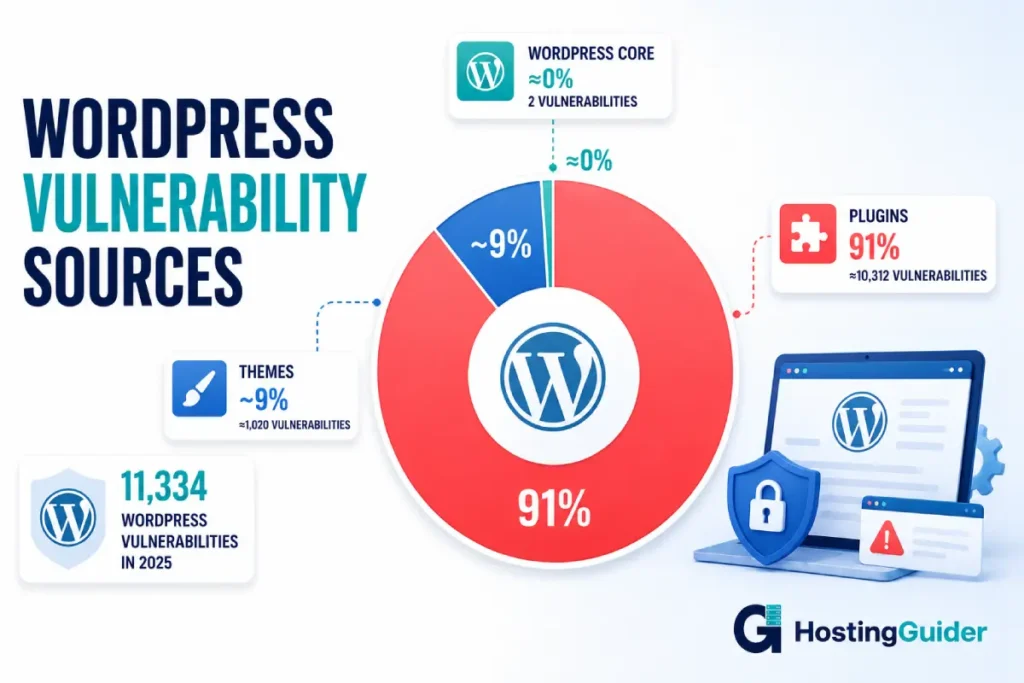
11,334 new WordPress vulnerabilities were disclosed in 2025, a 42% increase from 7,966 in 2024, according to Patchstack’s State of WordPress Security in 2026 report.
Key findings from Patchstack’s research:
- 91% of all WordPress vulnerabilities originate in plugins; only two were found in WordPress core all year.
- Highly exploitable vulnerabilities rose 113% year over year; more high-severity flaws were found in 2025 than in the previous two years combined.
- 1,966 (17%) of disclosed vulnerabilities carried a high-severity score, meaning they were likely targets for mass automated attacks.
- 46% of vulnerabilities had no developer patch available at the time of public disclosure.
- The weighted median time from disclosure to first mass exploitation was just 5 hours; 20% were exploited within 6 hours, 45% within 24 hours, and 70% within 7 days.
Patchstack also found that traditional, generic WAF setups blocked only 12% of WordPress-specific vulnerability exploits in its testing, a reminder that relying on plugin updates and a generic firewall alone is no longer a viable defense when attackers weaponize new flaws within hours.
Wordfence, the most widely deployed WordPress security plugin, continues to block tens of millions of exploit attempts and billions of brute-force login attempts across its network every month, a baseline level of automated, untargeted attack traffic that every WordPress site is exposed to.
Hosting and WordPress Security
The type of hosting environment significantly affects how WordPress sites handle security threats:
- Shared hosting creates a “neighbor risk”; one compromised site on a shared server can affect others through cross-site contamination. See our article on zero-day exploits and shared hosting risk for more details.
- Managed WordPress hosting providers typically include server-level malware scanning, firewall rules tuned for WordPress, automatic core updates, and daily backups.
- VPS and dedicated hosting give site owners full control but require manual security configuration.
For a full breakdown of what managed hosting handles on the security side, see our article on managed WordPress security.
DDoS Attack Statistics
Attack Volume: Cloudflare’s Own Data
Distributed Denial-of-Service (DDoS) attacks flood a target server with traffic until it becomes unavailable to real users. The scale of DDoS activity in 2025 was striking.
Cloudflare, one of the world’s largest DDoS mitigation networks, publishes its own quarterly threat reports. According to Cloudflare’s DDoS threat reporting for 2025:
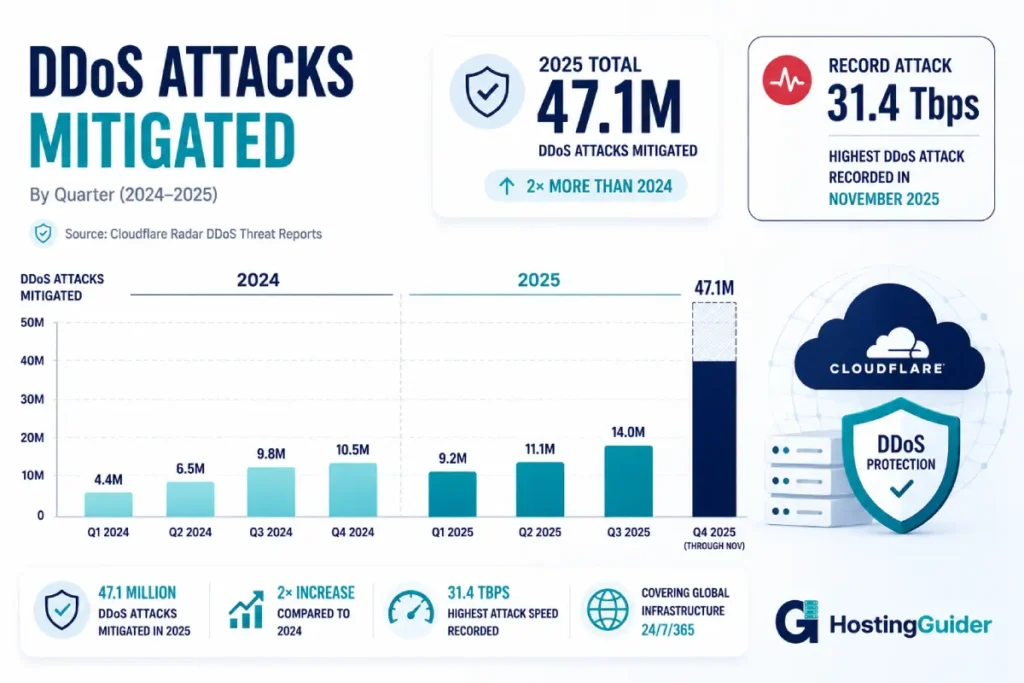
- Cloudflare mitigated 47.1 million DDoS attacks across all of 2025, more than double the prior year.
- In Q1 2025 alone, Cloudflare blocked 20.5 million DDoS attacks, a 358% year-over-year increase, nearly matching its entire 2024 total in a single quarter.
- Network-layer DDoS attacks more than tripled year over year in 2025.
- Cloudflare blocked a 7.3 Tbps attack in May 2025, the largest ever recorded at the time.
- That record was shattered in November 2025 by a 31.4 Tbps attack launched by the Aisuru botnet, roughly six times the peak of the largest attack recorded in 2024.
Most attacks in 2025 lasted under 10 minutes, effectively closing the window for human-led mitigation and pushing the industry toward fully autonomous defenses.
Cloudflare’s 2026 Threat Report frames the shift bluntly: attackers are trading one-off “sophistication” for sheer throughput, and hyper-volumetric attacks now demand automated response.
Cost of a DDoS Attack
The financial impact of a DDoS attack extends beyond immediate downtime:
- Reputational damage, lost customer trust, and recovery costs compound the direct revenue loss.
- For ecommerce businesses, even brief downtime during peak sales periods can cause disproportionate damage.
- Enterprise-level DDoS attacks can cost millions in a single incident.
For website owners, the most practical defense is choosing a hosting provider that includes DDoS mitigation at the infrastructure level.
HTTPS and SSL Certificate Adoption
HTTPS Now Covers Nearly the Entire Web
The shift to HTTPS encryption has reached near-universal adoption.
Current statistics:
- 90.0% of all websites now default to HTTPS (W3Techs, June 2026), meaning they automatically redirect visitors to an encrypted connection.
- 92.6% of the top 100,000 websites use HTTPS by default (W3Techs).
- More than 95% of Chrome page loads on desktop use HTTPS (Google Transparency Report).
- HTTPS adoption on Chrome for Android has surpassed 99% (Google Transparency Report).
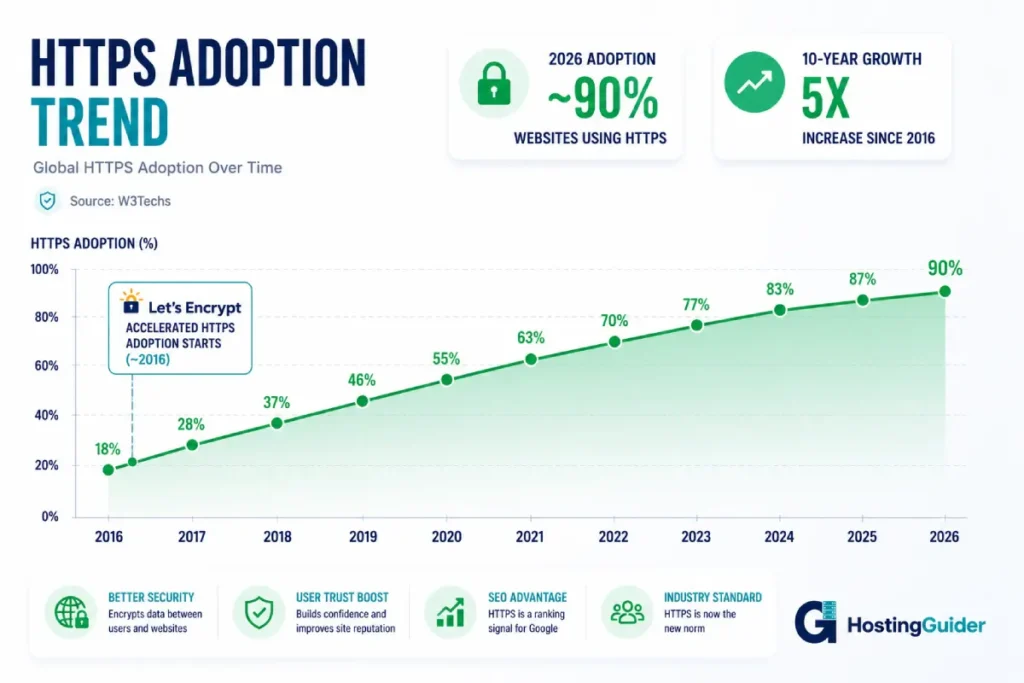
The data comes from W3Techs’ continuous survey of millions of websites and from Google’s HTTPS Transparency Report, which tracks Chrome browser encryption rates across platforms.
SSL Certificate Market: Let’s Encrypt Dominates
W3Techs tracks SSL certificate authority market share across millions of websites continuously. Let’s Encrypt is the #1 SSL certificate authority by market share globally. By issuing free, automated certificates, Let’s Encrypt made HTTPS adoption practically free for any website owner and directly drove the surge in HTTPS adoption since 2016.
Most major hosting providers now include free SSL certificates, typically via Let’s Encrypt integration. This represents a major shift from the era when SSL certificates cost $50–$300 per year and required manual installation.
For context on what an SSL certificate does and does not protect, see our article on why HTTPS is not enough, and what hosting security layers you still need.
What SSL Does Not Protect
A valid SSL certificate encrypts data in transit between the browser and server. It does not:
- Prevent malware injected into your site files
- Stop brute-force login attacks targeting your admin panel
- Protect against plugin vulnerabilities
- Secure data already stored on your server
HTTPS is a baseline requirement, not a complete security posture. See our essential hosting security tips for a broader checklist.
Hosting Security Risks by Type
Shared Hosting Security Considerations
Shared hosting places multiple websites on the same physical server. When one site is compromised, it can create risks for neighboring sites through shared resources. The most common shared hosting security issues include:
- Cross-site contamination: Malware spreads through shared file system access
- IP reputation damage: A spamming neighbor affects your server’s IP reputation for email delivery
- Resource exhaustion: A compromised site’s processes consume shared CPU and RAM
These cross-tenant risks are covered in more depth in our earlier section on shared hosting and zero-day exposure.
Hosting Security Across Different Tiers
The security controls available to website owners vary significantly by hosting type:
| Hosting Type | Server-Level Firewall | Malware Scanning | DDoS Mitigation | Isolation Level |
| Shared Hosting | Provider-managed | Varies | Basic | Low |
| VPS Hosting | Configurable | Owner-managed | Varies | High |
| Managed WordPress | WordPress-tuned | Included | Included | Medium-High |
| Dedicated Server | Full control | Owner-managed | Varies | Full |
GDPR and Compliance Context
Website security is not only a technical concern; it is a legal one:
- The GDPR requires breach notification to supervisory authorities within 72 hours of discovery (GDPR Article 33).
- Reported personal data breaches to European supervisory authorities have continued to trend upward year over year as enforcement matures.
- US data breach regulations vary by state, with California’s CCPA among the strictest.
For businesses using web hosting to process customer data, compliance requirements directly affect hosting choices, server location, data processing agreements with the host, and access logging are all relevant. See our guide on GDPR-compliant hosting requirements for practical guidance.
Frequently Asked Questions
What is the average cost of a data breach in 2026?
The most recent verified figure is $4.44 million as the global average, from IBM’s Cost of a Data Breach Report 2025, a 9% decrease from the prior year and the first decline in five years. US organizations still face an average of $10.22 million per breach, the highest national figure globally and a record high.
What percentage of the web uses HTTPS in 2026?
90.0% of all websites now default to HTTPS, according to W3Techs (June 2026), and 92.6% of the top 100,000 websites use it by default. Google’s Transparency Report shows more than 95% of Chrome desktop page loads and over 99% of Chrome-on-Android page loads are encrypted. Let’s Encrypt is the #1 SSL certificate authority by market share, having made free certificates the standard for most websites.
How many WordPress vulnerabilities were disclosed in 2025?
Patchstack documented 11,334 new WordPress vulnerabilities in 2025, a 42% increase from 7,966 in 2024. 91% originated in plugins, only two were found in WordPress core, and 46% had no patch available at the time of public disclosure.
How big was the DDoS attack problem in 2025?
Cloudflare alone mitigated 47.1 million DDoS attacks in 2025, more than double 2024, including 20.5 million in Q1 (a 358% year-over-year jump). The year set a new record with a 31.4 Tbps attack in November 2025. These figures reflect only one provider’s mitigation data; the global total is significantly higher.
Does hosting type affect website security?
Yes, significantly. Managed WordPress hosting providers typically include server-level firewalls tuned for WordPress, automated malware scanning, DDoS mitigation, and daily backups. Shared hosting provides the least isolation between neighboring sites. VPS and dedicated hosting offer the most control but require manual security configuration.
How long does it take to detect a data breach?
On average, 241 days to identify and contain a breach, the lowest in nine years, according to IBM’s 2025 research. Breaches involving stolen credentials take the longest at around 292 days. Containing a breach within 200 days saves an average of $1.14 million compared with those that drag on longer.