When you register a domain name, you hand over personal information. Your name, your email address, your phone number, and your mailing address.
That information goes into a public database called WHOIS. Without privacy protection, anyone in the world can look up your domain name and see all of it.
Domain privacy protection is the service that replaces your real information with the registrar’s contact details in that public database. Most registrars offer it. Some include it free. Others charge a few dollars a year.
But privacy protection does not hide everything. And understanding what it covers and what it leaves exposed is important before you assume you are fully protected.
This guide explains exactly what domain privacy protection does, what it does not do, and whether you actually need it.
What WHOIS Is and Why It Exists
WHOIS is a public database that stores registration information for every domain name. It was created in the early days of the internet so that network administrators could find out who operated a domain for technical and administrative reasons.
Every time a domain is registered, the registrar submits contact information to the WHOIS database. That information becomes publicly accessible almost immediately.
The Internet Corporation for Assigned Names and Numbers, known as ICANN, governs the domain name system and sets rules for what registrars must collect and make available.
You can search WHOIS data through tools like ICANN Lookup or through most domain registrars’ lookup tools. Any domain name you type into these tools reveals its registration information unless privacy protection is active.
What Your WHOIS Record Includes Without Privacy Protection
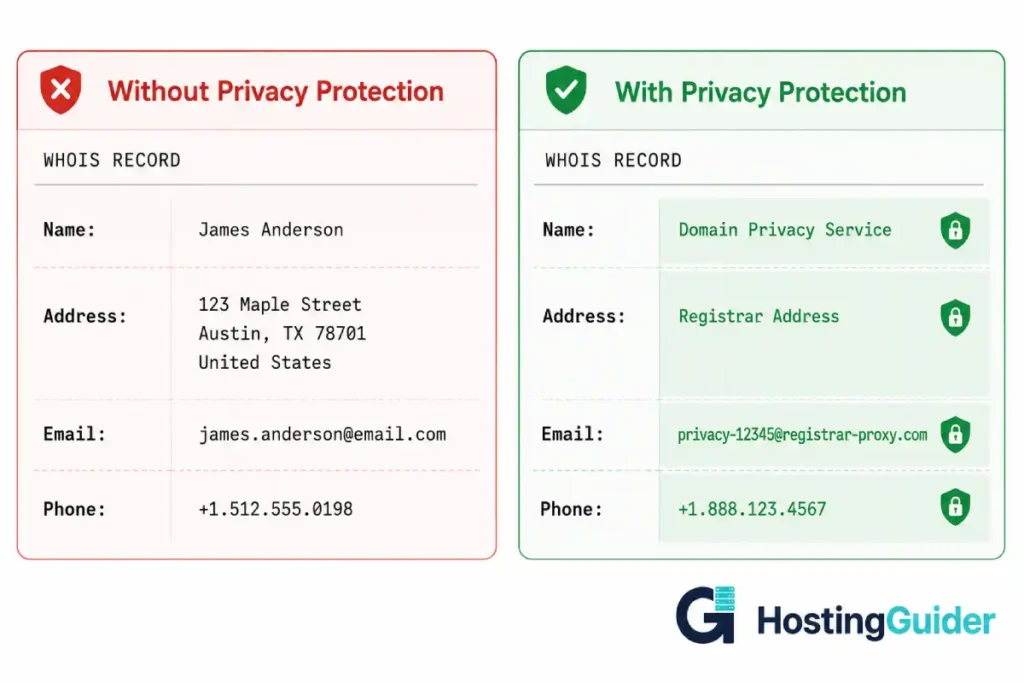
Without privacy protection, your WHOIS record typically contains:
- Your full legal name or business name
- Your mailing address including street, city, country, and postal code
- Your email address
- Your phone number
- Your fax number if provided
- The name of your registrar
- The date the domain was registered
- The date the registration expires
- The domain’s nameservers
- The name and contact details of the technical contact
- The name and contact details of the administrative contact
All of this is visible to anyone who searches for your domain name. No login required. No fee. Anyone with internet access can see it.
What Domain Privacy Protection Actually Does
Domain privacy protection replaces your personal contact details in the WHOIS database with the registrar’s or a proxy service’s contact details.
Instead of your name and home address, the WHOIS record shows something like:
- Name: Domain Privacy Service
- Address: Registrar’s business address
- Email: A forwarding address generated by the registrar
- Phone: A generic number that routes to a message service
Your actual contact information is stored by the registrar but not shown publicly. Anyone looking up your domain sees the proxy contact details instead.
Email sent to the forwarding address is typically forwarded to your real email. Some registrars forward all email. Others filter for legitimate contact requests and block obvious spam.
What Privacy Protection Hides
When domain privacy protection is active, these things are hidden from public WHOIS lookups:
- Your personal name or business name
- Your home or office mailing address
- Your personal email address
- Your personal phone number
- Your fax number
For individuals running websites from home, these are significant pieces of personal information. A home address and personal phone number in a public database is a genuine privacy concern, particularly for solo operators, bloggers, freelancers, and small business owners who do not operate from a commercial address.
What Privacy Protection Does Not Hide
This is the part most people do not realise.
Privacy protection is specifically about the WHOIS contact fields. It does not hide everything about your domain or your website. Several important pieces of information remain publicly visible regardless of whether privacy protection is active.
The domain name itself The domain you registered is public by design. Privacy protection does not make your domain name invisible.
The registrar name Your registrar is visible in WHOIS. Anyone looking up your domain can see which company you registered it through.
Registration and expiry dates The date your domain was registered and the date it expires are public. This tells observers how old your domain is and when it renews.
The nameservers Your domain’s nameservers are visible. Nameservers often reveal which hosting provider or DNS service you use. If your nameservers are ns1.cloudflare.com and ns2.cloudflare.com, that is visible to anyone.
Your website content and server IP Your website is public. Your server’s IP address can be found through a simple DNS lookup regardless of WHOIS privacy settings.
SSL certificate records Every SSL certificate issued for a domain is logged in the Certificate Transparency system, which is publicly searchable. This can reveal subdomains and certificate history even when WHOIS is private.
Historical WHOIS data Before privacy protection was active on your domain, your real contact details were in WHOIS and may have been archived by third-party WHOIS history services. Privacy protection does not erase historical records.
Business registration information If you run a registered business, your company information may be in public business registries that are entirely separate from WHOIS.
What Privacy Protection Prevents in Practice
Even with its limitations, privacy protection provides meaningful practical benefits.
It prevents automated email harvesting Bots scrape WHOIS records for email addresses to add to spam lists. Your personal email address in a public database without privacy protection is a direct feed to those lists. Privacy protection stops that specific data pipeline.
It reduces unsolicited contact Domain brokers, SEO agencies, web design companies, and scammers regularly harvest WHOIS contact information to send unsolicited offers and messages. Privacy protection removes your contact details from that pipeline.
It protects your home address For individuals who register domains from a home address, privacy protection prevents that address from being publicly searchable by domain name.
It reduces targeted spam to your registration email The email address used to register a domain is often different from addresses listed elsewhere. Privacy protection stops that specific address from being exposed.
It provides a modest layer of protection against social engineering Having your name, address, phone number, and email visible together in one place makes social engineering attacks easier. Privacy protection removes that combination from the public record.
What Privacy Protection Does Not Prevent
Law enforcement access Registrars are required to provide real registration information to law enforcement and legal authorities when required by law. Privacy protection hides your information from the general public, not from governments or courts.
Legal disputes and UDRP proceedings The Uniform Domain Name Dispute Resolution Policy governs domain name disputes. In a formal dispute proceeding, registrars must disclose the registrant’s real information to the relevant dispute resolution body. Privacy protection does not shield you from this.
Your hosting provider knowing who you are Your hosting provider has your real payment information and account details regardless of WHOIS privacy settings.
Someone finding you through other means If your name or business is mentioned on your website, on social media, in press coverage, or in any public record, WHOIS privacy does not prevent someone from connecting those dots.
Overly determined investigators Historical WHOIS data, DNS records, certificate transparency logs, and public business registries together can often identify a registrant even with privacy protection active. Privacy protection raises the barrier. It does not make identification impossible.
WHOIS and GDPR
The relationship between WHOIS and GDPR has changed significantly since 2018.
GDPR restricts the collection and publication of personal data from EU residents. In response, ICANN and most major registrars reduced the amount of personal information published in WHOIS records for registrants in the EU and EEA.
As a result, if you are an individual in the EU registering a domain, your personal contact information may already be partially or fully hidden in public WHOIS regardless of whether you pay for privacy protection. The required data fields in public WHOIS have been reduced to comply with GDPR.
This does not mean privacy protection is irrelevant for EU registrants. Registrars still collect your full contact information. The privacy protection question shifts toward what the registrar does with that data and whether they have signed appropriate data processing agreements.
Read our GDPR and hosting guide for more on data protection requirements that extend beyond WHOIS privacy.
Who Needs Domain Privacy Protection Most
Privacy protection matters most for certain types of registrants.
Individuals running websites from home addresses If your domain registration uses your home address, that address is in a public database. Privacy protection removes it.
Bloggers, freelancers, and solo operators People who run websites independently without a commercial address benefit significantly from keeping their personal contact details out of a public database.
Anyone concerned about spam The reduction in unsolicited contact from email harvesters and domain marketers is a practical day-to-day benefit for most registrants.
Small businesses without a public-facing address A business that does not want its operating address publicly searchable by domain name benefits from privacy protection.
Who Needs It Less
Large registered businesses with public addresses If your company has a public business address, a listed phone number, and a public-facing email, hiding those same details in WHOIS provides limited additional privacy.
Anyone whose domain is already publicly associated with their identity If your website carries your name and biography, hiding your name from WHOIS provides minimal privacy benefit since the association is already public.
What Good Privacy Protection Looks Like
Not all privacy protection is implemented equally. Here is what to look for.
| Feature | What It Means | Why It Matters |
|---|---|---|
| Full contact replacement | All fields replaced, not just email | Partial replacement leaves some exposure |
| Email forwarding | Legitimate emails still reach you | You do not miss genuine contact |
| Spam filtering on forwarded email | Junk filtered before reaching you | Reduces rather than redirects spam |
| Included free or low cost | No incentive to let it lapse | Consistency over time |
| Applies immediately at registration | Not activated manually after purchase | No gap in protection |
| Applied at renewal automatically | Does not lapse when domain renews | Continuous coverage |
Registrars that include privacy protection free on all domains and apply it automatically are significantly better than registrars that charge extra or require manual activation. Namecheap includes privacy free. Porkbun includes privacy free. Cloudflare Registrar does not charge for privacy. These are better defaults than registrars who charge several dollars per year as an add-on.
Read our guide on how to buy a domain name and why your domain name matters more than most people realise for the broader domain decision context.
The Cost Question
Domain privacy protection typically costs between zero and five dollars per year depending on the registrar.
At that price, for any individual or small business, it is almost always worth adding if it is not already included free.
The protection it provides against spam, unsolicited contact, and personal information exposure is tangible. The cost is negligible. The only reason not to have it is if you have chosen a registrar that includes it by default.
If your registrar charges significantly more than five dollars per year for privacy protection, that is a registrar charging above-market rates for a commodity service. Consider whether better-value registrars might serve you better overall.
Summary
Domain privacy protection is a useful and affordable service. It does one specific thing very well: it removes your personal contact information from a public database that anyone can search.
It does not make you invisible online. It does not hide your domain, your website, your hosting, or your business. It does not protect you from legal disclosure requirements. It does not erase historical records.
For individuals and small businesses, the protection it provides against spam and personal information exposure is worth the small cost or the five minutes to confirm it is active on your registration.
Check your current domain registrations now. If privacy protection is not active, activate it. If your registrar charges more than a few dollars per year for it, that cost is worth weighing against what better registrars offer for free.