For years, the e-commerce world followed a strict rule. Small stores used basic website builders. Big, serious businesses built custom sites on deep platforms.
Today, that line is completely gone. Modern website builders have evolved into heavy software engines. They now power massive brands, track worldwide inventory, and process millions in sales.
You can absolutely run a serious store on a website builder, but your business structure must fit inside their software limits.
What Makes an E-Commerce Store Serious?
A serious store is not defined by how many developers you hire. It is defined by your daily operational workflow and transaction volume.
A serious brand needs to process thousands of clean orders every single month. It must sync stock across places like Amazon and eBay instantly. It relies heavily on fast loading speeds to keep buyers from bouncing. Finally, it uses automated marketing setups like abandoned cart recovery to capture lost sales.
If your software platform struggles with these tasks, your business will lose money.
Where Modern Builders Win the Game
Modern platforms are no longer slow or clunky. They handle massive global traffic bursts with zero issues.
Built-In Loading Speed
Slow pages kill conversions. In the past, drag-and-drop code was heavy and slow. Today, optimized cloud infrastructure runs these platforms fast. Data shows website builders beat unoptimized open-source sites on speed tests regularly, keeping mobile shoppers happy.
Multi-Channel Syncing
Serious brands do not sell in just one spot. Modern builders connect directly to outside marketplaces. When a customer buys an item on Instagram or TikTok, your central dashboard updates your stock numbers instantly. This completely stops you from accidentally selling items you do not have in stock.
Automated Marketing Tools
You do not need to buy ten different apps to run your shop. Email tools, reward points, and abandoned cart alerts are already built into the core dashboard.
The Walled Garden: Where Builders Face Friction
A website builder is a managed ecosystem. This setup gives you great ease of use, but it also creates strict boundaries.
The Product Catalog Ceiling
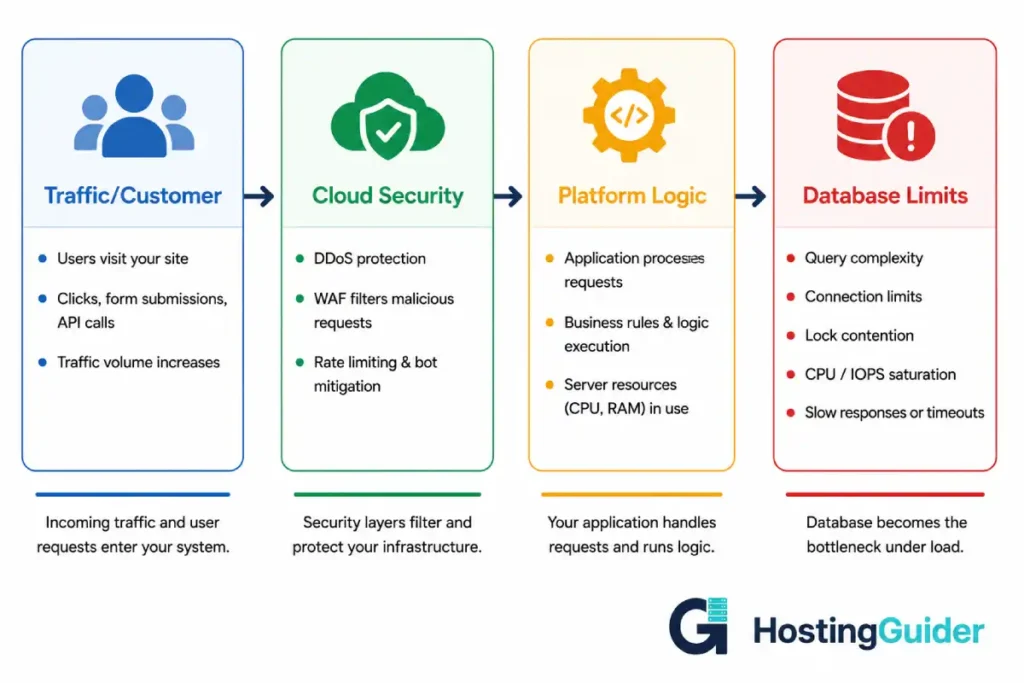
Most website builders have a hard cap on database limits. For example, some platforms limit you to exactly 50,000 items. This works great for clothing lines or boutique gear. However, it will not work for huge dropshipping sites that need hundreds of thousands of individual listings.
Locked Checkout Systems
You cannot change the core checkout code. If your business needs a highly custom payment flow, like specific wholesale tax exemptions or multi-address shipping choices, website builders will block you.
Rigid API Connections
As a business scales up, it starts using advanced warehouse software and heavy data systems. Linking custom third-party databases into a closed builder ecosystem is much harder than working with open-source code.
Reviewing the Top Options
If a managed platform matches your product goals, pick your software based on your exact feature needs.
Wix eCommerce
Wix offers incredible flexibility for growing shops. It handles detailed search optimization tools and clean catalog structures smoothly.
If you are planning a massive structural shift, moving your site to a dedicated Cloudways environment or using a hosted builder depends entirely on your tech budget.
Squarespace Commerce
Squarespace is the ultimate choice for highly visual brands. Its backend is beautifully simple, making it perfect for smaller product lines that focus on clean design.
Platform Comparison: Hosted vs. Open-Source
Choosing your infrastructure path changes your daily technical workload completely.
| Operational Feature | Hosted Website Builder | Custom Open-Source (WooCommerce) |
| Server Upkeep | Handled by platform (0 hours) | Managed entirely by your tech team |
| Platform Security | Fully automated at the edge | Requires setting up a web hosting firewall |
| Product Limits | Often capped (e.g., 50,000 items) | Unlimited server space |
| Code Access | Restricted to front-end tools | Total control over all database files |
If you run an open-source store on your own server, you carry all data risks. You must run a full WordPress security checklist and use strong DDoS protection hosting to stay online.
With a website builder, the host manages all that structural defense automatically.
The True Cost of Scaling Up
Many business owners forget to check how platform fees change as order volumes climb higher.
When you launch a store on Squarespace, entry-level plans charge transaction fees on specific digital items or memberships. Upgrading to their top business plans eliminates these platform fees, leaving you with just your standard card processing costs.
Wix follows a similar pattern. While physical item sales are fee-free on standard plans, advanced tools like recurring subscription models change fee percentages based on your specific plan tier.
Always map out your monthly sales numbers against these tier limits to protect your profit margins.
The Final Verdict
You can easily run a serious business on a website builder if your operations match their strengths.
Say Yes if:
- Your total catalog stays below 50,000 items.
- You want a lean team focused on marketing rather than fixing server errors.
- Your buyers use a standard checkout flow.
- You want steady website uptime metrics without hiring full-time engineers.
Say No if:
- You manage massive inventories that change constantly.
- Your items require highly complex custom code calculations during checkout.
- You focus entirely on wholesale business models with unique client registration fields.
Managed builders allow you to ignore server settings completely. This lets you put all your energy directly into driving sales revenue.