Enterprise businesses have hosting requirements that go well beyond what a standard plan can handle. Performance at scale, compliance obligations, security at the infrastructure level, and uptime that directly affects revenue all demand a different conversation.
Managed hosting removes the burden of server administration from your team. The provider handles infrastructure, security, monitoring, and maintenance. Your team focuses on the business.
This guide covers what managed hosting means at the enterprise level, which options exist, and what to look for before committing to a provider.
What Managed Actually Means at Enterprise Scale
Managed hosting is not the same for a small business and an enterprise. The label covers a wide range of service levels.
At the basic end, managed means the provider handles server patching and updates. At the enterprise end, it means:
- 24/7 proactive infrastructure monitoring
- Dedicated account management
- SLA-backed uptime guarantees with financial penalties for failure
- Security management including WAF, DDoS mitigation, and threat response
- Performance optimisation at the server level
- Compliance support for PCI DSS, HIPAA, or GDPR environments
- Disaster recovery and failover infrastructure
The more your business depends on uptime and performance, the more of these you need covered by the provider rather than your internal team.
Why Enterprises Choose Managed Over Unmanaged
Unmanaged hosting gives you full control but places all operational responsibility on your team. For most enterprise environments, that trade-off does not make sense.
| Factor | Managed Hosting | Unmanaged Hosting |
|---|---|---|
| Server maintenance | Provider handles it | Internal team handles it |
| Security patching | Automatic, provider-managed | Manual, team responsibility |
| Incident response | Provider responds 24/7 | Internal team responds |
| Compliance support | Often included or available | Must be built internally |
| Uptime SLA | Backed by provider contract | No provider accountability |
| Cost | Higher monthly | Lower monthly, higher staffing cost |
The real cost of unmanaged hosting at enterprise scale is not the server price. It is the staffing, response times, and risk exposure when something goes wrong at 2am. Our managed vs. unmanaged hosting guide covers this trade-off in practical terms.
Enterprise Managed Hosting Options
There are four primary categories of managed hosting suited to enterprise needs. Each serves a different use case.
Managed Dedicated Servers
A dedicated server gives your business exclusive use of a physical machine. No other organisations share the hardware. Managed dedicated means the provider handles all server-level operations while you retain control of your applications and data.
Best for:
- Businesses with consistent, high-volume traffic
- Industries with strict data isolation requirements such as healthcare and financial services
- Applications that cannot tolerate the variability of shared physical infrastructure
Key considerations:
- Fixed resources mean you cannot scale instantly during traffic spikes
- Managed dedicated narrows the cost gap versus unmanaged significantly
- Hardware upgrades require planning and sometimes brief downtime
Read our full breakdown of what a dedicated server is and the cost-effectiveness of dedicated hosting before evaluating this option.
Managed Cloud Hosting
Managed cloud hosting runs your infrastructure across a distributed network of servers. Resources scale automatically. If one server has an issue, traffic routes to another instantly.
Best for:
- Enterprises with unpredictable or rapidly growing traffic
- Businesses running multiple applications or services across regions
- Teams that need cloud-level performance without managing the infrastructure
Key considerations:
- Cost scales with usage, which can be unpredictable without proper monitoring
- Provider selection matters significantly: infrastructure quality varies between AWS, Google Cloud, and others
- Cloud hosting scales in ways dedicated servers cannot, which makes it the better fit for variable workloads
For a direct comparison of cloud versus traditional infrastructure for enterprise use, read our cloud vs. traditional hosting breakdown.
See our tested picks: Best Cloud Hosting
Managed VPS Hosting
Managed VPS gives your applications dedicated resources within a virtualised environment. The provider handles all server-level operations. You work within your allocated environment without managing the underlying infrastructure.
Best for:
- Mid-to-large businesses that need isolated performance without full dedicated hardware
- Teams that want root-level access without server administration responsibility
- Businesses scaling beyond shared hosting but not yet at dedicated server requirements
Key considerations:
- Resources are fixed per plan, but upgrading is typically straightforward
- Performance is strong and predictable but does not match bare metal dedicated for the most intensive workloads
- VPS scalability has limits that cloud infrastructure does not
See our tested picks: Best VPS Hosting
Managed WordPress Hosting
For enterprises running large WordPress deployments, managed WordPress hosting provides a server environment specifically optimised for WordPress performance, security, and reliability.
Best for:
- Large content publishers and media companies on WordPress
- Enterprise WooCommerce stores
- Marketing teams running multiple WordPress properties
- Organisations that want WordPress-specific security and staging managed centrally
Key considerations:
- Environment is optimised for WordPress, which limits flexibility for non-WordPress workloads
- Includes automatic WordPress core and plugin updates, staging environments, and daily backups
- Security is handled at the server level, reducing reliance on security plugins
Read about managed WordPress hosting features and the security protections it includes before evaluating providers.
See our tested picks: Best Managed WordPress Hosting
Side-by-Side: Which Option Fits Which Enterprise Need
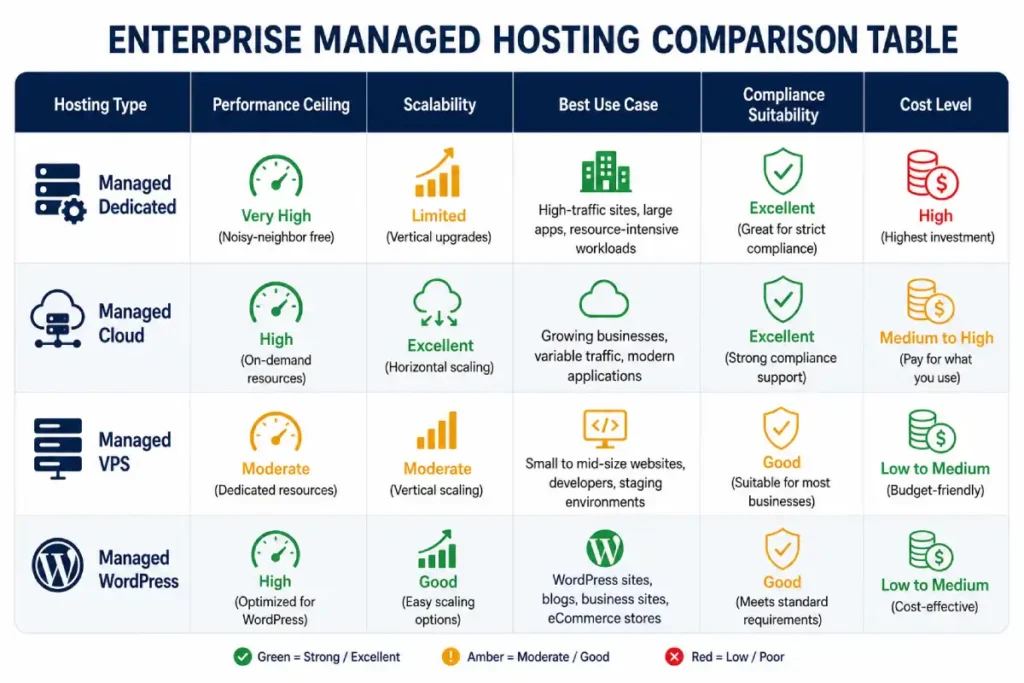
| Hosting Type | Performance | Scalability | Compliance Fit | Cost Level | Best Use Case |
|---|---|---|---|---|---|
| Managed Dedicated | Maximum | Low, fixed hardware | Strongest, full isolation | High | Regulated industries, high-volume applications |
| Managed Cloud | Very High | Excellent, auto-scales | Strong | Variable | Unpredictable traffic, multi-region operations |
| Managed VPS | High | Moderate, upgrade required | Good | Medium | Consistent workloads, growing businesses |
| Managed WordPress | Optimised for WP | Good within WP stack | Good | Medium to High | Large WordPress and WooCommerce deployments |
Key Requirements to Evaluate in Any Enterprise Provider
Do not evaluate enterprise managed hosting on price alone. These are the criteria that matter.
Uptime SLA
- Minimum acceptable: 99.9%
- Preferred for enterprise: 99.95% or above
- Must be backed by a written SLA with financial penalties for failure
- Read about why uptime guarantees matter and how to interpret uptime performance data
Security Infrastructure
- Web application firewall active by default
- DDoS mitigation always on, not reactive
- Intrusion detection and automated threat response
- Malware scanning with defined response process
- SSL included on all environments
- Read our secure hosting features guide for the full checklist
Compliance Support
- PCI DSS compliance for businesses handling payment data
- HIPAA for healthcare data environments
- GDPR data residency options for EU customer data
- ISO 27001 certification is a strong indicator of security maturity
Support Model
- Dedicated account manager on enterprise plans
- 24/7 access to senior engineers, not just first-line support
- Defined SLA for response and resolution times
- Escalation path that is documented, not verbal
Backup and Disaster Recovery
- Daily automated backups stored separately from the primary environment
- Point-in-time restore capability
- Documented recovery time objective (RTO) and recovery point objective (RPO)
- Failover infrastructure tested regularly
Scalability Path
- Clear process for scaling resources without downtime
- No requirement to migrate to a new environment to upgrade
- Cloud infrastructure preferred for workloads with variable demand
Providers Worth Evaluating at Enterprise Level
A few names consistently come up in enterprise managed hosting conversations.
Liquid Web is built specifically for mission-critical workloads. Their support team is staffed by senior engineers available around the clock. Many plans include a 100% uptime SLA, which is rare in the industry. For businesses where downtime directly translates to financial loss, they are one of the strongest options available.
Kinsta operates on Google Cloud’s Premium Tier network and offers enterprise managed WordPress hosting with global CDN, staging environments, and compliance-ready infrastructure. Their enterprise plans include dedicated account management and priority support.
Cloudways provides managed cloud hosting on top of AWS, Google Cloud, and DigitalOcean. It gives enterprise teams the flexibility to choose their cloud provider and region while the managed layer handles server operations, security patching, and monitoring.
WP Engine is a strong option for enterprises running large WordPress operations. Their enterprise plans include multi-environment workflows, global CDN, advanced staging, and dedicated account support. For marketing organisations managing multiple WordPress properties, it is purpose-built for that use case.
For detailed performance testing and plan comparisons across all of these, the HostingGuider reviews section has independent assessments of each.
Questions to Ask Before Signing an Enterprise Hosting Contract
- What exactly does the uptime SLA cover, and what compensation applies if it is breached?
- Where are your data centers located, and do you offer data residency guarantees?
- What is your incident response process and what are the defined response times?
- Is compliance support included, or does it require an additional agreement?
- How is the account managed on a day-to-day basis? Is there a named account manager?
- What does the offboarding or migration process look like if we need to leave?
- How is billing handled for cloud infrastructure? Are there usage caps or alerts?
These questions surface the gaps between what a provider markets and what they actually deliver at contract level.
Final Thoughts
Enterprise managed hosting is not a commodity purchase. The right provider becomes an infrastructure partner, not just a vendor.
Performance, compliance, security, and support are all non-negotiable at this level. Evaluate providers against specific requirements, not general reputation.
The investment is significant. So is the cost of getting it wrong.